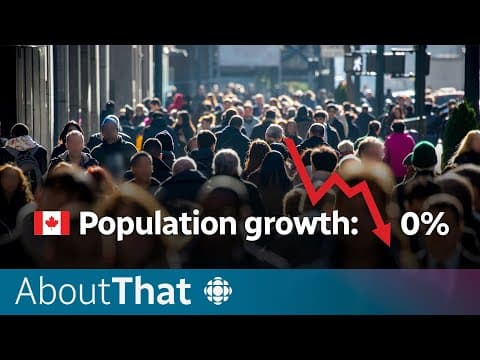
[0:00]The federal government just made a major cut to its immigration plan for both permanent and temporary residents with the goal of not just slowing population growth in Canada but actually reducing it to basically zero. It's reducing permanent immigration levels by at least 20%. Cutting temporary immigrant numbers by nearly 500,000 a year. This is a huge about face for the liberal government. They basically hit pause on the system for for three years. It's just unbelievable dramatic revision downwards. The government had been signaling for a while that it was going to make some changes to its immigration plan. But no one we spoke to expected the cuts to be this big. So, why such a dramatic U-turn? Let's go through it.
[0:49]When the Prime Minister announced these cuts to Canada's immigration plan, he said there was one main priority: To give all levels of government time to catch up, time to make the necessary investments in healthcare, in housing, in social services, to accommodate more people in the future. At its core, this is a story about a massive spike in demand for housing, for public services, and a supply that just couldn't keep up. And here's what I mean: On average, over the past few decades, Canada's population has grown by somewhere between 200 and 600,000 people per year. That dropped off during the pandemic when borders were closed, but look what happened since then. Canada's population has grown by more than a million people over the past two years. That type of population growth in in kind of a rich country is unheard of. That that that's just off the charts. Canada usually grows by around 300,000 people a year, so to be growing by over a million is substantial. We haven't had that sort of population growth in really more than a century. And if you look back at the federal government's immigration forecast a few years ago, they said the plan was to welcome around 1.2 million new immigrants over a three-year period. That was already a record-breaking number that made headlines all over the world. But here's the thing: That forecast didn't include any mention of temporary residents that would end up coming to Canada over those three years. And by temporary, we mean international students and temporary foreign workers. So after the pandemic, um, there was a narrative of a labor shortage crisis. It was a belief that, you know, we're in a in an economy now where we can't have too many immigrants entering the country. There can't be too many. I mean, our vacant job vacancies are so high, they've reached a million, we just need more workers. This was an urgent problem that needed fixing. And there was no target, no limit set on how many of these temporary visas the government could hand out. So, the door was thrown wide open, and Canada's population actually grew by about three million people in three years. Almost triple the official forecast, and according to Statistics Canada, if you're comparing natural population growth to immigration, 98% of that growth was from immigration. It took a lot of people by surprise, including the provinces and cities that became home to all of these new people. 560,000 temporary immigrants, it's too much. The number of people coming here is too fast. This growth was so sudden and it caught policymakers off guard that there was basically no time to react. They lost control of the system, it was a runaway train that they they couldn't slow down. Even the Prime Minister himself has acknowledged this. In the tumultuous times as we emerged from the pandemic, between addressing labor needs and maintaining population growth, we didn't get the balance quite right. Now, in terms of what exactly local and provincial governments need time to catch up on, Trudeau mentioned three specific things. Healthcare, in housing, in social services. Let's start with housing.
[4:12]When a country's population is growing, you need more homes for people to live in, right? Here's what that looked like over the past few decades. You can see it's about a two to one ratio, new people to new homes, which is, according to urban planners around where you want to be. But the gap started to grow a little bit between 2016 and the pandemic, and then by 2021, it had basically doubled. Canada is now building, on average, one new home for every four new working age people. And this mismatch between supply and demand doesn't just mean it's become harder to find a place to live, which it has. It's also driven up prices. You get a big sudden increase in the demand for housing. When you combine that with a very what we call inelastic, unresponsive supply of housing, then you get big increases in prices. In early 2020, right before the pandemic, the average cost of a house in Canada was around 540,000. By 2022, that shot up to a whopping 840,000. It's since leveled off a little, but a home is still almost 200 grand more expensive than it was pre-pandemic. And it's not much better if you're renting. Last year, according to the CMHC, Canada had the lowest vacancy rate ever on record. And what happens when your landlord knows there's a line of people waiting to fill their unit? They bump up the rent. Play that out across the entire country and you get this: a record-breaking jump in the average cost of rent. Now, to be clear, house prices in Canada have been high for a while now. And yes, unaffordability is made worse by high interest rates, building costs, red tape, it's all part of the picture too. But even the Bank of Canada has been clear that strong population growth has added pressure to house prices and rents. And there was concern among economists that pressure was only going to keep building. A recent CIBC report estimated, even if the population continued to grow slightly less than it has over the past couple years, we'd still have a shortage of about five million houses by 2030. And building five million units in the next six years, you'd be hard pressed to find someone, anyone, who thinks that's realistic. The reality is that when you add 1.3 million people to the population within the space of the year, we can't possibly match that on the supply side.
[6:50]Okay, so in a free market, prices are intimately linked to the balance between supply and demand, that makes sense. But what happens when there's a supply and demand problem for public services, like healthcare? Well, you get our shortages and queues and lineups. People wait, waiting longer and longer to get a service. Now, the problems with Canada's healthcare system are wide-ranging and complex. It is a system suffering from regional disparities, record numbers of burnt-out healthcare workers and aging population. But it also hasn't grown as fast as the number of people who need it. In 2019, there were just over 91,000 doctors in Canada. Over the next four years, there were about 6,000 more, but for a population that's grown by millions in that time. So, what does that mean for all those people who need a doctor? Essentially, fewer and fewer have access to one. Research has estimate the number of Canadians without a family doctor went from about 4 and a half million in 2019 to about 6 and a half million in 2023. And a recent Angus Reid survey suggests more often than not, it's recent immigrants that are suffering most from this discrepancy. More and more people are coming here, not being able to access the care they need in a timely manner. And often what happens is if you can't uh see your family doctor, you end up having to go to emergency because of a lack of options. And let's talk about the ER. Last year, there were a million more emergency room visits in Canada than the year before, which has meant those admitted are now waiting about 40% longer than they were in 2020. And it's really put a tremendous amount of pressure on the hospital system but also primary care. Big population swings like this can also have a big impact on infrastructure. Take PEI. Last year, the province saw a 33% jump in immigration, the highest on record, and its regional power provider, Maritime Electric, says it hasn't had time to update its grid and it's about to reach capacity. This year, we're over 90,000 customers. That's a new threshold for us. If we get into cold weather events for extended periods of times, it could be a challenge for us. We've seen massive massive population growth over the past years, particularly in the area of temporary workers and temporary residents. And we are now saying, okay, we need to let our communities, our our infrastructures catch up to the population. And that's the crux of this. Canada's population grew by a lot, really fast. Housing, infrastructure, public services, they've been buckling under the pressure. And everyone, including and often especially new immigrants, have been suffering because of it. But one other thing that might explain why the government acted so drastically, so suddenly. Public support for Canada's immigration system has been dropping fast. The consensus in and around immigration is one that is that is under threat in Canada. Canadians have some legitimate questions about about the increase and the rapidity of the increase. A recent national survey suggests around half of Canadians now view immigration as harmful to the country. That's up 10 points from last year. And what's driving this shift? A so-called scarcity mindset, according to the survey authors, when it comes to housing, healthcare, and social services. So, solving this problem quickly might be as much a political matter as it is a pragmatic one for the liberal government. They really realized that it's a weak spot for them that the immigration file has become something that a lot of voters are talking about. And so they're sending a message to voters saying, we hear you, we are going to respond in a big time way. We understand that we didn't get this right. Amia Copa. It's very clearly Amia Copa. The big questions now: To what extent will slashing immigration fix the problems that we've mentioned, and what of the reason that Canada welcomed so many new immigrants in the first place? How will this affect the economy that's only avoided a recession over the past year or so because of immigration?


