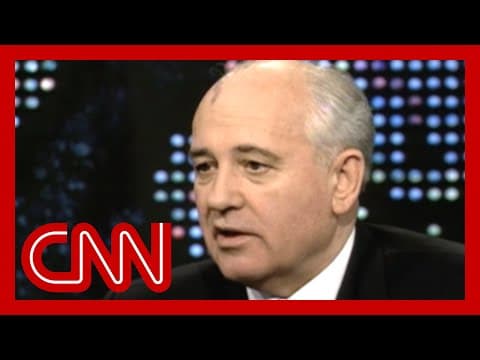
[0:00]you. What changed you? You grew up in an atmosphere of communism. Your grandfather was a famed communist. Your people were very involved in the communist movement. You grew up in a traditional Russian household. What changed Michael Gorbachev? What made you able to turn a place that didn't have freedom into freedom? What did it to you?
[0:29]Life changed us. Efforts, attempts to reform the country, to reform our society were made several times after Stalin's death because what we inherited after Stalin, a totalitarian regime, repressions, the domination of one party of one ideology, the suppression of freedom. That did not give our society, our country enough fresh air and therefore the country was suffocating and it needed a second wind. And therefore every people who were concerned about our country, tried to do something. They wanted to try some reforms. Khrushchev tried it, Kosygin tried an economic reform, but all of those were defeated because the nomenklatura always acted in a way to prevent reforms from succeeding. So we had to give a lot of thought to to how we safeguard reforms. And I understood when I thought about that. Initially of course I acted during the first years of reforms, I acted just like my predecessors, mostly focusing on economic reforms on industry, agriculture, etc. But then we saw that when we really wanted to push the reforms forward, the system, the nomenklatura began to resist, began to sabotage that process. And not just the party nomenklatura, but also the management nomenklatura. And I decided, I concluded as a result of that that we would lose just like the previous reformers, like Kosygin and Khrushchev, if we don't implement democratic changes, if we don't have free elections. But you decided to do what they didn't do. You took them on. You didn't have to take them on. You could have lived the life of a typical Soviet president. Why did you take them on? Well, no, this, I think, would be someone other than Gorbachev if I did not take them on. My experience, my convictions, my education, my pain and my feeling about my country and my people, all of this was growing on me and over the years, I became angry, I became unhappy about what was happening in the country, how we were treating our people, our citizens. And initially it was some unhappiness, but then it became really an opinion. But initially I thought that the system could be improved and I began by trying to improve the existing system. And then I thought that we have to change the system, to replace the system. It cannot be improved. Was it difficult to open doors to the United States? Because you had to be raised with feelings about the United States, like they were raised, we were raised with feelings about the Soviets. Was that hard to open that door? Very difficult. I think maybe that was the hardest thing. And if we in moving from Geneva to Reykjavik, to Washington, to Moscow, in trying to understand the positions of each other and studying each other. If we had not believed each other, Then I think if we had not established human rapport, then we wouldn't have been able, I think to develop real cooperation, real work together. It was hard. When President Reagan and I first began to talk, we were together just like you and I today at a small table and President Reagan began to accuse me, you know, human rights violations. He said you have no democracy. He said you need to make these changes in foreign policies and these changes, etc, etc. And my answer when our dialogue began to go that way was, Mr. President, you are not a prosecutor and I am not an accused. Let us not lecture each other. We represent big countries. Let us speak as equals. I think that then we will be able to find keys to any problem. So it was difficult. But still it became possible, but that changes in Soviet-American relations, nothing would have changed in the world. Champaign, Illinois, for Mikhail Gorbachev on this special edition of Larry King weekend. Hello. Hi, Larry. Hi. Uh, President Gorbachev, I'm honored to talk to you. Do you believe that communism as a political philosophy and a system still something to offer to the world?
[5:36]I think that in principle, this as a system, as a philosophy, as a model of organizing society, of reforming society has to be rejected based on our experience, the experience of our country and of Eastern European countries. As regards the use of certain methods to achieve greater social justice, greater regulation by the state of certain social processes. There were certain useful aspects that can be, could be used in the future as well.
[6:17]That's why I'm speaking of socialist values. By the way, I believe also that socialists who are in power in some countries, in some countries they are, they also use liberal theories. It's not really a choice of capitalism versus socialism. I believe that based on our experience and on the Western experience, Western values and other values, we have to conclude that what we need is a new society, a new civilization that would take advantage of all that is best and would reject all that is worst and take advantage of the good things for the new civilization. Together. So let us not just uh try to stamp out everything. We have to reject what did not work in our country. Let me get a break and come back. Uh let's go back to your calls. Rotterdam, Holland, hello. Hello, hi Larry. Hi. My question is, uh if Mr. Gorbachev had known that Perestroika would lead to the disintegration of the Soviet Union, would he still have supported it the way he did? No, I don't think that this was our plan. It was not fatalistically inevitable. I think that it could have been avoided. The collapse of the, the breakup of the Soviet Union could have been avoided. I believe it was one of my big mistakes that I was not able to explain my policies to conduct the kind of policies, a more vigorous policies that would have made it impossible for the coup plotters in 1991 to have that coup that made it impossible to sign the new Union treaty. We had the treaty, we had the even the scenario of how we will be signing the treaty, where we will be sitting and how we would be signing the treaty. And that treaty would have opened, I think, a very fruitful chapter in a new federation, in a new country. It would have been a real federation rather than the unitary state that we used to have, a totalitarian state. Last call quickly, Edmonton, Canada quickly, hello. Mr. Gorbachev, how would you like history to judge you? Uh, we only have 30 seconds. How would you like history to judge you? What should it say? Well, this is for history, this is history's privilege. History is a capricious lady, but I I hope that it will judge me fairly.
[8:55]I have no doubt it will. Thank you.