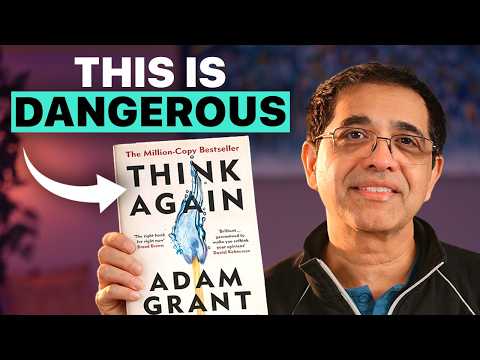
[0:00]Most people read books to get smarter. They get more informed, but their life stays exactly the same. But a few books make you dangerously smart. They rewire your brain and change how you think, how you decide, and how you see what others don't. I have been a CEO and board advisor to billion dollar companies, and I've distilled hundreds of titles down to four that function as a toolkit for a self-taught genius. But first, something more valuable than the list itself, a framework for finding the books that actually rewire you. Every book is an investment of time and attention. Most of them entertain you, some inform you, but a very few change you. Here's how to tell the difference, before you commit to a book, ask three questions. I call them the three gates. Gate number one, the operator. Will this book change how you think or just change what you think? If a book can install new mental moves, new ways to see, to reason, to decide, then it'll make you a better operator. Because it will bring the kind of system upgrade that we're talking about here. Gate number two, the challenger. Does this book make you uncomfortable? Does it challenge your beliefs? You know, the best books don't confirm what you know, they dismentle everything you are certain about, page by page permanently. If you finish a book and you feel validated, you've learned nothing new. And gate number three, the fire alarm. I always ask myself, will this book stop me from doing dumb things with confidence? Will it prevent an expensive mistake? Great books hand you tools to stop you from confusing confidence from competence. If a book passes any of these three gates, it will upgrade your inner operating system. Now, of course, I love books like Grit or Atomic Habit, or so good they can't ignore you. Great books. They're brilliant for building tactics and changing your daily behavior. We want to go beyond just behavioral shifts. We want to upgrade and scale our entire way of thinking. Most books will change your speed. These four will change your engine. Book number one was a gut punch to me. It forced me to ask a terrifying question. Are my heroes visionaries or just lottery winners? Nasim Taleb talks about it in our first book, Fooled by Randomness. He shows why randomness manufactures geniuses, and it changes the way we think about outcomes. Look at the math. Imagine you invite 10,000 traders from Wall Street to a stadium. Once a year, they flip a coin, heads, they double their money, tails, they go bus, they go home. After one year, half of them will go home, 5,000 will come back. If you keep doing this for 5 years, then 5 years later, 312 of those traders will be left in the stadium. They won all five times. Now, these 312 people will be on the cover of Forbes. They'll write books, they'll sell you systems, they'll start a YouTube channel, but are they masters? No, they are a statistical certainty. They didn't beat the system, they were produced by the system. That's why Tap's point is chilling. You cannot distinguish a master from a lucky idiot, simply by looking at their track record. At the AI company where I was CEO, we were one of the fastest growing firms in the US. I was surrounded by some of the smartest minds, exceptional talent, but we also got a once in a decade tailwind we didn't control. The internet was overwhelmed at that moment with the cyber threat of fake transactions and bots that acted like humans. It had become an existential crisis for the internet. So we were the right company at the right time. Was our team exceptional? Sure, did we work our butts off? Of course, but without that existential threat, without that tailwind, all of my visionary strategies would have been a forgotten footnote somewhere. Because we often confuse a tailwind with our own talent. This is called the survivorship bias. Stop trying to be a better forecaster of your future. Start trying to be less fragile, more resilient to randomness. Now, what if you've read this book already? Then the graduate level upgrade would be a book from a Nobel Prize winner Daniel Kahneman, Thinking, Fast and Slow. Kahneman shows you exactly what's happening in your brain when you were being fooled by randomness. His book shows the exact wiring, system one that makes you jump to conclusions immediately, and system two, which helps us avoid those mistakes. How do you make all of this actionable? Here are two steps. First, the luck labor audit. Every Friday, audit your wins into two columns. Column A, labor. What did I control? And column B, luck, timing, tail winds. If column B is empty, then your ego is doing all the driving and you are headed for a crash. Second, the wreckage tour. Now this is my favorite. Stop studying just the survivors. Find the people who made your exact bet and then make it. Learn from them, because if your plan only works in the calm seas, it's not a plan, it's a prayer. Book number two is about the biggest mistakes successful people make. When you win, you stop searching, and you somehow start defending what you already know. Adam Grant calls this out in his book, Think Again. This is our second book. The smarter you are, the harder it is to change your mind. There was a study done on tax professionals. Researchers gave complex tax code and problems to both junior students and seasoned CPAs. When the rules changed just a little, the experts failed three times more often than the students. Because the experts were so certain. The more you know, the less you see. I call it the Proficiency Prison, and the case studies are everywhere. Kodak invented digital photography. They had the technology, they had the talent, they had the resources, but they buried it. Why? Because it threatened their film business, and Kodak's no more. Blockbuster had a chance to buy Netflix for $50 million, and they passed. Now, none of these executives were stupid. They were just trying to protect yesterday's wins. They were trapped in their own proficiency prison. We wear three masks when we don't want to change our thinking, the preacher, the prosecutor, and the politician. The preacher defends the belief like it's a scripture. Prosecutors will defend their belief by spotting flaws in others, and politicians, well, they'll say whatever the room wants to hear. Now, what do you do to take these masks off? Be a scientist. Treat your beliefs as hypotheses, run experiments, update your beliefs based on data. Now, if you've read this book, then the graduate level work is Innovator's Dilemma by Clayton Christensen. That book shows you exactly why companies love to stay in their proficiency prison. Intel dominated the computer chip market for decades. They were so busy protecting that business, they completely ignored the GPU revolution. Today, Intel is roughly a $220 billion giant, but Nvidia is a $4 trillion ecosystem. And that is what the Innovator's Dilemma is all about. The action plan here, there are three mindsets that help me a lot: scientist, stranger, startup. First, the scientist mode. Take your strongest current belief and rewrite it as I currently believe X, but it could be wrong if X, Y, Z. It turns on the scientist mode on demand. Second, the stranger mode. Try to explain your strategy or plan to someone outside of your industry, someone who doesn't know anything about it. Where they get confused is exactly where you need to focus. And finally, the startup mode. I never hire a C-level executive in any company that I work with, until I ask them this very question. If you had a million dollars and all the technology in the world, what would you build to take down your own company? If they can map out their own destruction, they're scientists. If they defend the status quo, they are just priests. The scientist is never certain, and the priest is never curious. The third book completely changes how you judge your own decisions. Annie Duke spent 20 years being a world-class poker player. In her book, Thinking in Bets, she talks about this interesting way of thinking. Treat every decision like a bet. When I was coming to Boston from Mumbai for my master's study, the university had only given me a conditional scholarship, because my scores were okay, they weren't great.
[8:54]So they said, you know, pay for the first semester yourself and teach undergrad mathematics at the same time. And the department said, you know, if you survive, we'll pay for the rest of the graduate program, and if not, you have to pay out of pocket. And I said, sure. What they didn't know was that if I failed, I had no way to pay for the rest of the program. I thought in terms of bets. I outlined my strengths, my weaknesses, I made a list of things that could go wrong, and I calculated my odds. There was about a 30% chance that I would fail. I was okay taking that risk. I bought a one-way ticket from Mumbai to Boston. It wasn't bravery, I really didn't have a plan B. The only plan was to focus on increasing my odds every day. Now, of course, the bet could have gone the other way, but the point is to know exactly what is at risk and whether you have a plan to manage that risk. And if you've read this book already, the graduate version is super forecasting. Philip Tetlock studied 25,000 predictions over decades, and found that the most accurate people on Earth, or the super forecasters, don't think in terms of yes or no. They think in terms of bets, odds, possibilities, probabilities, and they update that number every time new data hits the wire. They aren't trying to be right all the time. All they're trying to do is to be less wrong after every iteration. So, how do you put this in action? The simplest one is to decision journal. Just do it for 30 days. I did it, super helpful. For the next 30 days, for example, before any major decision or a pivot, write down three things. One, your confidence level, 0 to 100%. Number two, what you know, what you don't, and what evidence will change your odds. And number three, write down three reasons why you could be wrong about this decision. And track that for 30 days. Your emotions will get quieter, your thinking will get clearer. When you start thinking in bets, you stop reacting, and you start revising. Book number four is the most dangerous one on this list. Everything we have covered so far leads to this single question. What if your intelligence itself is the trap? David Robson spent years studying the relationship between intelligence and cognitive failure. And the book he wrote was the Intelligence Trap. He shows that smart people have this special failure mode, because they can rationalize anything. And they become their own enemies because they become their own defense attorneys. Most people hit a wall and question themselves. Smart people hit a wall and question the wall. And I've learned this the hard way. At my first job after coming out of MIT, I was the head of marketing for a global company. And in hindsight, I did not build an advisory board of mentors. And I did not ask dumb questions early on. And when the company hired a new president, he could see that I wasn't ready for a promotion. So he brought in an SVP of marketing instead of promoting me. And in hindsight, I think I had trapped myself in my own narrative about my capabilities, about my competence. And that's a very subtle trap. The book helps you avoid such self-justification. The one drill that helps me the most is what I call the anti-mentor. So, before any major decision, ask one person in your life whose judgment you trust, to argue the opposite case. As hard as they can, tell them, don't be polite. Try to kill the plan on paper, and if no one in your life can do that, that's also a great problem to solve. The second practice is the empty cup. Before your next high stakes meeting, write down three naive questions you would be embarrassed to ask. And go ahead and ask anyway. There is a concept in the Zen Buddhism called Shoshin, beginner's mind. The expert's cup is always full, no room for anything new. The beginner's cup is always empty, ready to receive everything. I saw this on a train ride many years ago. I remember we were going to New York City from New Jersey with our two kids. And they were little, seven and four. The train has to go through this tunnel because it goes under the river. And it was pitch dark outside, and both kids were so incredibly excited to see it. They just started giggling with joy, pure shoshin, pure magic. And that made me think. I took that train and went through the same tunnel, twice a day, and never even once was I overwhelmed with this feeling of sheer joy. As we grow old, why do we treat our sense of wonder as weakness and embarrassment? Why treat our curiosity as if it's a curse? These books will help you reset your system so you can answer those questions. But the ultimate system upgrade isn't adding more to your cup. It's your ability to go through that dark tunnel and still find magic in it. If you like this video, don't forget to subscribe and check out my most recent video here. Thank you, and I love you.