[0:09]Christus, Christus, Christus Impera. The lives of the Saints by Father Alban Butler, March 3rd, St. Teresa, Eustokio Versari. Teresa Versari was born in Bergamo, Lombardi, on July 31st, 1801. Kira was one of the daughters of Antonio Versari and his wife Elena, who belonged to the family of the Counts of Padroga Grimeli. The Versari had a great devotion to St. Jerome. One of their sons, who later became bishop of Bresha, was called Jerome, and Teresa had the middle name Ustokio in memory of the daughter of St. Paula. As is well known, these two saints had been close friends of St. Jerome and had exercised in turn the superior of the convent of women that he had founded in Jerusalem. In the case of Teresa, the name of Fustokia was prophetic. It is said that Teresa decided to become a nun at the age of 10 on the day of her first communion. Such inspirations are not uncommon at that age, but Teresa's firm resolution only grew until the day of her confirmation. In this, she was greatly helped by Canon Joseph Benga of the Cathedral of Bergamo. It is difficult to determine whether the canon had clear ideas about Teresa or whether he was trying to test her vocation, for three times he made her enter and leave the Benedictine convent of Santa Grata. Teresa's blind obedience to the canon earned her not a little criticism and mockery, but the blessed endured it with patience and joy. It was undoubtedly a time of hard apprenticeship, after leaving the convent for the third time, Teresa devoted herself entirely to the religious instruction of girls in a small house called Gromo, which soon became the seed of the new religious congregation she was to found. Antonia, her sister and two other young women, named Virginia Simoni and Caterina Magnoni, joined her soon after. All four made their profession of simple vows before Canon Banaglio, who assigned them to the teaching of youth. The life of the new community was very austere, with long periods of silence and fasting. Teresa had to face many spiritual difficulties, doubts and temptations. The congregation soon began to grow as many young women from good families joined, including three of Teresa's sisters, named Maria, Judith, and Catherine, as well as her own mother who had been widowed. Canon Banaglio was in charge of the spiritual direction of the community and helped to draw up the rules and constitutions that included various charitable works, schools for poor children, visits to sick women, religious and recreation centers for young girls in danger, and above all, retreats for women in the spirit of St. Ignatius of Loyola. The bishop of Bergamo, Miss Garther Carlo Gritty Morlaki, had first favored the new congregation, but then set about hindering its growth. Teresa was further tested by her own indecision and humility. Was God really calling her to found a new congregation, given that other similar institutes already existed, such as that of the Sacred Heart, founded by St. Madeleine Sophie Baratt? Teresa went to Turin where Mother Baratt had begun to organize, since 1832, retreats for women and felt very much inclined to unite her congregation with that of the saint. But she soon realized that God's will was different, for there was more than enough room for both congregations, however similar they might be. Thus, the blessed had to overcome this and other difficulties before she succeeded in getting her institute solidly established. Finally, in 1841, Teresa and her companions were able to make solemn profession in the hands of the prefect of the congregation of bishops and religious himself, Cardinal Constantine Patrici. A few days later, the Holy Sea's decree of approval was published and the congregation was definitively confirmed in 1847. On this occasion, the foundress was authorized to open a house in Rome. Among those who helped Teresa Versari in her difficulties was Blessed Luigi Pavoni of Bresha, who took charge of printing the constitutions of the new congregation at a time when this meant exposing herself to much trouble. But the blessed ignored the murmurings and gossip. Moreover, he interceded with bishops Barza to support the cause of the daughters of the sacred heart in Rome. When Teresa bought an old monastery in Bresha, Blessed Louis planned the changes that needed to be made to the building and personally oversaw the work. To help Teresa, he made several trips to Bergamo and Trent and undertook to ensure daily mass at the mother house. Nothing was too difficult for Blessed Eloisius when it came to helping the sisters. The great mutual esteem in which Blessed Eloisius and Blessed Teresa held each other, has continued between their respective congregations in the century that has passed since their deaths.
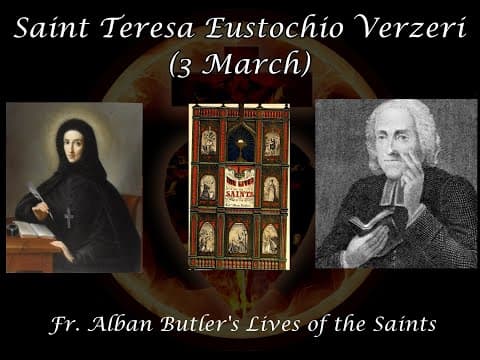
Saint Teresa Eustochio Verzeri (3 March): Butler's Lives of the Saints
Sensus Fidelium
5m 54s803 words~5 min read
YouTube auto captions
Transcript source
YouTube auto captions
This transcript was extracted from YouTube's auto-generated caption track. The transcript below is server-rendered so it can be read, searched, cited, and shared without opening the original YouTube player.
Pull quotes
[0:09]Kira was one of the daughters of Antonio Versari and his wife Elena, who belonged to the family of the Counts of Padroga Grimeli.
[0:09]One of their sons, who later became bishop of Bresha, was called Jerome, and Teresa had the middle name Ustokio in memory of the daughter of St.
[0:09]Jerome and had exercised in turn the superior of the convent of women that he had founded in Jerusalem.
[0:09]It is said that Teresa decided to become a nun at the age of 10 on the day of her first communion.
Use this transcript
Related transcript hubs
Watch on YouTube
Share
MORE TRANSCRIPTS


