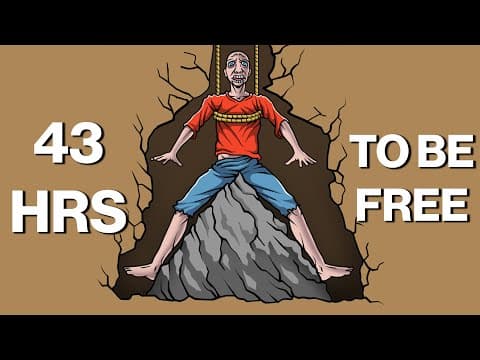
[0:00]Black Eagle Cave tragedy. Three experienced cavers, John Parker, Leo Sanchez, and Mike Barnes, went to explore and map parts of Black Eagle Cave that no one had seen before. The men had been in many caves before and were well prepared. They went into the cave and moved through the narrow passages. The cave had tight spaces, sharp rocks and slippery walls, but their experience kept them confident. As they went down a steep, narrow drop, something unexpected happened. Mike put his foot on a rock that looked solid, but the rock broke under him. His leg got stuck between two sharp edges. The walls were wet, and his other leg slipped. His body fell forward. The pain hit right away. His left leg was twisted in a very bad way. As he tried to steady himself, his weight pulled on his trapped leg. He felt an intense pain, and by that time, he knew it was broken. His body was being pulled in the tight space. Leo and John tried to help, but the narrow passage made it hard for them to reach Mike. They quickly understood that pulling him out would only make things worse. So Leo just tied a rope around Mike's upper body to keep him from slipping more. They knew they needed a careful plan. John squeezed into the small space beside Mike to help hold him steady. Leo found a strong spot to anchor another rope. They planned to carefully pull Mike up while John helped free his trapped leg. Mike was breathing hard from the pain. They started the slow process of freeing him. Leo gently pulled on the rope to lift Mike's upper body, while John worked to loosen the rocks around his leg. Mike tried not to scream as the pain shot through his leg. The rock moved bit by bit as John cleared it away. At last, Mike's leg came free. His ankle was badly swollen and twisted. It hurt to move it. They moved him to a bigger space, but it took many hours to get out of the cave completely. John and Leo helped Mike the whole way. They made it out tired, but alive. Red Knolls Cave tragedy. On December 21st, 1997, five young men went to the Safford Shafts, also known as Red Knolls Cave, in Arizona. They arrived around 9:00 p.m. Red Knolls wasn't a normal place to hang out. It had deep pits, 40 to 60 feet down in what was once an ancient lake bed. The men found a small crack in the ground, barely a foot square, and poured four gallons of gas down the crack. Then they set it on fire. For a moment, nothing happened. Then suddenly, the ground exploded. Fire and dirt shot into the air, and the small crack instantly became a large hole. Four of the men were thrown backwards by the blast. Brandon, however, wasn't so lucky. He was standing too close to the edge when the explosion happened. The blast knocked him off his feet and he fell 40 feet straight down into the pit, breaking his leg in the process. He slid deeper into the crack with his body twisted in a bad position. Rocks and dirt fell in after him. Then a huge rock fell and landed on top of him, trapping him completely. The others ran to the edge and shouted his name, but smoke and dust filled the air, making it hard to see. Brandon was stuck in the crack with his head pushed sideways against the wall. His broken leg hurt terribly. The weight of the rocks pressed on his body, making it hard to breathe. He couldn't call out either because of all the dust. His friends knew they couldn't get him out by themselves, so they rushed to their car and drove to town for help. Rescue workers arrived within an hour at night and set up gear over the hole. They weren't sure if Brandon was still alive. Meanwhile, Brandon was in terrible pain. His stomach area hurt badly, and the cold night air was making his body temperature drop. The rescue team had to move the big rock first. They chipped at the sides of it, but this was slow work, and each hit made more rocks fall. When they made enough room, they tied ropes to the rock and six men pulled on the ropes. Finally, they managed to move the rock away. Then they started digging. They removed rocks and dirt by hand, being very careful not to hurt Brandon more or cause another collapse. Throughout the whole thing, Brandon kept passing out as the pain and cold were too much. After many hours, they reached Brandon. They were surprised he was alive. They put a safety belt on him, keeping his broken leg still. Slowly, they pulled him out. Brandon was trapped for 12 hours. He looked very bad with his leg being swollen, his face pale and dirty, and his body temperature very low. At the hospital, doctors found he had a broken leg, kidney problems, and suffered hypothermia. He was incredibly lucky to survive. He probably had to pay a huge hospital bill, being from the US where health care costs aren't exactly low. On that note, I wanted to let you know about a growing problem. Health insurance companies are now teaming up with data brokers. The same guys who sell your information to advertisers, which is why you get those annoying spam emails and calls. Together, they're collecting data that can be used as determinants of health and they use this to raise your health insurance rates based on your online activity. That meme about your digital footprint is becoming less of a joke and more of a real concern worldwide. If that weren't bad enough, AI is enabling a new wave of scams. With access to your personal info from these data brokers, scammers can take things further, like taking out huge loans in your name without you even knowing. They can steal your data, then use AI to do things like clone your voice. That's where today's sponsor incogni comes in. You give them only the minimum personal info needed to find your data online, and they go to work, requesting removals from data brokers on your behalf. They even handle objections from those brokers, so you don't have to lift a finger. You can finally feel safer online by going to incogni.com/paintexplainer, where you'll get 60% off an annual plan. Thanks again to incogni for sponsoring today's video. Keyhole Cave tragedy. On July 18th, 1998, four friends went to Keyhole Cave early in the morning. Craig Douglas, his sister Jessica and their friends Buster Miller and Jennifer Russell wanted to explore the cave all the way to the bottom. The cave had many tight spots, and the deepest part was 113 feet down. To get there, they had to go through a very small tunnel, only one foot high, then drop down an 8-foot hole. They put on their lights and knee pads and started going down. For a few hours, everything was fine. They moved through the small tunnels until they got to Paul's Pipe, the last small tunnel before the final drop. Craig went in first, but as he reached the edge of the drop, his foot got stuck in a rock. When he tried to get it unstuck, his knee got caught between two rocks. The pain was bad. Every time he moved, the rock squeezed his knee harder. He was in a bad spot. His body was facing down with his weight pulling on his stuck knee. If he slipped, he would hang by his trapped knee. His sister realized he was in trouble. Craig tried for 15 minutes to get free, and Miller tried to help him, but there was hardly any room. Craig's leg began to swell up, and he was having trouble breathing. Somehow, he managed to move just enough to get into a safer position, but his leg was still stuck. They knew they needed help quickly. Jennifer, who was the fastest, went to get help while the others put clothes in the small space to help support Craig. When rescue workers arrived, Craig had been stuck for over five hours. His leg was swollen, as no blood was getting to it. The space was so small that only one person at a time could work to free him. They tried pulling and using oil to make it slippery, but nothing worked. Craig was getting too cold from prolonged contact with the rock. The rescue team wrapped him in a special blanket and used a heater to keep him warm and prevent hypothermia. As time passed, the air got bad. The oxygen level got so low that it was hard to breathe, so the team had to bring in fresh air through tubes. After 30 hours, Craig was still stuck in there. His body was getting weaker by the hour. The rescue team used drills to break away bits of rock. All of a sudden, however, he stopped shivering, which was a bad sign. Finally, there was just enough room for one last try. The rescuers gave Craig himself the drill. With his last bit of strength, he was able to free his leg. It was Sunday evening, 30 hours after he had gotten stuck. When his leg came free, the pain was very bad as blood started flowing again. He couldn't walk at all. With help, he slowly made his way out of the cave. This took eight more hours. On Monday morning at 9:15, after 43 hours underground, Craig finally got out. He went straight to the hospital, where doctors worked to save his leg. New River Cave incident. On January 18th, 1980, a group of friends went to New River Cave in Giles County, Virginia. Among them was 18-year-old Laura Sherback and her husband. They planned to spend the night in the cave. New River Cave was known for being wet with water that had eroded the rock into sharp edges. Nevertheless, many beginners liked this cave since it didn't require ropes. The group arrived at 7:00 p.m. with camping gear. And at first, they had no problems. They crawled and climbed about 2,000 feet into the cave until they reached a narrow section called the Blowhole. The floor here was made of loose dirt and slippery wet stone. Beyond the blowhole, the passage got even smaller. Laura had to climb carefully with her hands and legs stretched out against the walls. She was young, and she didn't have much caving experience. Then, tragically, her boot slipped on a wet rock. She fell and couldn't grab hold of anything. As she tried to stop herself, her legs spread apart right above a sharp rock jutting from the cave floor. She landed hard with her legs spread, and the sharp rock cut deeply into her lower body. She screamed as blood began soaking through her clothes. The pain was excruciating. Her friends rushed to help, and when they checked her injury, they saw it was very bad. She had serious cuts in her pelvic area. The fall hurt her inside, and the blood loss almost made her organs stop working. Miraculously, she survived. Two friends raced back through the cave to get help, while the others tried to keep Laura warm. They took off her wet clothes and put her in a sleeping bag, but every time she moved, the pain got worse. She kept passing out. By 10:00 p.m., the Giles County rescue squad heard about the accident, but there was a problem. The two men who went for help couldn't remember the exact way back to Laura. The cave tunnels all looked the same. Rescue teams, including trained cavers, came to help. They crawled through the tunnels looking for Laura, but time was running out. Finally, they found her. She was barely awake. Her breathing was very weak. She was in shock from blood loss, and she was getting dangerously cold. Medical workers gave her fluids through an IV. They cleaned and took care of her wounds, but she couldn't move due to pain. They immediately put her on a stretcher, and over 25 people worked to carry her out. They carefully maneuvered her through narrow, twisting passages. By 5:00 a.m., nine hours later after her accident, Laura finally got out of the cave and was rushed to the hospital. Doctors said she had bad cuts. The fall hurt her inside, and the blood loss almost made her organs stop working. Miraculously, she survived. Boy Scout Cave incident. On December 27th, 2003, eight boys from the San Antonio Boy Village and two counselors went to Boy Scout Cave in Florida. Among them were Michael Shero and Javick Henderson, respectively 15 and 16 years old, who wanted to explore the cave. The counselors stayed outside because they were too big for the narrow path, as adults had gotten stuck there before. Despite this, the cave was thought to be safe because it was dry and stable, and many beginners went in without problems in the past. The boys went in around noon with only nine flashlights and no extra supplies. Inside, it was 72 degrees Fahrenheit. Cool enough to make them cold over time, which is why one counselor made a fire near the entrance, not knowing this would cause problems later. The boys were told to come back by 3:00 p.m. and Michael and Henderson led the way. They had been in other caves before, but they had never received proper caving training. After about an hour of crawling and twisting through tight paths, they reached the hairpin curve, a section that had trapped inexperienced cavers before, though the boys weren't aware of this. Michael went in first without testing if the passage was wide enough for his size. The hairpin curve was a narrow crack with a sharp turn. You couldn't see what was ahead. Some parts of the rock were smooth, others had sharp edges. Everyone had to twist their bodies to get through. Henderson followed, but tragically he got stuck at the turn. His shoulders were caught against the walls, and his hips were locked in a tight position. Michael tried to help, while the others waited in the wider section of the passage. The rough walls scraped their skin as Henderson's oddly bent body pushed against the sharp rock. After an hour, Michael passed out from the cold and from being tired. This happened because his body had been in contact with the cold rocks for too long without movement. Henderson could only scream for help. As the lights got weak, some boys thought the fire outside was using up the air, which was not true. But they all got scared and just in case, left their friends to get help. The counselors were shocked when the boys came out. One called 911, while the other put out the fire. Within an hour, rescue teams came with special tools. Inside, rescuers found the boys huddled together in fear. They checked and found that the air and oxygen levels were fine. But Michael and Henderson were still in trouble. At the hairpin curve, Henderson was awake but shaking with cold skin, while Michael was still passed out. Both were getting very cold from the rock. The rescuers used various tools to make the passage wider, and after an hour, they freed Henderson and wrapped him in a warm blanket. Then they worked for almost two hours to free Michael, who had a weak pulse. They carefully carried both boys out. At the hospital, they were treated for hypothermia. Michael's body was 92 degrees Fahrenheit, almost 7 degrees Fahrenheit below the normal temperature, and he remained unconscious for a day. Henderson got better faster, even though he had lots of bruises. After this, new safety rules were made for youth groups in caves. If you like this video, subscribe for similar ones or join my Discord to suggest another.
12m 5s2,698 words~14 min read
YouTube auto captions
Transcript source
YouTube auto captions
This transcript was extracted from YouTube's auto-generated caption track. The transcript below is server-rendered so it can be read, searched, cited, and shared without opening the original YouTube player.
Pull quotes
[0:00]Three experienced cavers, John Parker, Leo Sanchez, and Mike Barnes, went to explore and map parts of Black Eagle Cave that no one had seen before.
[0:00]The cave had tight spaces, sharp rocks and slippery walls, but their experience kept them confident.
[0:00]Leo and John tried to help, but the narrow passage made it hard for them to reach Mike.
[0:00]So Leo just tied a rope around Mike's upper body to keep him from slipping more.
Use this transcript
Related transcript hubs
Watch on YouTube
Share
MORE TRANSCRIPTS


