[0:01]Hello, my dear friends. How are you? Welcome. Thank you for joining me here. I'm Arith Hargar and given the information on the previous video about Freya's connection to Friday the 13th, which is absolutely none.
[0:16]I've spoken in that video about a particular case as depictions of witches in a medieval church in Northern Germany. To be more precise in Schleswig Cathedral, now in Germany, but formally from Denmark. And I've made a little study on it some years back at my patron at the Patreon platform, at my side of Patreon.
[0:43]And I would like to share it here with you on video format. Just a quick reminder that given what I've expressed concerning YouTube and being faithful to my moral values. I'll continue the studies, I'll continue the work at Patreon next year, 2026.
[1:02]And my presence here at YouTube will be considerably less frequent. But for those who might not remember, uh why and and what I said in my and my reasons for this, and for those who don't know, at all what I'm talking about.
[1:20]Check a previous video I've done about it and you can also see it down below at the description of of this video, I think. Um, well, anyway, if change doesn't naturally occur, which often doesn't occur at all or it takes too long and in the meantime, there's just too much suffering, too many people suffering.
[1:38]Well, it has to be done by force under the power that is given to us. Let us jump into today's video, right? And leave all of that behind for now.
[1:50]More information on on the shifting, let's say, of my work and platforms on that previously mentioned video, to anyone who cares to know my own reasons for such a shift.
[2:03]Well, um, as previously said on my latest video about um, about Freya in my Nordic studies, the belief of Freya, this goddess, as the Queen of Witches, although not entirely a recent idea, it has gained more ground and and popularity and and appealing in our contemporary time.
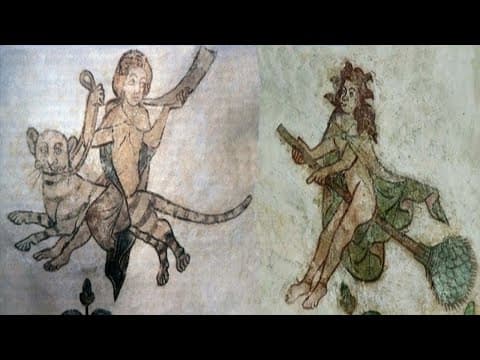
[2:22]Mostly due to a misinterpretation of which figures in the ceiling of a medieval church. I'll show you the images in question right here on the screen.
[2:35]The image you you see right in front of you on the screen is a circa 12th century, 1300s common error. The depiction of a cloaked woman riding a large cat, which appears on a wall in the Schleswig Cathedral in Schleswig-Holstein, a former Denmark, right, northern Germany, now.
[2:54]Uh, she's commonly interpreted as Freya. She's also alongside another feminine figure riding a broom, interpreted as Frigg, more commonly in modern studies, interpreted as such, which again, after further investigation, this is also a misinterpretation and too easy a finding or or too easy finding a pattern where there's none, right?
[3:19]So, to be more directly here, um, these are, in fact, Christian depictions of what we could perhaps call proto-witch figure.
[3:32]These two representations are one of the biggest puzzles about medieval Scandinavia. Uh, two female representations, uh, that were painted in St. Peter's Cathedral in Schleswig in Germany, or originally Denmark, as I said.
[3:47]Um, they were dated around the year um, 1300, uh, which led to the traditional interpretation that they were the goddesses Freya riding on a cat and Frigg, uh, flying on a broom.
[4:03]Um, sorry. This interpretation is very common in books, websites, and even on postcards sold in this church itself, at this church.
[4:13]However, more recently, researchers have questioned the date of these two figurations, considering that they would have been made in the mid-15th century and not in the 13th century as thought before.
[4:31]Therefore, the previous interpretation began to be questioned, obviously leading to a new interpretation and new studies on this context. So, the first female figure is therefore not the goddess Freya.
[4:47]Um, there are no literary or iconographic traditions of her riding cats and the the church animal is actually a fantastical being in the form of a feline, which uh, which has anthropomorphic features and supernatural size.
[5:04]I should remind you, come down that Freya was indeed associated with cats, right?
[5:13]But there is no evidence that the goddess rides them, right? One of the main reasons that led to the association between Freya and cats was because this goddess was quite important in the social space of Scandinavian nobility, and the cat, a rare animal in Northern Europe, even in the middle in the medieval times.
[5:33]Would be a companion animal of wealthy members of Scandinavian societies. Uh, I have some videos about Freya and cats. I'll leave at least two of them here.
[5:48]Uh, on this right upper corner and in the description of this video, so you can take a pip. Now, another factor must also be taken into account concerning feline sexuality and fertility in relation to these same connotations in the Freya cult, right?
[6:01]But that's on that other video, right? Older video. However, the cat became a more usual symbol, especially in churches, but also in manuscripts and illustrations in other literary works in medieval times.
[6:20]Both as a representative figure of evil and the demonic, as well as in relation to pest control, within the domestic environment and such. But according to the latest research, this latest research being in 2022, which was when I first spoke of this at my side of Patreon.
[6:38]Well, it seems that this fresco in the church is not a cat, but a supernatural being. Now, the second figure is even more questionable, Frigg.
[6:50]Uh, well, she was the goddess Frigg was never depicted nude, let alone flying around. An important historical detail is that the iconographic tradition of witches flying on broomsticks dates back to the the 1450s.
[7:07]Meaning, there isn't a tradition of witches flying on brooms before the late Middle Ages, already entering the modern period.
[7:15]You know, I have made considerable studies and videos on the history of witchcraft and, of course, um, the broom being such an iconic symbol of the stereotype of the witch.
[7:28]Um, it's important to look into the origins of such a depiction, and, indeed, there are there are no evidences of that before the second half of the 15th century.
[7:41]So, we are talking about a depiction almost 500 years after the church in Europe began to take its first steps towards the witch figure as, uh, as the beginning of a problematic religious conception.
[7:56]And, and in the case of pre-Christian Scandinavian and Icelandic belief systems, the depiction of a possibly Frigg figure as a witch riding a broom is more than 700 years or more when Frigg still had a possible part to play.
[8:20]Albeit there's practically nothing of relevance in the very little evidences of her we have in the belief systems of heathen Scandinavia. Uh, but truth be told, uh, Frigg never actually had much relevance in the religious conceptions of pre-Christian continental Scandinavia.
[8:38]Uh, and in the Scandinavian peninsula as well. Um, so the two female figures can only be analyzed if we take into account two contexts. First, the huge amount of paintings representing fantastic beings existing in a side wing of this cathedral and dating from the late Middle Ages.
[8:56]Such as dragons, dwarves, centaurs, um, all painted with a clearly late static.
[9:04]The second context is the botanical one. Uh, the cathedral is full of paintings, sculptures, ornamentations and symbolism of flowers and plants that are very important for the daily life of the region.
[9:20]For example, um, the second female figure, the Frigg, is flying on a broom made of milk thistle, uh, Silybum marianum, just to show off.
[9:35]Uh, therapeutic, um, therapeutic, and then I fuck up in English. Now I'm done here.
[9:42]Why why are you still watching? So, the milk thistle, as I was saying, uh, it's a therapeutic, therapeutic. Good gods, uh, it's a plant for therapy.
[9:54]And also, um, a hallucinogenic plant. A very popular from the transition to the Renaissance.
[10:00]So, in case this may lead to ideas of the plant being associated with Frigg and a possible connection to a trans state related to the cult of the gods. Well, uh, there are no evidences of any cult associated to Frigg.
[10:17]Let alone specific plants and other objects related to this goddess side from weaving, right? Spinning and weaving, uh, which was also a highly associated with Freya as well.
[10:30]But both goddesses were merged together and it is hard to understand which one's attributes was assimilated into the other. Besides, Frigg uh, did not have much relevance, as I said, in the religious scope in Scandinavia.
[10:46]Um, the association between hallucinogenic plants and magical women, witches in this case, uh, is rather late into the Middle Ages.
[10:56]Therefore, the two figurations show evidences that they are already in a context, not only far from the old Nordic, old Norse traditions, but also there's a clear popular and religious imagination stepping away from such traditions.
[11:16]Creating new types of folkloric associations that we do not see at all in pre-Christian Scandinavian belief systems.
[11:24]Thus, the two figurations are fully inserted in the late Middle Ages context of Continental Europe and in this way they are not goddesses at all, but representations of witches, well within the European post-Catholic folklore of the very late Middle Ages.
[11:49]So, I just wanted to make this, all of this um clear, as clear as possible, as I have shown you these two figurations on previous posts at Patreon for my patrons and on videos here at YouTube and other platforms all over the Internet, I've also spoken of this and showing you these images.
[12:08]So, as always, I do hope you, I do hope you all of you have a wonderful time these last days of the year.
[12:17]May your deepest desires come true, unless you are a deeply weird and pervert person or a psychopath.
[12:23]Be well, my dear friends. Thank you so much for watching. See you on the next video. And as always,
[12:30]Thanks for today. Thank you for today. Until we meet again, my dear friends.


