[0:00]It was in the late 1990s, I was in London for the very first time. The ease and convenience of using the London Underground was a joy for me. The London Underground map was so easy to use and I of course took it for granted.
[0:15]Now, little did I know then, that it wasn't always the same. That beautiful user interface that I took for granted, was actually a beautiful work of design.
[0:25]I heard this story in a TED Talk by Michael Beirut, a New York-based designer.
[0:31]Hi, welcome back to Stories at Work, a series where I share real stories from across the world that you can use when you want to drive home a business point.
[0:42]Our website www.storyworks.in already has over a hundred stories and we are adding one every week. Let's start today's story.
[1:01]The world's first underground railway opened in London in 1863 as a way of reducing street congestion. Over the next 40 years, the technology for safe tunnelling of tubes deeper below London, the advent of electric engines and the safe lifts that could take passengers from ground to below, helped the network to expand.
[1:23]In 1908, eight different independent railways merged to create a single railway system, which was then called the Underground. They needed a map to represent the system so that people would know where to ride, where to get on, where to get off, how to reach from one place to another in this very complex network.
[1:44]The map they made was complicated. You could see rivers, bodies of water, trees and parks, the stations were all crammed together at the centre of the map, and then out in the periphery, there were some stations that couldn't even fit into the map.
[1:58]So, while the map was geographically accurate, it wasn't so useful. It definitely wasn't user-friendly.
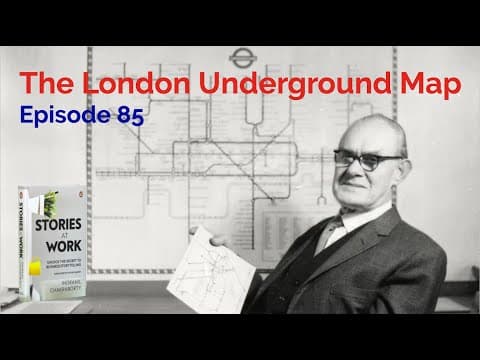
[2:05]Enter Harry Beck. Harry Beck was a 29-year-old engineer draftsman who had been working on and off for the London Underground.
[2:14]And he had a very key insight, and that was that when people were riding underground in trains, they didn't really care what's happening over ground, above the ground. They just wanted to get from station A to station B, from station to station.
[2:32]What they needed to know is, where do I get on? Where do I get off? How do I change from one line to another? It's the system that was important, not the geography.
[2:43]So Harry Beck took this very complicated mess of jumbled lines, and he simplified it. The lines only go in three directions. They're horizontal, they're vertical, or they're 45 degrees.
[2:59]Likewise, he spaced the stations equally, not geographically. He made every station colour correspond to the colour of the line, and he fixed it all so that it's not really a map anymore.
[3:11]What it is, is a diagram, just like electrical circuitry, except the circuitry here isn't wires conducting electrons, it's tubes containing trains moving people from place to place.
[3:25]In 1933, the Underground decided, at last, to give Harry Beck's map a try. The Underground did a test run of a thousand copies of these maps, pocket-size. They were gone in an hour.
[3:38]That's when they realised that they were onto something, they printed 750,000 more, and this is the map that you see today. That is the map that made my life so easy in the late 1990s. The map that I took for granted.
[3:55]Beck's design really became the template for the way we think of metro maps today. Tokyo, Paris, Berlin, Sao Paulo, Sydney, Washington D.C., and I am sure soon the Mumbai Metro, all of them convert complex geographies into crisp geometry.
[4:13]All of them use different colours to distinguish between different lines. All of them use simple symbols to distinguish between the type of station, whether you can cross over or it's just a singular station.
[4:25]They are all part of a universal language for undergrounds, it looks like. I am sure Harry Beck wouldn't have known what "user interface" was, but that's what he really designed.
[4:37]And as Michael Beirut says in his TED Talk, what Harry Beck really did is that he took the challenge and broke it down into three principles. Principles that you and I can easily apply to nearly any design problem.
[4:50]The first one is focus. Focus on who you're doing this for. The second principle is simplicity. What is the simplest way to deliver that need?
[5:02]Finally, the last thing is thinking in a cross-disciplinary way. Who would've thought that an electrical engineer would be the person who holds the key to unlock what was then one of the most complicated geographical networks in the world?
[5:18]What a story! Where can you use this story? This would be a great example to use when you are talking about keeping the customer at the centre of your solution.
[5:28]It is also a great example when you are explaining the importance of user interface. Finally, if you are laying down design principles of focus, simplicity and ease of use, this would be a great example that you could use.
[5:43]I hope you liked that story. And if you did, you can find a hundred more on our website www.storyworks.in. These stories are searchable using the business point you want to make.
[6:00]The website and our YouTube channel have two playlists. The StoryBank playlist, which already has 84 stories, contains stories like this. Real incidences that you can use to drive home a business point or share with your team to inspire them to take action.
[6:14]The second playlist is called LeaderSpeak. This has videos where leaders have shared stories that have created opinions they have. When you are sharing the same opinion or driving home a similar message, you could use that story.
[6:28]Finally, our latest playlist is called Parables. This has parables that can be used to drive home a business point. Thanks for listening. See you next week. Bye for now.