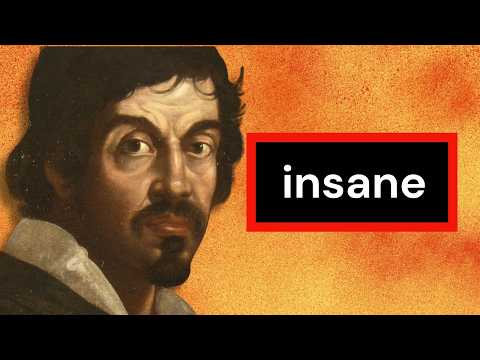
[0:03]This painting was lost for almost 300 years. It hung in a Jesuit dining room in Dublin, cleaned every year, admired casually by the priests who walked past it at dinner.
[0:14]And for most of that time, nobody suspected it was one of the greatest lost masterpieces in the history of Western art. When conservators finally examined it in 1990,
[0:24]they confirmed what they had barely dared to hope. This was a lost original by Caravaggio.
[0:30]Estimated value somewhere between 30 and 50 million euros, sitting in a dining room for decades.
[0:36]That story alone tells you almost everything you need to know about this painter.
[0:40]He produced work of such extraordinary power that it survived centuries of neglect, misattribution, and outright disappearance.
[0:47]And it still stops people cold when they find it. But there is a detail in this particular painting that almost no one notices on first viewing.
[0:54]And when you see it, it completely changes what this image is actually about.
[0:58]That figure holding the lantern, pressing into the frame from the right, that is Caravaggio himself.
[1:04]He painted his own face into the scene, watching, present at the arrest of Jesus, not as a disciple, not as a soldier, just as a witness holding the light.
[1:14]Why would he do that? And why does it matter? To understand that, we need to understand who Caravaggio actually was.
[1:20]Because the official version, brilliant painter, troubled genius, leaves out most of the story.
[1:26]Michelangelo Merisi da Caravaggio was born in Milan in 1571.
[1:31]His father died of plague when Caravaggio was six years old.
[1:35]He grew up poor, and by most historical accounts, extremely difficult to be around.
[1:40]By his mid-20s, he was in Rome, apprenticed, broke, painting fruit and flowers just to survive.
[1:49]And then something in his work changed almost overnight. He began painting real people, not idealized figures from scripture,
[1:57]not clean-limbed gods descended from classical sculpture, real people from the street with dirty fingernails and tired eyes, an expressions that looked like they might belong to someone you passed on your way here today.
[2:07]Look at that face. That is not a biblical figure. That is a conman trying not to get caught.
[2:12]Caravaggio painted that expression because he had seen it, possibly because he had worn it.
[2:17]Rome's art world noticed immediately. Within a few years, he had the most powerful art patron in the city, Cardinal Francesco Maria Del Monte.
[2:27]He had commissions from the church. He had money for the first time in his life.
[2:31]He also had a criminal record that was growing faster than his reputation. In a single 12-month stretch around 1600,
[2:39]he was arrested multiple times for assault, for carrying an illegal weapon, for throwing a plate of artichokes at a waiter in a restaurant.
[2:45]That last one is documented. It actually happened, and none of it stopped the church from wanting his paintings.
[2:53]Because his paintings were doing something that no one else's paintings were doing.
[2:56]Look at this painting for a moment. This is The Calling of Saint Matthew, painted around 1599 for the Contarelli Chapel in Rome.
[3:06]It shows the moment when Jesus walks into a tax collector's office and points at Matthew, calling him to abandon everything and follow him.
[3:13]But look at what Caravaggio actually painted. The room looks like a tavern.
[3:19]The men at the table look like gamblers.
[3:22]And Matthew's reaction, the figure pointing at his own chest as if to say, "Me?" is not the serene acceptance of a man receiving divine grace.
[3:32]It is confusion, it is disbelief. It is a man who cannot understand why he has been chosen.
[3:36]The church wanted grandeur. They wanted golden light and classical composure.
[3:41]Caravaggio gave them an awkward Tuesday afternoon in a bad part of Rome. And somehow that made it more powerful, not less.
[3:49]When he submitted The Death of the Virgin to the church that had commissioned it, they rejected it.
[3:54]The reason was simple. The Virgin Mary looked like a real dead woman.
[3:59]Heavy, swollen, undignified.
[4:03]There was a rumor, which has circulated for 400 years, that he used the body of a drowned woman from the Tiber as his model.
[4:11]We cannot confirm that, but we cannot rule it out either. And that ambiguity is itself revealing.
[4:19]With Caravaggio, the boundary between what he observed and what he invented was never entirely clear.
[4:24]The technique behind all of this has a name: Chiaroscuro. The extreme contrast between light and shadow that makes his figures look as though they are emerging from absolute darkness into a single shaft of light.
[4:38]He did not invent this technique, but he took it further than anyone before him had dared to go.
[4:43]In Judith Beheading Holofernes, the heroine does not look triumphant. She looks disgusted.
[4:50]She is doing something necessary and terrible, and she knows exactly what it is.
[4:56]Caravaggio refuses to let her, or us, look away from that.
[5:00]But there is one painting from this period that contains a detail so strange, so personally revealing, that it stopped art historians in their tracks when they finally understood what they were looking at.
[5:12]Before I tell you what that detail is, you need to know what happened to Caravaggio in 1606.
[5:20]Because it is the only way to understand why he painted it. On the 29th of May, 1606,
[5:26]Caravaggio killed a man named Ranuccio Tomassoni in a street fight in Rome.
[5:33]The exact cause of the dispute is still debated by historians.
[5:37]A gambling debt, a rivalry over a woman, a quarrel that escalated past the point of no return.
[5:45]What we know is that Caravaggio walked away with a serious wound to his own face.
[5:51]And Tomasoni did not walk away at all. Caravaggio fled Rome that night.
[5:55]He was sentenced to death in absentia. Under Roman law at the time, any citizen was legally permitted to kill him on sight and collect a reward from the authorities.
[6:05]He had no path back, no appeal, no negotiation. He was 34 years old, at the absolute peak of his powers, and he was now a fugitive.
[6:15]He went to Naples, then Malta, where he somehow persuaded the Knights of Malta, the most elite Catholic military order in existence, to accept him as one of their own.
[6:27]Within months, he was arrested again for a violent assault on a fellow knight, and imprisoned in a fortress. He escaped.
[6:36]The historical record gives us no explanation of how. He simply was in the prison, and then he was not.
[6:43]He moved through Sicily, painting as he went, then back to Naples, where he was attacked so badly outside a tavern that reports reached Rome that he was dead.
[6:53]He was not, but he was severely disfigured. Throughout all of this, the exile, the escapes, the violence,
[6:59]he kept painting, extraordinary work, work that got darker and stranger, and more personal, the longer he ran.
[7:09]And it is during this period of exile that he painted the image I mentioned earlier, the one with the detail that no one noticed for centuries.
[7:16]This is David with the Head of Goliath, painted around 1610. It is now in the Borghesi Gallery in Rome.
[7:23]On the surface, the subject is straightforward. David, the young shepherd who killed the giant Goliath, holds up the severed head after the battle.
[7:33]It is a scene painted hundreds of times in the Renaissance and Baroque periods.
[7:38]But look at the head. Art historians are in near universal agreement that the face of Goliath is a self-portrait.
[7:46]Caravaggio painted his own face as the severed head of the defeated monster. And now look at David.
[7:51]David is not triumphant. He is not celebrating. He looks, and this is the word that comes up again and again in scholarly writing on this painting,
[8:02]he looks sad, almost tender, as if he pities what he has had to do.
[8:07]Some historians believe this David is also a self-portrait of a kind, a younger version of Caravaggio, looking with grief at what the older version had become.
[8:18]Think about what it means that a man who had actually killed someone, who was living as a fugitive under a death sentence, painted himself as both the monster and the one who destroys it.
[8:31]That is not a stylistic choice, that is a confession. There is a Latin inscription on David's sword in some versions of this composition.
[8:40]H.A.S.O.S. Scholars have proposed several interpretations, but the most widely cited reads it as a fragment of a Latin phrase.
[8:46]Humilitas occidit superbiam. Humility kills pride.
[8:52]If that reading is correct, then Caravaggio was not just painting a biblical scene.
[8:59]He was making a moral statement about himself, acknowledging, in the only language available to him at the time, that the part of him capable of greatness and the part of him capable of violence were the same part, and that one of them needed to die.
[9:12]Think back to that figure in The Taking of Christ, Caravaggio holding a lantern, watching the arrest of Jesus,
[9:22]present at the most consequential betrayal in Christian history, holding the only light in the scene.
[9:29]That image was painted around 1602, four years before the killing, while he was still celebrated, still protected, still welcome in Rome.
[9:37]And yet he placed himself there in that moment, in that role, neither guilty nor innocent, just watching, illuminating something he cannot stop.
[9:50]I think that is the most honest self-portrait any artist has ever painted. Not a face in a mirror,
[9:57]a position in a story. Caravaggio died in 1610 on a beach in Porto Ercole, apparently from fever.
[10:04]He was 38 years old. He had been granted a Papal pardon and was making his way back to Rome when he died.
[10:11]He never arrived. His influence, however, arrived everywhere. Rembrandt studied him.
[10:17]Rubens collected him. Artemisia Gentileschi, one of the first great women painters in Western history, built her entire early style around what he had discovered about light and suffering.
[10:29]And yet for roughly two centuries after his death, his reputation collapsed almost entirely.
[10:37]He was considered too brutal, too vulgar, too obsessed with darkness. The 20th century rediscovered him,
[10:45]and the rediscovery was total. Today he is considered one of the most influential painters who ever lived.
[10:51]The word that gets used most often in language that would have surprised the critics who buried him is honest.
[10:58]He painted what he saw. He painted what he felt. He painted what he had done.
[11:04]And because of that, his work does something that very few paintings from any era managed to do.
[11:10]It makes you feel that you are not looking at a scene from the past. You are looking at something happening right now in bad light, in a room that smells like the street outside,
[11:21]involving people who are not sure how any of this is going to end. Leave your interpretation in the comments. I read every one of them.