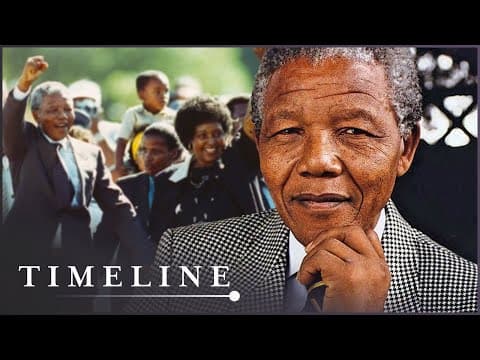
[0:37]January 1994, Nelson Mandela at a Party Congress, relaxed, adored by his followers. Calm, dignified, the undisputed leader of the African National Congress. It's easy to forget that this is the man who endured 27 years in prison at the hands of successive South African governments, which were vilified throughout the world. Yet he appears to show no bitterness. Suffering can break you, can embitter you, can make you a ghastly and totally intolerable creature to have around. It can also make you more humane, more compassionate, more caring, more understanding. And the world did not make a mistake in identifying him as one of the greatest of those who were prisoners of conscience. Because he had shown in, in, in his trial, when he said, there are some things, which are so noble that one is prepared, not only to live for them, but to die for them. And when you, the minute you, I think you, you, you give yourself for the sake of others, something happens in the chemistry of the body, of the soul. I greet you warmly in this the year of liberation for all South Africans. We have thus characterized the year 1994, to express the deep seated hope of all our people, that this year, all of us will at last achieve our emancipation. This year, a new birth will occur. He's probably the one leader in the world whose morality and leadership is completely unquestioned. In a context where you find the whole world is in some state of upheaval and change. South Africa is the one country where that change is very positive. And a lot of that change is symbolized through Nelson Mandela.
[3:39]Nelson Mandela's release from prison in February 1990 was a watershed in South African history. It was the beginning of the end of apartheid. But for Mandela the last four years have been grueling politically and personally. Negotiations dragged on and the political violence escalated. Although he has been able to forgive those who kept him in prison, his family has found it much harder to do so. I'm still very bitter about everything that this government and this government's policies have done to me and my family. Because I don't think we will ever fully recover from the consequences of what they've done. Um, I mean I've been deprived of a father for all my life, I've been deprived of a childhood. And I don't think I'll ever be able to recapture that. Um, because as much as he is back now and you know he tries his hardest to be the perfect or the ideal father. But there's still so much uh rediscovering of one another that we have to do and I'm just very worried about the time whether we'll ever really have the time to do that. Mandela has had to sacrifice everything for the struggle, including his family. In 1992, he had to sacrifice his marriage to Winnie. She had been convicted of kidnapping and Nelson reluctantly announced a separation.
[5:24]My own sense is he loves Winnie deeply. And in many ways, he is a lonely man.
[5:41]I mean he gives himself prodigally on behalf of others, on behalf of the ANC. But at the end of the day, he goes to this huge house and even though he has grandchildren and others with them, with him, it's not the same thing. And he was sustained, I think in prison um in part, and in very large part by his relationship with her. And I have hoped fondly that there would be a rehabilitation of Winnie and that somewhere down the line there would be a reconciliation. Our love for each other has never been tainted.
[6:40]What happened was just a situational separation. And we love each other as we have always loved each other from the moment we met those many years ago. Winnie and the children, Zeni and Zindzi, never led a normal family life. For Nelson, politics came first and he spent little time with them. In 1963, he was tried for sabotage and planning a violent revolution. He was sentenced to life imprisonment.
[7:42]Robben Island, 9 kilometers from Cape Town, where Mandela spent most of his 27 years in prison. It was the defining experience of his life. The regime on the island was harsh. Prison wardens tried to break and demoralize political prisoners like Mandela.
[8:27]We were compelled to work with pick and shovel, and you really had to work hard. And then also they would do very insulting things deliberately to humiliate and to demoralize people. And then of course, very abusive, the warders used the most uh vicious racist abuse continuously.
[8:55]Despite the beauty of the island, the men saw little of it.
[9:04]He never once saw a child, not once. And when we did one day a year, the voice of a child, you know, there was a, it was a spontaneous tools down by everybody in the quarry and we were hoping to see just a sight of a child. It must have been a warder's child, a group of children. And the warders made damn sure they wouldn't see a child.
[9:34]Visitors to the island had to take the ferry from Cape Town. Though Mandela relied greatly on his family for support, visits were rare. Winnie and the children live 1500 kilometers from Cape Town. I'm not too sure whether I really saw any beauty in Robin Island because I was always very aware of what the trip was all about. It was always very emotional, it was always quite traumatic. It would be quite exciting going down to see him. It would be quite sad coming away from there. And I think in those circumstances, it's really difficult to appreciate, you know, the beauty of the rocks or the flowers there or you know, the sea itself. Because there was the harsh reality of what Robben Island really was all about.
[10:34]Prisoners were not allowed visits by their children. Zindzi had to wait until her father had been imprisoned 10 years before she met him for the first time. I'd always been very aware of him as I was growing up because people always spoke about him and they were always in great awe of him. So I was quite apprehensive because I just felt like I was meeting some kind of demigod. But when I actually saw him, you know, he's got he's has an amazing personality. He's got great depth of feeling and warmth. You know, he just made me within the first 5-10 minutes feel so much at home.
[11:19]Well, we tried to recapture what life could have been if we were at home as a family. Uh, I think both of us got uh sufficient um feelings to recharge our batteries and to be able to carry on until the next visit. Um, we survived uh those years because of the love we have for each other. Prison strengthened Mandela as a man and as a leader. He's also become a confident and charismatic campaigner. And in negotiations with President de Klerk, he's proved a tough adversary. Their relationship has often been stormy. I refused to go with him to the White House to see Clinton, President Clinton. And when a journalist says, well, look, what's your relation with the President of South Africa next to you there? I said, Mr. de Klerk is not the President of South Africa.
[12:40]He is the President of the whites.
[12:49]And Mr. Dandel, the question has been raised about a debate between some people. I'm sure he's referring to the debate between President de Klerk and myself. He has challenged me, and I said to him, I am not going to have a school boy debate.
[13:18]I am going to debate national issues.
[13:24]And I say one of us will emerge from that debate badly bruised. It will not be me. Mandela's personal life has suffered since his release from prison. His marriage came under strain. The crunch came when Winnie was found guilty of involvement in the kidnapping of Stompie Seipei, who was later found dead. Winnie's reputation was seriously damaging Mandela. He was persuaded to part with her.
[14:19]I think he came out of prison guilty, feeling guilty about what Winnie and his children had to endure. And he was determined to do everything to put to try and repair that damage and nurse the injured. And I think he resisted any breakup. But when he realized that there was no way forward, then very firmly and quietly, he knew it had to end.
[15:03]My love for her remains undiminished. However, in view of the tensions that have arisen, owing to differences between ourselves in a number of issues in recent months, we have mutually agreed that a separation will be best for each one of us. It was too much for him to handle the question of a wife who has to be charged for more murders and whose name had been dragged in so much mud. Um, he couldn't deal with that.
[15:54]And that was a situational it wasn't of his making. He found himself having to take to to make choices. And if you lead a country that has great expectations of you, what do you do? He had given up his family for 27 years. What would it have really meant? I suppose they convinced him in that regard. What would it have meant to at least uh give it up if it was going to stand in his way of assuming the leadership of his people.
[16:43]Today, though Winnie's reputation has improved, she is rarely seen at Mandela's side. They have been separated for two years, but could there still be a reconciliation? Bishop Tutu. When I have spoken with him about this, he wouldn't want to do anything, I suspect, that would be detrimental to the party, detrimental to the cause.
[17:11]But my sense, my intuition is he really would give his back teeth to be reconciled with her again.
[18:16]The moment he stepped out of prison, he was national property. And it was as if, you know, we were lucky to have even 10 minutes of his time for the family. Uh, he had given his life totally to the struggle and it would have been wrong of us to stand in his way because uh this was a fulfillment of the people's dreams that we'd come out of prison and lead them and deliver them finally to liberation.
[19:53]Why should a government which professes to be a government of Christians decide to use murder as a method of rising to political power? That is the strategy that is being used by the government, and that is why they have never taken any precautions to protect our people against violence. Why should a government which professes to be a government of Christians decide to use murder as a method of rising to political power after the 27th of April?