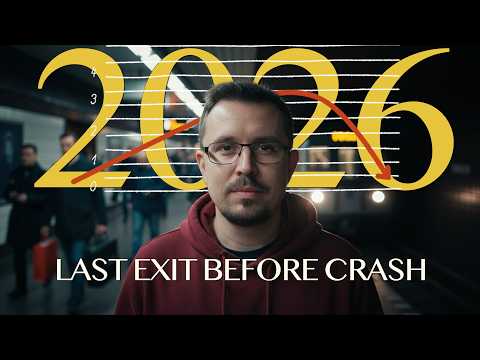
[0:00]There is a vibration running through everything right now. Now, you might have not seen it yet, but you can certainly feel it. In the job market, in the way people talk about their futures, and the quiet desperation hiding behind LinkedIn posts about "grateful for this opportunity." Something fundamental is shifting beneath the surface of modern work. Not loudly, not all at once, but with the steady, inevitable pressure of tectonic plates grinding against each other. Look at the patterns, debt levels at historic heights, inflation eating wages faster than raises can compensate. Job applications vanishing into algorithmic black holes. Companies posting record profits, while announcing mass layoffs. Workers doing the output of three people for the salary of one. These aren't isolated incidents, they're symptoms. In 2026, it isn't just another year on the calendar. It's starting to feel like a threshold, the moment when all those quiet pressures converge into something you can't ignore anymore. The economy is restructuring itself. The relationship between employer and employee is being rewritten. The invisible contract that promised stability in exchange for loyalty has been shredded. And most people haven't noticed yet, because the shredding happened one page at a time. By the way, if this way of thinking resonates with you, I'll be exploring it more in upcoming videos. Subscribe so you don't miss it. There is tightening happening. You can sense it in how much harder it is to get ahead. How much more is demanded for less in return. How the margins of your life, the space where you're supposed to rest, think and dream, keep shrinking. And you know, the strangest part, almost everyone around you is acting like, hey, this is normal. Like the train isn't approaching, like the rails aren't humming with an approaching weight. But once you start paying attention to the pattern, once you start connecting the dots, you realize something deeply unsettling. The system isn't broken. It's working exactly as intended. And it's not designed in your favor. So, lately, I've been waking up with this strange heaviness in my chest. It's not panic, it's not fear, it's just a quiet certainty that something is shifting and not in a gentle way. A few months ago, I started noticing how my days were blurring together. Wake up, work, recover from work, think about work tomorrow, repeat. And it wasn't burnout, it wasn't laziness, it was more like the walls were closing in, you know, one millimeter at a time. And maybe you felt something similar, a tightening, a pressure, like the world is accelerating in a direction you never agreed to. And you've been pulling along whether you consent or not. Now, I couldn't shake the thought that 2026 wasn't just another year. It felt like a deadline, a tipping point. The kind of moment that historians will look back on and say, that's when it became undeniable. And that's what pushed me into a rabbit hole I wasn't ready for, because once you start looking at what's happening, once you stop accepting the narratives you're fed and start examining the actual mechanics of modern work, you discover something uncomfortable. The trap isn't closing because of bad luck or poor choices. It's closing because it was designed to close. And most people, they won't realize they're caught until it's too late to do anything about it. Now, I used to think that I was overreacting, that I was seeing patterns that weren't there, but the more I dug, the more I realized I wasn't paranoid, I was just early. And if I'm right about what's coming, then the window to escape is narrower than most people think. And not in a dramatic apocalyptic sense, but in a slow, administrative, segregating way that makes the wall feel inevitable. That realization changed everything for me, and that's where this story really begins. I'm going to show you three things, what's happening that most people don't see yet. Why it's worse than you think and the one move almost nobody is making that changes everything. Let's start with what's invisible.
[4:32]Most people don't notice the moment a trap closes, it usually happens slowly, subtly, like water heating one degree at a time until you don't realize you're boiling. A small change in policy here, a shift in expectations there, one more meeting added, one more responsibility dumped on your desk, one more reminder that you're lucky to even have a job. In 2026, something is becoming brutally clear. Work isn't just demanding more, it's demanding ownership of your time, your focus, your mental bandwidth, and eventually your entire identity. Companies used to chase efficiency, now they chase total control. And here's where the pattern gets disturbing. Job postings quietly list more responsibility for less pay. Raises barely cover inflation. And the flexibility workers fought for during the pandemic is being clawed back inch by inch with return to office mandates and surveillance software. There is this quote from George Orwell I keep thinking about. Who controls the past controls the future, who controls the present controls the past. And today it feels more like, who controls your time controls your life, and more people have already handed over more time than they realize. Worker productivity is at record heights, higher than at any point in modern history, but wages haven't meaningfully moved in decades. Remote workers are monitored with digital surveillance tools that track keystrokes, mouse movements, and active screen time. Layoffs happen not because companies are struggling, but because shareholders demand higher profit margins. And the job market's colder than it's been in years, colder in a way that feels intentional. It's almost like the system needs people to feel trapped so they won't try to leave. The new normal is specifically designed to keep you tired enough not to ask questions, desperate enough not to negotiate, scared enough not to take risks. But here's the part that most people miss, the part that keeps them paralyzed for years. The trap isn't the low wages. It's not the long hours. It's not even the lack of security or benefits or respect. The real trap, it's psychological. It's thinking you have no alternative. It's the belief that this is just how life works now, and anyone who escapes must have gotten lucky or had some unfair advantage. That belief, that invisible cage, built from learned helplessness is what keeps people frozen, waiting, hoping, telling themselves, they'll figure it out soon. That things will get better soon, that the right opportunity will eventually appear. But what if soon is already gone? What if the window you've been waiting for has slowly been closing this entire time? What if 2026, it isn't a warning, but the point of no return? Because here's where things start to feel strange. Where the pattern become impossible to ignore, and where I discovered something that most people miss, not because it's hidden, but because we've been conditioned not to look.
[7:54]When I started digging deeper into what's actually happening, not the sanitized narratives from corporate media, but the raw data, like historical parallels, the economic incentives, I found something that didn't make sense at all. It reminded me of something from history, actually, something I learned about, but never really understood the implications of until now. The Industrial Revolution, when machines first entered factories in the early 1800s, workers thought that they were temporary, a tool, something that would make their work easier.
[8:32]Not replace them entirely, but the shift was permanent. Entire professions vanished. And by the time people understood what was happening, the world had already been restructured around them. What's happening now, feels eerily similar, except this time, the machines aren't gears and pulleys. They're algorithms, automation systems, AI that doesn't sleep, doesn't take breaks, doesn't get sick, doesn't ask for benefits, and doesn't need health care. And companies are racing to replace as many humans as possible, not because they desperately need to for survival, but because it makes the system run smoother, more predictable, more controllable, more profitable.
[9:18]And this is where most people stop paying attention. Don't. There is a hidden pattern in the timing too, one that almost nobody talks about. Tech booms coincide with layoff spikes. Automation investment rises while job listings shrink. Corporate profits climb to record heights while workers are told to work harder, do more with less, upskill, prove your value, compete. It's almost like a shadow shift is happening behind the scenes. A quiet reconfiguration of the entire workforce structure, executed without the workforce's knowledge or consent. Now, here's the part that broke my brain. The average corporate employee now produces more value per hour than at any point in human history. But they take home a smaller percentage of that value that workers did in the 1970s. You're not struggling because you're less productive, you're struggling because the system extracts more while returning less. Efficiency increased, your share decreased. Most people think they need to work harder. The data says they need to keep more. This is where the trap tightens. I read about a warehouse worker who got written up by an algorithm. Not by a manager, but by code. The system detected that his bathroom breaks were 11% longer than average over a two-week period.
[10:49]He was flagged for underperforming. No human reviewed it. No context considered, just data, a threshold, and a warning. He didn't quit, he started holding it. That's not a horror story from some dystopian novel, that's last year. But here's the twist. The part that should terrify you. This isn't just happening in warehouses anymore, it's spreading. Metastasizing into offices, creative industries, white collar jobs, remote work environments, that the same pressure, the same surveillance, the same algorithmic management. The same sense that the margins of your autonomy are shrinking, that you're being optimized, that your value is being calculated by formulas you can't see. And the same systems are being quietly installed everywhere, dressed up in polite corporate language. Productivity tracking, performance metrics, data driven management, the only difference is the aesthetics. And the strangest part, this same idea shows up in movies we all know. Stories we've seen, but never quite connected to our own lives. In the Matrix, humans don't realize that they're trapped because the system is designed to feel normal, comfortable, familiar. The cage is so well constructed that most people defend it. In a movie Office Space, the characters live inside a quiet corporate machine that drains them without even threatening them outright. No violence, no drama, just slow extraction of life force in exchange for a pay check, and the illusion of stability. History, modern life, film, different context, different worlds, but the same underlying pattern. A system tightening itself around human beings while pretending nothing has fundamentally changed. But here's the detail that changed everything for me. While I was digging into all of this, the data, the patterns, the historical parallels, I noticed something most people miss.
[12:47]Something hiding in plain sight. There is a way out. A narrow exit, one that almost nobody is using because they've been conditioned not to see it. But before I tell you what it is, you need to understand why most people never find it, because once I saw it, I couldn't unsee it. Once you understand how the trap works, you start to see the gaps in the construction, the places where the walls don't quite meet. And this is where my own story began to shift, where everything I thought I knew about work and security and the right way to live started to unravel. For years, I lived inside the same illusion everyone else does. Work hard, climb the ladder, and wait for opportunities. Hope for fair treatment, trust that the system rewards merit and loyalty, but the deeper I explored, the more obvious it became. There is no right time to escape wage slavery. There is no moment when your employer will give you permission, or your savings account will magically reach some threshold where freedom becomes possible. So, there is only before it's too late. So, I stopped waiting for permission. I stopped waiting for a perfect moment. I stopped waiting for conditions to be ideal, and I started making YouTube videos, and not because I had some master plan or business strategy. Just because I wanted to. I had things I needed to say, and I didn't want to wait for anyone's approval to say them. Now, the first couple of videos, terrible, low views, didn't matter. I kept going. And then I started experimenting. I wrote a book. I sold a few copies. I made a PDF guide. I created a course. Some things worked. Some things didn't. But I kept testing. None of it was impressive by itself. None of it would make a good, I quit my job LinkedIn post, but each piece was a brick in a wall I was building between myself and total dependency on a system that didn't care if I collapsed. So, right now, I'm working on a side project that I believe will free me this year. Not because I got lucky, not because I had some unfair advantage, just because I refused to stop building. I learned something critical during this process, something that they don't teach you in school or at work. Your exit, it doesn't come from a single, dramatic moment. It doesn't come from one big break or lucky opportunity. It comes from dozens of tiny acts of reclamation. A video you make at night when you're supposed to be relaxing. A product you launch quietly with no fanfare just to see if it works. A skill you develop in the margins. A system you create that slowly, incrementally strengthens your independence. Now, I stopped thinking about quitting my job, that big, terrifying leap, and I started thinking about expanding my freedom. Because freedom doesn't arrive all at once like a lightning bolt. It grows, it compounds. And once it grows past a system, and once it grows past a certain point, the system loses its grip on you. The fear starts to dissolve. The golden handcuffs start to feel flimsy. The threats that once paralyze you, you'll lose your benefits, you'll never find another job, you're too old to start over, start to sound like the desperate lies they've always been. This wasn't about becoming rich. It wasn't about some overnight success fantasy or get rich scheme. It was about something far more fundamental, rejecting the idea that my life was owned by a corporation. That my time belonged to someone else, that my worth was determined by a salary negotiation. I refused to be optimized like a warehouse algorithm. I refused to be monitored like I couldn't be trusted. I refused to be squeezed into tighter and tighter corners until there was no room left to breathe. And once you start reclaiming your time, your mind follows. Your sense of possibility expands. You remember what it feels like to build something because you want to, not because someone else demands it. If you're watching this, there is a reason. Something inside you already knows the truth, even if you haven't fully admitted it to yourself yet. 2026 is not a normal year. It's a threshold, a checkpoint. The kind of inflection point where the choices you make now will echo for decades. If you don't build your exit now, if you keep telling yourself that you'll start next month, next year, when conditions are better, the window narrows. Not in a dramatic, apocalyptic sense, but in a slow, suffocating, administrative way. Companies will demand more, jobs will pay less relative to the cost of living. Automation will extend into more industries, layoffs will normalize, opportunity will concentrate into the hands of the few who moved early, who built their independence before the walls closed completely. Now, you don't need to quit your job tomorrow, you don't need to make millions of dollars, you don't need anyone's permission or approval, you just need momentum. And momentum comes with experimentation. Now here's what's worked for me. Pick a format you can create consistently, videos, writing, audio, it doesn't matter. Just pick one and start. Don't wait for it to be perfect. Don't wait to find your voice. Start messy, improve as you go. Test products, a guide, a template, a course, a book, something small. Launch it before you're ready. See what happens. Some will flop and one might surprise you. You won't know until you try. Build in public. Don't hide while you figure it out. Create in the open, share what you've learned. Let people see your progress. The audience comes from the journey, not the destination. Keep experimenting. What works this year might not work next year. What doesn't work now might work in six months. The goal isn't to find one perfect thing. It's to build a system where you're always testing, always learning, always creating. The point is not the size of what you build. The point is ownership. You need assets you control. Income streams you can create. Skills nobody can take from you. Value you can offer directly to the world without needing an employer to validate you first. Because once you have those, once you have a small foundation of independence, you stop living at the mercy of a system that doesn't care if you collapse from exhaustion or stress or despair. So, build slowly, build quietly, build consistently without announcement or fanfare. And remember this, because it's the most important thing I can tell you. The goal here isn't to escape work entirely, it's to escape dependence. The kind of dependency that makes you silence your thoughts just to keep your job. The kind that makes you tolerate mistreatment because you can't afford to leave. The kind that turns your entire life into a series of obligations instead of choices. You deserve choices, real ones. Ones that come from strength and autonomy, not desperation and fear. No system, no corporation, no economy can fully control someone who creates their own path. Not instantly, not perfectly, not without setbacks and failures and moments of doubt, but slowly, steadily, and with intention and clarity and refusal to give up, freedom becomes possible. Your identity is bigger than your job title, your worth is bigger than your salary, and your future is bigger than the limits someone else places on you for their own benefit. The news is tightening, yes. The system is shifting against the workers, yes, but the exit still exists. The window is still open. It just won't stay that way. Remember that vibration that I talked about in the beginning, the one that you can feel, but not quite see. It's not coming, it's already here. The plates are already moving. The question isn't whether the trap will close, it's whether you'll still be inside when it does. One small action this week, then another, then another. Build a skill, create something, offer value, learn, grow, reclaim one hour and use it for yourself, not for someone else's profit margin. So the only question left is what are you going to build this week?
[22:29]Oh, you're still here. Oh, that's right. It's the behind the scenes vlog. So this part of the video is where I share more personal things, it's mostly for my subscribers, but if you're new here, you're more than welcome to stick around. So, 2026, my new year, fresh start, all that, but here's the thing. I've been gone for two months. November and December, no uploads, no social media, just quiet. Now, some of you probably noticed, and some of you probably didn't. Either way, I needed it. I didn't plan to disappear. I just reached a point where I realized I was moving too fast in the wrong direction. You know that feeling, right? When you're busy, but you're not actually building anything. That was me. So I stopped. So I logged off. I shut everything down, a full digital detox, and I started to work on something that I'd been putting off for too long. The studio, right now, yeah, it's it's different. Complete redesign, new lighting, new setup. I tore everything down and rebuilt it from scratch. You can see I have two monitors now. And no, it's actually not for video editing. I actually prefer using one monitor for editing. Keeps me focused, keeps the timeline clean. But here's the embarrassing part. The second monitor, it's for my accounting. I know, it's riveting stuff, but honestly, I've been drowning in spreadsheets, invoices, tax documents, receipts I should have filed six months ago. The business side of this whole thing has been a nightmare, and I finally admitted that I needed more screen space just to stay organized. So, yeah, that's the glamorous reality of running a one-man show, two monitors. One is for videos, and the other one is for the IRS. Anyway, taking a break for social media was a bit strange. At first, I felt this weird pull, like I was supposed to be posting, supposed to be doing something, checking notifications, scrolling, reacting. But after a few days, that feeling went away, and I started to remember why I started this channel in the first place. Not to build a brand, and not to escape wage slavery, not to chase algorithm, not to sell courses or products, or turn myself into some productivity guru. I started this because I had something to say. And over the last year, I lost sight of that. I got a bit distracted. I tried to build too many things at once, you know, books, products, courses, Patreon, merch ideas, consulting offers, and the videos, you know, the actual work, they became sort of secondary. So, I really missed making videos. I really did. So, I'm back and this year I'm doing things a bit differently. No more Twitter, no more Instagram, just YouTube. This is where I belong. This is my church. This is where the work matters, you know, and everything else, it's just noise. Now, I do have a confession to make. This year, I want to hit 100,000 subscribers. I know, it's it's a silly number, doesn't mean anything in the grand scheme of things. It's not going to change my life. It's not going to solve any real problems. But I like the challenge. I like the idea of focusing on one clear goal and seeing if I can actually pull it off. Not by gaming the system, not by chasing trends or clickbait, but by making better videos. So, the silver play button is in my sights and I want it this year. Now, maybe that's vain, maybe it's silly, but sometimes, you know, we need something like that. Some arbitrary milestone to help us focus, to give us a reason to push harder. So, that's what I'm doing. As for the business side of things, I'm trying a completely different approach this year. No more get rich quick fast thinking. No more trying to monetize every piece of content. No more launching products just because I think they'll sell. I'm going back to the basics, making authentic videos. Say what I actually believe. Trust that the rest will follow. That's it. And here's the other thing. I'm shifting my focus away from fancy editing. Don't get me wrong. I love the editing process. I love the visual storytelling, the pacing, the way a good cut can completely change emotional weight of a line. But editing takes time, you know? And I'm not sure how much of it actually matters. Are you here for the editing or for the things I have to say? So, I've spent weeks on videos that flopped, and I've spent a few days on videos that actually took off. And honestly, I don't think the editing was, the script was, the idea was. So, this year, I'm focusing more on the storytelling, you know, the structure, the the words themselves. If the foundation is strong, the video doesn't need as much polish. At least that's the theory. We'll see if it works. Anyway, it's 2026 and I'm super glad to be back. Let's make this a great year. Let's make 2026 the year of change. Not just for me, but for all of us. If you made it this far, thank you. Seriously, it means more than you know, and I'll see you in the next one. Bye.


