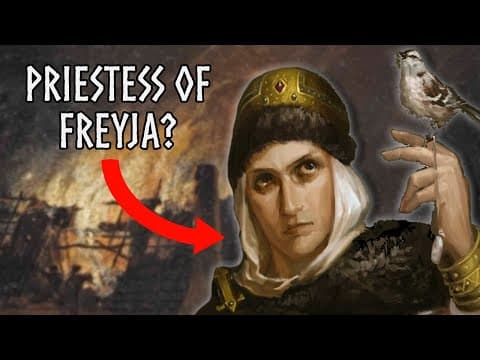
[0:14]In the year 945, the Kingdom of Rus’ stood on the brink of disaster. A few years prior, Prince Igor had embarked on a catastrophic assault on the Byzantine Empire, leading to most of his fleet being burned by Greek fire, his warriors pulled to the depths of the Black Sea. His close lieutenant, Oleg, deserted Rus’, going east on an expedition into Persia, where his life was taken in the battle of Bardha. Igor’s warriors, constantly disappointed, pointed to the riches of their rivals: the retinue of Svenald, a fellow prince of Rus’, whose hoard of wealth afforded him to supply his companions with the best of weapons and clothing. Impatiently, foolishly, Igor decided to press this wealth from one of his vassals: a neighboring tribe, the Drevlians. However, Igor had already claimed tribute from the Drevlians, and to punish him for his impudence, his army was slaughtered, and the king himself brutally torn apart, limb from limb. Igor had no adult successor, only an immature son, Sviatoslav. All power lay in the hands of his widow, Olga, and all of these heavy expectations resolve the chaotic politics, safeguard the troubled borders, and restore the glory of the kingdom. But the first matter on her list was revenge of the bloodiest sort...
[1:47]The early years of Olga’s life are shrouded in mystery. According to the Primary Chronicle, written over a hundred years after the death of the queen, she came from the town of Pskov, and married Knyaz Igor in 903. It makes no mention of her age or birth date - she must have been atleast sixteen, thus born in 887. But, this chronology has been disputed by a number of scholars. Indeed, there are many issues with the chronology of the chronicle, in regards to Igor, Oleg and Olga. As I’ve explained in a previous video, Sviatoslav must have been a child or young teenager by 945 - some chronicles claim he was born in 942, but then he couldn’t have led the army as other chronicles say. So Sviatoslav must have been born between 934 and 943, when Olga would have been aged between 46 to 55, past the prime of any fertile woman. Now, it is not unheard of that women in the menopause could give birth, but it does make one question the conventional chronology. Perhaps Sviatoslav had been born to a surrogate, or perhaps, the chronology messed up: I find it likelier that Olga was born much later, in the early 900s. There is also the matter of Olga’s origins, both in terms of class and ethnicity. The chronicle alleged that she came from the town of Pskov, situated upon the Velikaya River, bleeding in from the south into Lake Pskov. This lake is directly connected to the larger Lake Peipus, and served as an excellent link between the Baltic Sea, and the southern trade routes. This made it a lucrative site of operation for the vikings, though it had initially been settled by Ugrians. At the end of the ninth century, it was settled and expanded by Norsemen and Western Slavs, who constructed defences, settlements, and a barrow cemetery. Perhaps Olga had been born to one of the pioneering families who settled in Pskov, and profited from the trade connections. However, it is uncertain if she was of noble birth or a lowborn. According to clerical tradition, she came from a more humble background. It is also uncertain if she was of Scandinavian or Slavic descent. One of the hints towards the former lies in her name, Olga, which is believed to stem from the Norse name of “Helga”, meaning sacred. It is commonly believed that she would have been known as Helga in her time, especially since she is known as Helga in both Byzantine and German sources contemporary to her life. However, the fact that she named her son Sviatoslav, an obviously Slavic name, indicates a close attachment or assimilation into Slavic culture. Thus, it isn’t far-fetched to believe that, based on the admittedly vague archaeological and written evidence, that Olga was born and raised in a hybrid Slavic-Scandinavian culture, with access to both of them. The implications are virtually endless: maybe her parents were mixed, she probably knew both languages to some extent, but without substantial evidence, all of this remains speculative. The earliest possible mention we have of Olga comes from the peace treaty between the Rus’ and Byzantines, presented in the Primary Chronicle, but believed to have been quoted from an original source now lost to time. It says that the peace-delegation included one of her representatives, a man named “Isgaut”. This means that even before becoming the Queen-Regent of Rus’, Olga was interested in trade and diplomacy, and wielded influence in these matters. And here our story picks up again from the opening. As you remember, Knyaz Igor departed once more to claim a second tribute from the Drevlians, leaving his wife and son in the city of Kiev. But the Drevlians did not desire any further conflict, as they hadn’t asked for it in the first place. Indeed, the death of Igor had opened the opportunity for the Prince of the Drevlians, Mal, to marry Olga, and make Sviatoslav a Drevlian puppet. A delegation was sent by boat to the city of Kiev, to deliver the grim news. According to the Chronicle, they reported how they had slain Igor, “because he was like a wolf, crafty and ravening, but that their princes, who had thus preserved the land of Dereva, were good, and that Olga should come and marry Prince Mal.” Olga responded: “Your proposal is pleasing to me. Indeed, my husband cannot rise again from the dead. But I desire to honor you tomorrow in the presence of my people. Return now to your boat and remain there with an aspect of arrogance. I shall send for you on the morrow, and you shall say: “We will not ride on horses, nor go on foot. Carry us in our boat.” And you shall be carried in your boat. And thus they were dismissed. Now Olga commanded her people to dig a deep ditch, just outside of the city. The next morning, the haughty Drevlians were carried in their boat, puffed up in their robes as they sat on the benches. But as they reached the castle and sight of Olga, the boats were thrown into the ditch. Olga asked the Drevlians if they found the honor to their taste, and they said: it was worse than the death of Igor. The Drevlians were buried alive. Olga had emulated a ritual ship burial - the highest honor. Ignorant of the fate of the envoys, the Drevlians received a message from Olga, telling them to send the most distinguished of their men. The best of their noblemen thus travelled to Kiev, where Olga had prepared a bathhouse for them, and told them to bathe before visiting her. But when the Drevlians entered the bath, the building was shut, and set on fire. The Drevlians were cooked alive. A new message was sent to the Drevlians, Olga telling them that she was coming to their lands to hold a funeral feast for her husband, and asking the Drevlians to prepare great quantities of mead. Honey was one of the most important goods produced by the Drevlians, and collected as tribute by the Rus’. At the head of a small escort, Olga entered the Drevlian lands, and arrived at the tomb of her husband. Here she wept incessantly, and bade her followers raise a tall mound in his honor. Afterwards, the company sat down to drink. The Drevlians asked of Olga where all of the envoys and nobles they had sent to her had gone. She replied, that they were following with her husband’s bodyguard. When the Drevlians got drunk, she directed her followers upon them, and five thousand Drevlians were massacred. Olga returned to Kyiv, where she raised an army headed by her son, Sviatoslav. After a successful battle, the Drevlians shut themselves inside of their capital, the city of Iskorosten. After a year’s long siege, Olga asked the defenders why they would not surrender, when all of the surrounding territories had. They said that they had no qualms about paying her tribute, but that she was obviously bent on avenging her husband. Olga, however, said she had now avenged him thrice, and was willing to make peace. The Drevlians agreed. Olga made a strange request of the Drevlians, obliging them to pay a tribute of birds. For every house in the city she was to be given three pigeons and three sparrows, citing it a mercy, that the beleaguered Drevlians were impoverished, and that she was not as cruel as her late husband. The Drevlians rejoiced, and gladly gave her this tribute. When Olga exited the city, she ordered her warriors to tie pieces of flammable cloth to the birds, and upon nightfall, set them alight. When the birds were set free they returned to their nests inside of the city, setting them, and all of the houses aflame. Not one single building was spared, and it was impossible to extinguish the flames. The people who fled, including the elders, were either killed or enslaved. Thus ended the bloody vengeance of Olga. The story of Olga’s vengeance is dramatic to say the least, and since it was only ever told in the chronicles, it is uncertain how much of it is actually true. Regular viewers of the channel will be aware of the Chronicle’s mixing of fact and fiction, drawing heavily from local and Biblical mythology. Indeed, it has been suggested that the motif of marriage and the dramatic vengeance has its origins in folklore and a Christian interpretation of an elegy. Much like many other incidents in the Chronicle, the incendiary birds is a motif in mediaeval literature, appearing, for example, in Scandinavian legend. Apart from the Primary Chronicle, no contemporary sources describe any events like it, but then again, they weren’t always interested in the affairs of Rus’. However, it is from Byzantine sources of the period that we know of Igor’s fate: the Primary Chronicle merely said that he was killed by the Drevlians, whereas the Byzantines clarified that he was literally torn apart. So something must certainly have happened. But to uncover the truth of Olga’s revenge, we need to dig deeper: literally. The legend remained a mystery until 2001, when an archaeological excavation began in Dereva, and the city of Iskorosten. It is here that we must find evidence for a fight, especially a conflagration. Iskorosten must have been a fairly impressive sight, consisting of three hillforts and four cemeteries, most of these containing mounds raised upon inhumation and cremation graves. Within the graves have been found wealthy items of both local and foreign craft, including Scandinavian jewelry. Findings of gold serve as a testament to the wealth of the Drevlians, as findings of this material are kind of rare in the region. A grave of special interest is the so-called “Igor’s grave”, a large mound situated about 7 km north-east of the town. Sadly, most of it was destroyed during the First World War, but one of the more interesting findings is a sword scabbard chape made of bronze, and seemingly made into the shape of a deity. It appears that the chape can be dated to the mid-10th century, which would line up with the death of Igor. But it remains uncertain whether it is his grave or not - if the body was cremated, it would be impossible to know if it had been torn apart. The main hillfort of Iskorosten was fortified by a large and deep ditch, and fortifications of wood and stone. Evidence does show that the constructions and defences were damaged by fire, meaning that the legend of Olga’s conflagration contains atleast a grain of truth. Did she literally send in a swarm of burning birds to incinerate the hillfort? Perhaps, perhaps not. But in the mid-10th century, the prosperous town of Iskorosten was destroyed by fire, shortly after Igor was killed by the Derevlians, as confirmed by Byzantine sources. One smoking gun would be if we could find evidence of the Derevlian envoys buried alive in Kiev. Archaeological excavations in Kyiv have been quite extensive, most of them carried out as a consequence of construction projects. Even though archaeologists have been able to make guesses at where Olga would’ve had her palace, nothing like a mass grave with boats in it has ever been found, atleast to my knowledge. According to the Chronicle, Olga spent the years after her vengeance reforming the tribute system. It had previously relied on violence, and she needed to stabilize the realm in order to prevent future bloodshed. Tribute payments were standardized, and she erected hunting grounds, boundary posts, towns, and trading posts, to ease the collection of tribute. Sleighs made up an important part of her communication network. Olga seems to have been reliant on agents appointed by her in various cities, to act as officials and revenue collectors. It is believed that these officials carried pendants as a mark of office, related to a contemporary Scandinavian system of badges, called “Jartegnir”, issued by the King. In Rus’, these badges seem to have been trapezoidal pendants. One of the more interesting findings of such a pendant comes from a chamber grave in the cemetery of Pskov, the alleged town of her birth. The grave belonged to a man who was around 45 to 55 years old, when he was buried in the early 960s. The grave was actually robbed during the early middle ages, but a considerable amount of wealthy artifacts still remain, including Byzantine and Samanid coins, and a number of religious artifacts. Interesting point about the artifacts is that they are both pagan and Christian, so, syncretic. The Christian ones include a wooden board with the remnant of a religious painting, a silver cross with a golden gilding, a wax-candle, and Byzantine copper folis. Whilst the folis aren’t Christian per se, they don’t have any intrinsic value, and have been interpreted as something the owner perceived to be Christian. The pagan items include objects deemed necessary in the afterlife, like wooden utensils, a collapsible scale set, a wooden chest, and so on. Most prominent are the sacrificial birds, including a decapitated rooster and a wood grouse. From other written and archaeological sources, we know that the sacrifice of birds was a common ritual in Scandinavian paganism, and even practiced in the lands of Rus’. So the grave is exemplary of a Rus’ elite, and an early convert to Christianity, predating the official Christening of Rus’ by several decades. The pendant carried by the man is fascinating, since it not only reveals the man to have been a powerful official, but also contains information about Rus’ itself, and Olga. The man was buried during her regency, meaning he must have answered to her, and this can be seen in the symbols of the pendant. On one side is a bird, probably a falcon, seemingly crowned by a cross, and on the other side a bident topped by a type of key called a latch lifter. Microscopic markings on the pendant, including tiny tiny defects and the loss of niello on the side of the bird, indicates that this side would have been worn against the body, with the side bearing the bident and key facing outwards. Regular viewers will be familiar with the bident as the traditional symbol of the ruling dynasty of Rus’. The key is a bit more complicated, but together with the bident, it was most probably a symbol for Olga as the regent for her son, Sviatoslav. Allow me to explain. These types of keys, called latchlifters, were used for locking and unlocking wooden locks, especially those in chests. They were incredibly common throughout the viking world, including Rus’, Scandinavia, and England. In the Nordic culture, to which much of the Rus’ elite belonged, and most likely Olga, keys were a symbol of women. They were commonly buried with keys, a wider Germanic tradition dating as far back as the Merovingians and the Anglo-Saxon settlement in Britain. Miniature keys would also be used in the Germanic world as pendants and ornaments. The meaning of the key was that women were the masters of the house: this is an important symbol both in the written mythology and legislation. Women kept the keys of the property, storerooms, chests and cupboards, and if the husband was absent or perished, the wife was in charge of everything, essentially a stewardess. This symbol then makes a lot of sense in the context of Olga, who upon the passing of her husband, Igor, the King of Rus’, had to manage the realm until the adulthood of their son, Sviatoslav. Until he had come of age, she was the master of the house - the palace, the kingdom. And anyone who served the government, answered to her - the keeper of keys. It has been argued that the key was an important symbol of Freyja, the goddess of bounty and fertility. The key as a symbol has been connected to her assistance in childbirth and marriage, and opening up the door to the other world. Freyja is sometimes associated with death. Indeed, some speculate that Olga might, in her early life, been a pagan priestess of Freyja, a “Völva”, and the key could serve as a hint to this connection. Another hint lies in the falcon present on the other side of the pendant. Now, falcons had a lot of symbolic meanings in not only the Scandinavian but also the Slavic world, and one potential meaning does not cancel out the others. The falcon could have been used by Olga and the Rus’ for... all of the reasons. Falcons were a symbol of royalty, since they were used in the aristocratic practice of falconry. But there was a religious connection, specifically one to the Cult of Freyja. At face value, the falcon might be seen as an inherently male symbol, but this isn’t really the case. In falconry, the female bird is favored, since she is significantly larger, more courageous, and willing to hunt bigger prey. Archaeological records do confirm that female birds were favored in Scandinavian falconry. Furthermore, female falcons have the primary role as guardians of the nest and nurturers of the young. They were responsible for feeding the brood, and teaching them to fly and hunt. In all of this we find a strong resemblance to Freyja. Indeed, no other Norse god is associated with the falcon, and Snorri Sturluson branded her: “The household deity of the Vanir”. Much like the key, the falcon as a symbol appears quite a lot in female Scandinavian graves. Falcons appear on the Oseberg tapestry, found in the ship-burial believed to belong to a priestess of Freyja, owing to other findings associated with the cult, including looms, spinning instruments, apples, nuts, corn, and a wagon. Thus, it isn’t unfeasible that Olga adapted the falcon as a symbol. Indeed, the written evidence certainly points to Olga being especially obsessed with birds. It writes of her investment and interest into falconry; of how she erected hunting stations for the catching of birds, and of course, the legend of how birds were used to incinerate Iskorosten. Indeed, the use of birds in this tactic may have been atleast partly sacrificial, in order to atone for the murder of Igor. In all likelihood, the story of vengeance as presented in the chronicle, was likely based on oral legend, possibly drawing its roots to Olga as a Freyjan priestess. As can be observed in the grave of her official, birds were incredibly important sacrifices. Ibn-Fadlan, the Arab traveller, recorded how the sacrifice of birds was administered by a pagan priestess, known to him as the “Angel of Death”. A hint of Olga’s priestly status could also be seen in her characterization in the Chronicle. The Priestess of the cult of Freyja had the task of reading the future - hence the association with the looms and spinning instruments: she is weaving the web of life and fate. She delivers cryptic messages to the Drevlians, portending their doom. Her boyars referred to her as “wiser than all others”. and she is later credited for outwitting the Byzantine Emperor. It is believed that Olga appears in the Icelandic Saga of Olaf Tryggvason, written by Oddr Snorrasson, almost three centuries later. Here she goes by the name “Allogia”, the wise mother of Vladimir I. She is described as a “very wise woman”, and a prophetess. Oddr writes the following: “It was their custom on the first evening of Yule to carry her on a chair to the King’s throne, and before the drinking began, the king asked his mother whether she could see any peril or threat looming over his realm.” The chair she’s carried on is very important, as other Sagas indicate that high seats and elevated platforms were important tools for the Völva. So whilst the Saga might not be entirely historical, it, again, indicates a tradition in which Olga was a pagan priestess. Freyja aside, there is also a potential correlation between Olga and a Slavic goddess, called Mokosh or Makosha. She was in many ways a parallel to Freyja, being associated with childbirth, matchmaking, love affairs, farming, housekeeping, weaving and spinning, divination, and fate. Much like Freyja, she was associated with the sacrifice of birds, chicken specifically, and the rooster had a strong correlation owing to it as a symbol of fertility and rebirth - the call of the rooster signalling the dawn of a new day. Deep into the middle ages, Orthodox priests would make complaints about peasants making chicken sacrifices to Mokosh. Divination could also be carried out, by reading the entrails of chicken innards. I don’t think it works with a bucket of KFC. Thus, Olga could have been a priestess of Freyja, but also a priestess of Mokosh, or potentially both, without one cancelling out the other. Starting around 950, the Rus’ even began a domestic production of imitation dirhams - Islamic silver coins. These coins had a falcon seemingly wearing a hood, a common headdress for Scandinavian women. It is also topped by a cross, a symbol also associated with Olga. Much like how she added the key to the dynastic symbol of the bident, evidence points to her later using a bident with a cross above it, as her symbol. The cross is of course a Christian symbol. Olga would later convert to Christianity. As aforementioned, Olga was responsible for reforming and bolstering the tribute collection, acquiring trade goods that would have been sold abroad. This was much in line with the teachings of Freyja, who was also associated with trade and commerce. Indeed, many of the Germanic dynasties would adopt a certain god as their ancestor: the Anglo-Saxon House of Kent associated itself with Woden, and other dynasties with Ingui. The Kings of Sweden and Norway drew heritage from Yngvi, and the Danish Skilfingar dynasty from Skjalf-Freyja. Thus, the ruling dynasty of Rus’, being especially dependent on commerce, might have derived its origins from Freyja, thus explaining their use of the falcon. According to some interpretations, the bident and later trident associated with the dynasty, nowadays with Ukraine, could represent a diving falcon. Olga, being so invested in commerce, had previously sent representatives to Constantinople, who was increasingly becoming the dominant trade partner of the Rus’. Accompanied by servants and sixteen family members, she decided to personally visit the city of God around the year 957, meeting the Emperor, Constantine VII. Under his sponsorship, Olga was baptized and given a new name: Helena, after the mother of Constantine the Great. According to the Primary Chronicle, the Emperor desired to marry Olga after having her baptized. But she replied: “How can you marry me after yourself baptizing me and calling me your daughter? For among Christians, that is unlawful, as you yourself must know.” Then the Emperor said: “Olga, you have outwitted me.” I mean, you got to give the guy some credit for knowing when to give up. Though this story may be apocryphal, the visit to Constantinople was confirmed by contemporary Byzantine sources. Though the chronicle claims that Olga converted after a discussion with the Emperor, a common motif in mediaeval literature, she most likely had ulterior motives, and the decision might seem a bit strange, if she truly was a pagan priestess. Following her bloody vengeance upon the Drevlians, Rus’ would have needed a strong and reliable ally. Constantinople offered such an opportunity, but most importantly, a trade partner. Ever since the early 900s, relations between Rus’ and Khazaria, its traditional partner, was steadily declining. Archaeology shows that by the mid-10th century, trade with Khazaria and the East was slowing down, coming to a complete stop in 970. Meanwhile, trade with Byzantium was steadily gaining traction, especially that of silk. Thus, better relations with Byzantium were economically and politically expedient. Another clue pointing to Olga’s reasons for converting primarily being political, was that she was also pursuing an alliance with the Germans - specifically, King Otto I, who had recently consolidated a powerful, German dominion. A year or so after returning to Kiev, arrived a German mission led by Bishop Adalbert. Despite having previous success with converting Slavic peoples, Adalbert wrote that the visit to Kyiv was a disaster. It is not really certain what kind of effect Olga’s conversion had on the wider country. She wasn’t the first to convert, as there is both written and archaeological evidence pointing to Christians in Rus’ in the previous decades. Many of these seem to have been Catholic Christians, instead of the Orthodox alignment followed by Olga, and later, Vladimir. A connection with Catholicism and the Western world would have been as expedient as the one to Constantinople. By subjugating the Derevlians, Olga had opened up access to western lands, and these territories had been traded with for several decades. A Catholic Rus’ might have looked entirely different, to the one of history. There is some evidence pointing to a limited construction of churches in Kiev, but otherwise, Olga seems to have uninterested in pursuing any form of forced conversion. This could possibly have led to further civil strife, and her husband before her had pursued a very functional policy of tolerance towards the many faiths present in the kingdom. Her ambitions seems to have been centered around peace and trade, creating a stable dominion to pass on to her son. So a conversion to Christianity to improve relations with the new big trade partner, but an overall policy of tolerance, was the most prudent decision. Still, the chronicle alleges that she attempted to convert her son, Sviatoslav. However, he declined, and remained a staunch pagan. It wouldn’t be until the reign of Sviatoslav’s son, Vladimir, that Rus’ would be converted to Christianity, but not before he attempted a reformation of the Slavic cult. Nowadays, however, Olga is primarily remembered for her early conversion: as a woman of deep personal faith. She was canonized alongside Vladimir at some point in the 13th century, and in 1547, officially recognized as a saint, equal to the apostles. She is nowadays venerated across the Christian sects of Eastern Europe, especially in Russia and Ukraine, the latter of whom regard her as a protector, in these darkest of days. Even though Sviatoslav refused to convert, Olga would still love him. He came of age in 964, and the throne was passed on to him. However, it would still seem as if Olga remained in some sort of official capacity. Sviatoslav spent most of his life on campaign, and had to relegate governance to his relatives, especially his sons, but in the early days, it was most likely left to his mother. This can be indicated by findings of his bident, upon a bone sigil in Kyiv. On one side, is the bident of Sviatoslav. On the other side, is a bident with a cross upon it. Much like the bident with the key, the key representing the pagan regent of the realm, the cross was purely a symbol of Olga. As the mother of Sviatoslav, Olga was also responsible for the rearing of his sons: Yaropolk, Oleg, and Vladimir. The year 968 marked the first intrusion of the Pechenegs into Rus’, a people of turkic nomads, and they immediately lay siege to the city of Kiev. Olga barricaded herself inside, together with her grandsons. A message was quickly sent to Sviatoslav, and he returned to lift the siege, driving the Pechenegs back into the steppe. Though Sviatoslav had sworn to protect his realm, he could not linger in the city of Kyiv, desiring instead the spoils of the Danube. His mother, now of old age, and weathered by the many toilsome years of governance, rearing, and administration, responded to him: “You behold me in my weakness. Why do you desire to depart from me?” Sviatoslav stayed. Three days later, she passed away. Her son wept along his sons and all the people. They buried Olga in a tomb, where a priest performed the final rites. As a conclusion to her story, the chronicler wrote the following: “Olga was the precursor of the Christian land, even as the day-spring precedes the sun and as the dawn precedes the day. For she shone like the moon by night, and she was radiant among the infidels like a pearl in the mire, since the people were soiled, and not yet purified of their sin by holy baptism.” “But she herself was cleansed by this sacred purification. She put off the sinful garments of the Old Adam, and was clad in the new Adam, which is Christ.” Thus we say to her, “Rejoice in the Russes’ knowledge of God, for we were the first fruits of their reconciliation with him.” Undeterred by the death of his mother, Sviatoslav rode out, eager to find his destiny, in the fields of swords and ravens. But this story will have to be told, another day.


