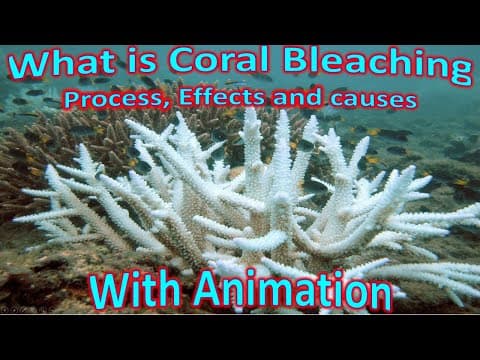
[0:12]Hello friends, welcome to another video of Zeta Axis and today we are going to discuss about coral bleaching. We will see what are its causes and what are the threats caused by the coral bleaching.
[0:27]So, here we can see a coral reef. This branch are coral reefs and here we can see these small nodule like structures.
[0:35]If we zoom in, we can see that each of these are polyps. The polyps are the small organisms which form these coral reefs.
[0:44]This is a diagrammatic representation of coral reefs. These are the tentacles, here is the mouth and you can see that the body of these polyps is attached to the calcium carbonate substrate.
[0:57]So, colony of polyps is what forms the coral reef. Now there is one important property of these polyps.
[1:03]In the tissues of these polyps, we have zooxanthellae. This zooxanthellae is an algae which performs photosynthesis.
[1:14]And the polyps mainly depends on the zooxanthellae for its food supply. 90% of the food supply is provided by zooxanthellae on only 10% is provided by the tentacles which are used for catching small organisms like small fish or small phytoplankton.
[1:32]So here if you see a single tissue of polyps, we can see that there are large number of pigmentations within this cell. These small pigmentations are zooxanthellae.
[1:43]These are the algae which perform photosynthesis and provide nutrients or food to this cell. Now let's see what is coral bleaching.
[1:53]So coral bleaching is a situation when these cells, they will emit these pigmentations out and this becomes colorless.
[2:04]Because the cells do not have their own color, they are translucent or transparent. It is the pigmentation which provides them the color.
[2:13]But since these pigments are released, the color becomes white, because they are transparent and we can now see the calcium carbonate substrate.
[2:21]And this condition is called coral bleaching. Coral bleaching is mainly caused by changes in some external factors like temperature increase of the ocean water or increase in sedimentation.
[2:35]The zooxanthellae, it becomes stressed. It is not able to perform photosynthesis properly. Because of this, it starts to emit active reactive elements which are harmful to the polyps.
[2:47]And therefore the polyps are forced to expel the zooxanthellae. And since the polyps are transparent, the color is provided by the zooxanthellae pigmentation.
[2:57]Therefore, when the zooxanthellae is expelled, the calcium carbonate skeleton becomes visible and we can see the white calcium carbonate substrate and therefore it appears white in color.
[3:05]So this is how the coral reefs appear once they have removed or once they have ejected the zooxanthellae. Now let's see the effect of coral bleaching on the coral reefs.
[3:14]Now remember that when the coral reefs are bleached, they do not die. They are alive, but they are under stressful condition.
[3:28]Since 90% of the food was supplied by zooxanthellae, emitting it out, it reduces the food supply of the polyps and therefore they are under huge stress.
[3:38]Corals can survive short-term bleaching and if conditions become favorable, zooxanthellae can be reabsorbed.
[3:49]So if the conditions become favorable, these polyps they will reabsorb the zooxanthellae and they will come back to the normal state.
[3:56]But if these unfavorable conditions continue for a longer period, then long term bleaching will occur. This will lead to the starvation of corals. Why?
[4:05]Because for 90% of the food, they depend on zooxanthellae algae, so they will eventually die and only the calcium carbonate substrate is left behind.
[4:15]So, if this coral bleaching lasts for a longer duration, then it is a threat to the survival of the polyps or the coral reefs. Now let's see some of the important factors which lead to coral bleaching.
[4:28]The first and the most important factor is increase in temperature of ocean water. The temperature of ocean water can increase due to several reasons like global warming or discharge of hot water from industries.
[4:43]Now, if the temperature increases and its effect can be seen to the death, then these corals will be bleached. But if this duration lasts for a smaller time, then these corals can become reactive.
[4:54]They can absorb the zooxanthellae and they will become alive. But if this period of hot water increases, then the corals will die and there will be only calcium carbonate substrate left.
[5:09]Now, let's see some of the important factors which cause increase in temperature of ocean water. The most important being global warming, El Nino, marine heatwaves etc.
[5:20]Now remember, just an increase of 1 degree Celsius in temperature of ocean water is sufficient to cause coral bleaching.
[5:29]So the corals are very sensitive to temperature and even slight changes in the temperature of ocean water can cause coral bleaching.
[5:36]We all know global warming, it is increasing the ocean water temperature and its effects will last for longer time period.
[5:44]Next is El Nino. The El Nino increases the temperature of water in Pacific Ocean every few years.
[5:53]This effect lasts for several months. Even though it is for several months, it can cause severe damage to the coral reefs.
[6:01]Marine heatwaves is also another phenomena. In this we see that there are certain regions in the ocean water where the heat is trapped and it remains above average temperature for a very long duration.
[6:13]So even these kind of phenomena also cause coral bleaching for corals. So here we can see the effect of global warming, which causes long term increase in temperature.
[6:24]We can see these red regions, this indicates the regions which have above average temperature and we can see its effect almost throughout the globe.
[6:34]In the future, as the global warming increases, the sea surface temperature as well as the temperature of the deeper ocean waters will increase and thus the phenomena of coral bleaching will also increase.
[6:46]Now the next factor which increases the temperature of ocean water is El Nino. El Nino warms ocean water in the Pacific Ocean.
[6:54]And here we can see three such instances from 1982, 97 and 2015. And what we can note that the extent of the effect of El Nino is increasing from 82 to 2015.
[7:09]So we can see that now large volume of water is warmed up by the El Nino. The third most important effect which increases the temperature of ocean water is marine heatwaves.
[7:19]Here, we can see that surface temperature of a particular region of the sea rises from 3 to 4 degree Celsius above the average temperature and it can last for weeks, months or even years.
[7:31]This increase in temperature negatively affects the health of corals. This phenomena has increased because of increase in global greenhouse emission, that is the global warming.
[7:42]So global warming directly also affects the coral bleaching as well as it affects indirectly via these marine heatwaves.
[7:50]The second factor which causes coral bleaching is sedimentation. Increase in sedimentation in the ocean water, it reduces the amount of sunlight that reaches the coral reefs.
[8:03]And therefore, they cannot perform proper photosynthesis. So here we see if the sedimentation increases in this ocean water, the amount of light that is coming to the corals will be blocked and therefore they will not be able to perform photosynthesis and they will be bleached and finally they can die.
[8:18]But if these sediments are removed in a short period of time, then these corals can become active again. So what are the major causes for the sedimentation?
[8:26]The first is sewage discharge in ocean. Large cities, they discharge their sewage in the oceans and this increases the sedimentation near the coastal areas.
[8:38]Sand storms can also bring large amount of sand in the ocean, thus increasing the sedimentation. Wave erosion is also a factor where the beaches are eroded by the sea waves, thus increasing the amount of sedimentation.
[8:52]Large amount of sediments, we already know is brought by the rivers. In India like rivers like Ganga or Indus, they bring a lot of sediments along with them and they dump it in the ocean. So these regions where there are deltas located, they will find lot of sedimentation there.
[9:10]Industrial discharge of certain chemicals also react with the elements in the ocean water and they form certain sediments within the water. So even though the water which is released from these industries might not have the sediments, but when it goes into the ocean water it reacts with the with the elements in the ocean water and forms these sediments.
[9:30]Then the next factor which causes coral bleaching is low tides, which bring the coral above the water level.
[9:38]So certain regions, they can see large difference between the level of water in high tide and low tide. Now, if such regions, they expose the corals to the sun directly, then they will be bleached and if this period is for shorter duration, they can become active and if it lasts for longer time, then they might not survive.
[10:01]Another is storm increasing fresh water supply. We know that corals require saline water. But certain big storms, they can increase the amount of fresh water and due to which the corals find it difficult to survive in this atmosphere.
[10:17]However, when the situation may come back, they can become active. However, if there is continuous increase in the supply of fresh water in the region, the corals find it difficult to survive.
[10:29]Again, if in a region, there is excessive radiation from the sun, which can directly reach these corals, then because of this excessive radiation, the corals will get bleached.
[10:41]The corals which are closer to the surface of the water, they may have higher effect of this excessive radiation from the sun. So here we can see a combined effect of solar radiation as well as tides.
[10:52]So in summer, the solar radiation is higher, as well as if the tides expose the corals, then they will receive more UV rays from the sun and there are more chances of them getting bleached and eventually die.
[11:05]Now the next important factor which causes coral bleaching is sunscreen cream. Here we can see that this sunscreen cream, it contains many chemicals.
[11:14]These are the names of these chemicals, which when enter the water, they cause harm to the coral reefs. Therefore, sunscreen are also one of the major problems which are causing coral bleaching.
[11:29]The chemicals in this the chemicals which are formed by the reactions, they impede the photosynthesis in corals and thus cause coral bleaching. Then there is some foreign elements which can be added to the ocean water.
[11:42]Like oil spills, herbicides which are taken by the drain water of floods or rain and then there are chemicals which impede the photosynthesis in corals because these herbicides they are used in the farms and if there is flooding, then all these chemicals along with the water will enter the ocean water and there they can cause certain chemical reactions and affect the coral bleaching.
[12:05]There are also infections due to pathogens. So sometimes there will be an infection in the region which can affect the corals. There could be a disease in the corals.
[12:14]So far we have seen different causes for coral bleaching. Now let's see some of the threatening factors which may become an important factor affecting the survival of corals.
[12:25]The first is global warming which is increasing the sea level. Now because of this, the water level is increasing.
[12:33]Now if corals, they cannot grow faster than the rise of ocean water, then they will get submerged. They could not perform photosynthesis properly and they may eventually die.
[12:44]Ocean acidification is another important factor which threatens the coral survival. More amount of carbon dioxide within the oceans, it impedes formation of calcium carbonate, which is important for forming the skeleton or the exoskeleton of the polyps, the substrate of the polyps or the coral reef is formed of calcium carbonate and it will dissolve if there is an increase in amount of the carbon dioxide in the oceans.
[13:12]Then there is excessive fishing especially trawler fishing which harms coral reefs. Let's see each of them. So here we can see that there is this barrier reef around this island and this is the ocean.
[13:24]Now suppose that the ocean water increases with a very high rate and these algae are not able to match the speed with which the ocean water increases.
[13:34]Then they will submerge in the ocean water to a greater depth and we know that sunlight will not be able to increase reach over here. So the photosynthesis will be affected and they will eventually die.
[13:47]The next is ocean acidification. Coral skeleton is made of calcium carbonate. It is made by combining Calcium in sea with carbonate CO3 dissolved in sea. So here we see that there is a balance in the amount of carbon dioxide in the atmosphere and in the oceans.
[14:05]But with the increase in the amount of carbon dioxide in the atmosphere, we will see that there is increase in the amount of carbon dioxide in the oceans because some of the carbon dioxide that is added over here will be dissolved by the oceans.
[14:21]Now, once the carbon dioxide dissolves in the ocean water, it creates carbonic acid, thus making the ocean water acidic. Now as the amount of carbonic acid increases in the ocean water, there are set of reactions which inhibit the process of formation of skeleton of the corals.
[14:41]This is the reaction through which the calcium carbonate is formed in coral reefs. But more acidification impedes this process and therefore it hinders the growth of coral reefs.
[14:55]Therefore, more increase in the amount of carbon dioxide in the atmosphere will lead to the acidification of ocean water and thus destroying coral reefs. So here is the process which explains how ocean acidification affects the formation of coral reefs.
[15:10]We can see that increase in CO2 in sea water increases hydrogen ion, which combines with carbonate to make bicarbonate. Thus this reaction forming calcium carbonate is hindered because of this.
[15:23]Thus corals find it difficult to form new cells and the already existing calcium carbonate also starts to dissolve and it becomes weak. Therefore, ocean acidification affects the survival of coral reefs.
[15:36]Now another factor, which is a big threat to the survival of corals is fishing, especially trawler fishing. What they do in this fishing is that they will use a cage at the sea floor and then they will drag it, thus destroying all the corals which are located on the sea floor.
[15:52]There are some other methods in which they use some explosive items, they throw it in the water, when the bomb explodes, it will kill all the fishes in the region as well as it destroys the corals. So all these methods of fishing are also harmful for the corals and if this kind of method increases in the future, then we will see that there will be huge decrease in the amount of corals.
[16:19]So here is a summary of what we have discussed in this one diagram. We can see that there is a healthy coral where there are zooxanthellae, then it is expelled if this process remains for some time, then it becomes bleached and then we see some of the important factors which cause this coral bleaching.
[16:36]I hope now you understand exactly what is coral bleaching and if you've liked the video, then do subscribe to the channel and share it with your friends. If you like what we are doing and you want to support us, then you can use the UPI ID given over here.
[16:51]Thanks for watching the video.


