[0:01]For decades, the Three Gorges Dam has stood as a symbol of China's engineering might. A project so vast that NASA said it measurably altered the Earth's rotation, making days .06 microseconds longer. The Three Gorges Dam generates more electricity than any other power plant on Earth. Enough to light up more than 70 million homes a year.
[0:27]But on the edge of the Himalayas, China is planning something even more ambitious, on a river you may never have heard of. This is a project of a century, the most impressive power generation system ever envisioned. It's the hydropower equivalent of a mission to Mars. But to build it, China must tunnel through mountains that are still rising in one of the most earthquake prone places on the planet, and that's not all. What happens here could affect hundreds of millions of lives downstream, in neighboring India and Bangladesh, risking new tensions over water. The engineering is unprecedented. So are the stakes.
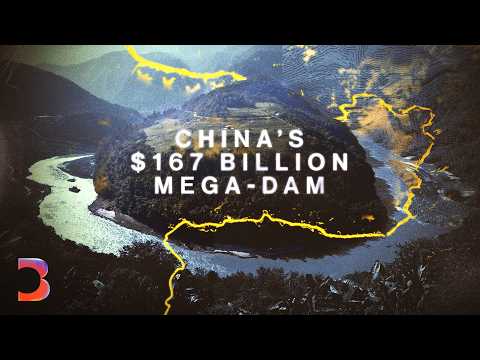
[1:18]There is like this stark beauty. It was called the roof of the world because uh it's the highest part of the world. From the glacial melt here, the Yarlung Tsangpo river flows over a thousand kilometers east along the edge of the Tibetan Plateau, before performing what many consider a geological miracle. At a location known as the Great Bend, right where the Plateau meets the Himalayas. It does this mad turn, so it stops flowing east and does a big hook and starts coming back and flowing west. about 180° bend uh where the the river drops about 2,000 m in elevation in just a 200 km period. Then the river leaves China, goes into India, and there it's known as the Brahmaputra, and then it empties out in the Bay of Bengal. The Yaxia Hydropower Project is massive in scale, long in duration, and far-reaching in impact. But it's back at the Great Bend, where construction of the Yaxia or Lower Yarlung Hydropower project officially began in July 2025. It's a place so remote, a road only reached it in 2013. The gorge of the Great Bend is the biggest canyon in the world. It's literally three times deeper and a little bit longer than the Grand Canyon in Arizona. It's this natural drop, the world's steepest and deepest that also gives the plateau its greatest hydropower potential.
[2:53]Those following the project say China's ambition is not just to tap this power, but to utterly dominate it. The energy generation from this project will break like records in in like many different dimensions. It will be by far the world's largest individual source of energy, 60 gigawatt of installed capacity. The Chinese government has said that this will generate about 300 billion kilowatt hours a year. That's more than the UK uses in an entire year. It's also about three times more than the Three Gorges generates. With little known officially about the project, including the construction timeline, analysts outside China have had to rely on social media, state television, and satellite images to piece together its design. Not so long ago, an article was published in nature, one of the premier peer-reviewed academic journals, that roughly describes the project as a diversion project. Unlike a traditional walled dam, observers believe this one will be made up of a series of hydropower stations along the river. Theories vary, but some outside experts suggest there would be one upstream dam with a large reservoir to regulate the water flow. This would be followed by a second smaller dam at the top of the gorge, where water would be diverted from the Great Bend through the mountains via a number of underground tunnels and turbines before potentially entering another smaller re-regulation dam at the bottom of the gorge. This could stabilize the flow before the river continues downstream into India. This will be quite an engineering feat after all, you're literally reconstructing a whole river underground. The volume of water that will be diverted here will be similar to the discharge of a medium-sized river, such as like the Rhine in Europe. It's a concept already tested at the Jinping dams, where engineers diverted the river through the mountains. But what is really novel about this project is just like its sheer scale. Many engineers would probably not believe that building such a project in such a remote location would be even possible. The government announced the project would cost 1.2 trillion Yuan. That's about $167 billion US dollars. And that compares to the Three Gorges, when it was built, completed back in the 2000s, it ended up at a cost of about $37 billion. So this is four to five times as much as that. But experts say for China, this project is not just about generating power. It's a core tenet of its national economic strategy. China is an engineering state and one of the things that, you know, having an engineering society in China has done is that it's a government that likes to build its way out of problems. The dam, to some extent, is an extension of China's biased towards production, towards investments. But it comes at a very interesting time. China is striving to make this transition from investment to consumption-based growth. So, the dam at this point would provide a critical demand boost at a time when consumption and investments has been weak. It's a project that promises an economic jolt for sectors like construction, cement, and steel. When the project was announced, it it rippled through the economy. Companies like Power Construction Corp of China, China Engineering Corp, Huaxin Cement, there's share prices all surged. But at another level, the dam will also enable China to produce more renewable energy and help their green transition. With a target of net zero emissions by 2060, China has said the project could cut 300 million tons of carbon emissions a year by replacing fossil fuel power. It's also about energy security, generating more power domestically as demand surges for energy hungry tech. But building this record shattering mega project, in one of the most remote and geologically unstable regions on Earth, tests the boundaries of modern engineering. In order to build a dam like this, you're dealing with intense energies and intense altitudes. Landslides, freezing, malfunctioning equipment, people falling off the side of mountains.
[7:33]They're building this massive project on a site where six tectonic plates connect up. That makes this one of the world's most earthquake prone regions. In fact, in 1950, a magnitude 8.6 earthquake, one of the largest ever recorded in human history, occurred in the area. for the last 40 years, China has developed the best hydropower engineers in the world by far. They're not magicians, and they can't stop tectonic plates and they can't stop earthquakes. So that's a massive danger. And even if the earthquake doesn't happen, these type of projects tend to have slow disasters happen within them. So they they seep plastic and concrete into the surrounding environment and that changes the entire environment of that place slowly over time.
[8:28]The International Campaign for Tibet also warns that dam projects frequently displace thousands from ancestral lands and sever traditional livelihoods with little consultation or support. The Three Gorges project, which required the forcible relocation of 1.3 million people from a much more heavily populated region, submerged large sections of the river valley, damaging habitats for many endemic species. China has done this before. Over the last two decades, China's 12 dams along the Mekong have reshaped the river and the lives that depend on it downstream.
[9:11]The Mekong runs about 4,500 km from the Tibetan Plateau in China through Myanmar, Laos, Thailand, Cambodia, and Vietnam.
[9:27]This river is the lifeblood of people for those countries. Tens of millions of people rely on natural resources that come right out of the river. China doesn't share information on its dam building with the downstream countries of the Mekong. Doesn't let the countries know the designs of the dams, how they're going to be operated, when ground breaks, when the reservoirs start to fill, let alone how they're operating in real time. Those who study the river say this has left communities in the dark and unable to rely on the river's seasonal floods and droughts. The Mekong is mighty because of its seasonal flood pulse. And this flood pulse drives the Mekong's fishery, it drives the agricultural production. What dams do is reduce the peak. At times, they can reduce the peak downstream by 20%, 2,000 km away. But in areas closer to the dam, like here in Northern Thailand, those fluctuations are felt even more acutely. In 2008, the flood waters came this high. In the dry season, the pattern reverses. Water release for hydropower can push the river levels three times higher than normal. As a result, environmentalists say the ecology of the river has been disrupted and the reproductive cycles of the fish and birds are upended. What were once thriving fishing villages are now diminished. Before dams, the water was normal but nowadays, the water levels have fluctuated more than usual, affecting fishing. It's had a huge impact.
[11:20]It's hard to make a living.
[11:25]People there have been suffering for years. They lose their livestock, they lose their equipment, they lose their gardens and farms when these sudden impulses of water come through. It's the same lack of data and transparency that has fueled concern downstream from the lower Yarlung Hydropower project in India and Bangladesh. While India's Brahmaputra River is fed by other tributaries too, experts say nearly 40% of its fertile sediment comes from the Yarlung Tsangpo's gorge, sustaining millions of lives and livelihoods. Both countries have have come to China and said that they want more information about it. Uh they want to know what the downstream effects are going to be. And they're wanting more than anything else, assurances that the downstream flow of the river that turns into the Brahmaputra won't be too impacted by this hydropower project. The border here has long been disputed and reports suggest officials in New Delhi fear Beijing could weaponize the water, controlling it for political leverage. The Chinese government's counter to to concerns from India, Bangladesh and others, has been that the same amount of river coming out of the canyon now will be coming out of it after it's done. And there won't be huge retention dams that could allow them to hold back water in the case of some sort of geopolitical conflict in the future. China's construction of the hydropower project in the Yarlung Tsangpo River downstream has gone through rigorous scientific verification and will not have any negative impact on the ecological environment, geology and water resources of the downstream countries.
[13:07]But still, tensions remain. India is countering China with the construction of its own mega dam on the Upper Siang, 90 km below the border, even as it faces local resistance and environmental scrutiny.
[13:26]Without knowledge exchange and cooperation across that border, then it's really easy to play on people's fears. And what I think it's really important is that these decisions are made on like quantifiable, open and like objective data that enable us international scientists, but also importantly like people whose livelihoods are at stake in that river basin, actually have a say. The objective of this discussion here is not to like vilify China or to basically put this project into a bad light. Indeed, it would have a major impact and major benefit for China's target to become more carbon neutral, which would have major implications for the global climate. If China can pull this off, then it's a statement to the rest of the world to say, like, we're reshaping rivers, we're we're creating clean energy, we're providing our economy and companies with infinite clean energy that it can use to build the economy of the future.