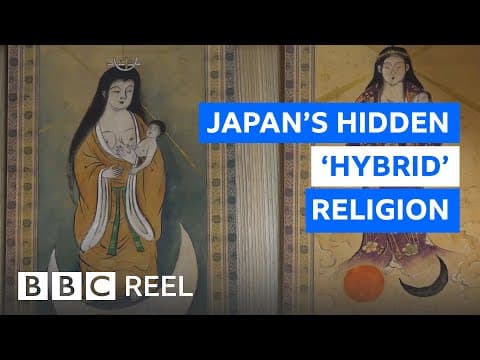
[0:03]There was a time when the government decided to outlaw Christianity, but followers felt they were still Christian at heart, so they made secret groups and continued their faith underground. Such times had been existing in this region.
[0:25]Christianity was outlawed in Japan in 1614. But some Christians in Nagasaki went underground and continued their faith in secret. These people became known as Kakure Kirishitan, or Hidden Christians. Christianity was thought to believe in the one and only God, and tended to deny other religions back then. However, Japan's main religions at that time were Shinto and Buddhism, and they were coexisting together, in a sense. As such, Christianity's attitude was really hard to understand for the majority of [Japanese] people. They started colonizing southeast Asia and the government felt it would be a threat for Japan, so the government decided to issue the ban on Christianity in 1614. Under the law, missionaries were arrested and sentenced to death, and they were thoroughly cracked down upon. In the 1630s, another law was issued which forced every Japanese person to register to a temple to prove that they were not Christian.
[1:50]Kirishitans [Christians] were forced to make a decision on whether to continue their belief and to be executed, or to abandon it. However, Kirishitans in Urakami, Sotome in Nagasaki city, and Ikitsuki Jima island made a different decision. That was to accept Buddhism and Shinto outwardly, and to protect their [Christian] faith underground. They camouflaged their way of worship and created their own style. They compared the Kwan-non statue from China to the Virgin Mary, or secretly followed the Christian calendar. In other areas, followers drew the Virgin Mary and kept it in a secret storeroom. They evolved their way of worshipping so as not to be found.
[2:45]This is their grave when they were hiding.
[2:56]Placing stones like a cross and praying.
[3:02]If you finish praying, break these stones, and leave. So, when they visited their ancestor's graves, they made a cross using stones to show that they still continued Christianity. Then leave the stones like this so others didn't find what these were. It is thought this was one of their ways to pray for their ancestors. Hiding underground continued through seven generations for about 260 years. This lasted until the law was removed in Meiji 6 (1873). After that, the majority of people returned to Catholicism, but some people decided not to return to the Church and continued with their way as they thought they could continue the way their ancestors had.
[4:04]Those people are called 'Kakure Kirishitan [Hidden Christian]'. Despite their way of worship differing depending on each region, this faith has been inherited by their descendants.
[4:35]I think our ancestors experienced harsh times to succeed with this Hidden Christian's belief.
[4:46]My group worships this drawing "Okakee", which is the Hidden Christian's so-called 'Virgin Mary'. I happen to have two drawings, but both of them are goddesses. They are siblings. Masaichi's group studies this drawing, that used to be hidden in a secret storeroom, and focuses their worship on it. Back then, the situation forced the missionaries and priests to leave the country. Their way of practice was continued only by followers, without missionaries or priests. While Catholicism evolved during Japan's ban on it, some of their practices are thought to preserve the original Christianity brought to Japan in the 16th Century. The other feature is that they also keep Buddhism and Shinto while continuing their Hidden Christian belief. So, they take the "faith-coexistence" style. They are different religions for sure, but it won't be a problem for our faith to follow this way. It's not only me, but my ancestors followed this way. So, I still keep this as it has been inherited. This might not be related to Japanese people's nationality, but we think Christianity teaches good things, and Islam also teaches good things, and so do Buddhism and Shinto. In a sense, they are all different religions, but we think all of them teach great things to each other. The Japanese use different religions, depending on the situation. While holding important life events in the Buddhism or Shinto style, the Japanese usually celebrate Christmas in December. Hidden Christians also join certain events likewise.
[6:48]The Hidden Christian faith is struggling to survive now as its followers decrease. Masaichi didn't baptize his son as he believes in his son's religious freedom. They have been accused of not following the original way of Christianity, and valuing their life above their faith. They thought this faith was important to them and tried to find a way to continue it somehow, and decided to protect their faith by accepting Buddhism and Shinto under the law.
[7:26]I think that they had a lot of courage to live in that way.


