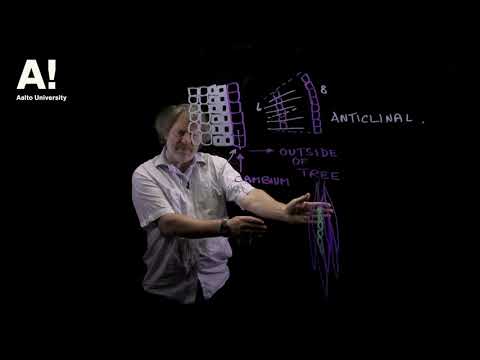
[0:05]Okay, so what I'm showing here is the cambium layer. Uh, that direction's the outside of the tree and you have to remember that it's the cambium that's moving outwards.
[0:16]Uh, and as it does so, it lays down xylem cells. It's just a lot easier for me to draw the xylem cells going that way, but you have to imagine that the cambium is moving and it's laying down xylem cells as it does so.
[0:30]In order to do that, the cells in the cambial layer divide in this direction and that forms what's called a periclinal division.
[0:40]The cambium moves outwards that way, leaves that cell behind and that cell differentiates into a xylem cell.
[0:48]So because we're looking downwards, this is the longitudinal direction.
[0:57]We're looking at the top if we are looking at a softwood, we're looking at the tracheids. So these are the lumen voids in the tracheids.
[1:08]So basically this layer is moving outwards and as it does so, it leaves cells behind and those are the xylem cells.
[1:17]So I'll just show that process speeding it up. Okay, so cambium is move that way. It's laid down another layer of cells.
[1:24]And as it does so, um, we start getting these growth rings forming, so these got very thin walls.
[1:34]Um, and as a consequence that they must be early wood tracheids.
[1:39]Okay, so we now got a layer of cells that's been laid down as the cambium moves outwards.
[1:46]Uh, and these have got much thicker walls, so we're beginning to lay down late wood, so we're moving on in the season.
[1:50]So another layer of cells, more latewood cells, the cambium is moving out.
[1:55]Okay, so the cambium is moving out, and as it does so, um, obviously the radius is increasing.
[2:03]And that means you've got to have cell division here. The cells don't get bigger, they stay the same size.
[2:10]So now we have to have cell division in that sense to accommodate the fact that we have this larger radius.
[2:18]So we're creating cells as we go out. So what we're ending up with is here we have six cells at that point and eight cells at that point.
[2:25]So that's anticlinal division. And this is periclinal.
[2:40]So here we're looking down at the top, and here we're looking from the outside in and I'm just showing that there's two different what are called fusiform initials.
[2:51]There's these uh fusiform initials that form the tracheids and the fusiform initials that form the ray cells.
[2:57]So as this cambial layer moves out away from you, it's laying down not just these tracheids, but also these ray cells.
[3:11]This is obviously for a softwood. I'm not illustrating a hardwood in this case. So this shows the cambium layer. The cambium layer is moving outwards. This is an initial, which is forming the parenchyma cell.
[3:20]So it's laying down parenchyma cells as it's moving outwards. These initials are laying down the tracheids as they move outwards.
[3:30]Here is the late wood, here is the early wood. And what I've shown here with these arrows, with these orange arrows are the transport pathways.
[3:38]Between each of these cells, um, is what's called a bordered pit. So they look a little bit like this if you look on a microscope and you do a good section.
[3:54]Okay, so this is the radial direction and that is the tangential direction.
[4:06]And coming towards you, that's the longitudinal direction. So these border pits are on the tangential faces of the cell.
[4:16]They have uh little valves in them which I'll talk about in a minute. Um, and the reason they have the valves is that if there's any wounding in the tree, if there's any problem with the water column going up a tree and air gets in, they can slam shut and basically they, they will preserve
[4:30]the remaining part of the water column and also they make sure that the tree isn't completely compromised by any of these sorts of things, so it's a defense mechanism.
[4:40]So we've got transport pathways that way using these pits.
[4:47]We've got transport pathways this way, the longitudinal pathway, but of course the cell is only finite in length.
[4:54]So you can only transport one cell, then you've got to go through one of these pits to get to the adjacent cell.
[5:03]And then we have these radial pathways which depend on the parenchyma. So the more parenchyma we have, the more radial flow pathways we have.
[5:14]Uh and obviously the more pits we have, then the easier this transport in the tangential senses.
[5:21]Uh there is a problem that occurs because of this valve slamming shut defense mechanism in the tree.
[5:28]We unfortunately encourage this to take place in the wood when we dry it and that makes some timbers much less permeable than others.


