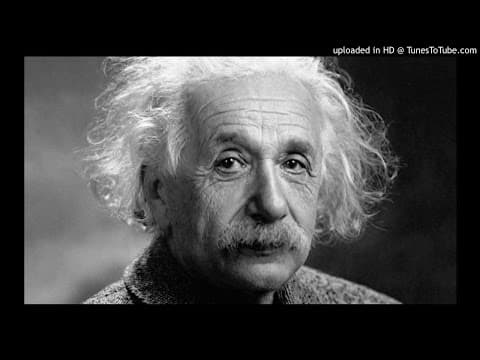
[0:02]Ladies and gentlemen, you're about to hear an address by Dr. Albert Einstein, world-famous scientist. Dr. Einstein was scheduled to address a Federal World Government rally, being held this evening by former GI students of Northwestern University in the Chicago Stadium. However, Dr. Einstein was unable to travel to Chicago for this occasion and is instead addressing the students by radio from his home in Princeton, New Jersey. He will be introduced by Dr. Paul A. Shilp of the Department of Philosophy at Northwestern University. Dr. Shilp. Mr. Chairman, fellow students, ladies and gentlemen. I have the distinguished honor and personal privilege to present to you on this auspicious occasion the world-renowned theoretical physicist, whose original work, more than that of any other living scientist, led to the discovery and development of atomic energy. Fortunately, the world's greatest living scientist is also the kind of a person who has as much of his social conscience as he has scientific insight and vision. In presenting him to you this evening, therefore, from his simple American home here in Princeton, I give you not merely a great scientist, but the equally as great citizen of the world, Dr. Albert Einstein. Ladies and gentlemen, the conversation I hate with three students of your university has made a strong impression on me. It showed me that a sense of responsibility and initiative is at work in the young generation of this country. These students are aware of the fact that the destiny of the new generation will be decided in these few years. They are determined to influence the pace of events within the framework of their possibilities. What is the situation? The development of technology and of the implements of war has brought about something akin to a shrinking of our planet. Economic interlinking has made the destinies of nations interdependent to a degree far greater than in previous years. The available weapons of destruction are of a kind such that no place on Earth is safeguarded against certain total, total destruction. The only hope for protection lies in the securing of peace in a supranational way. A world government must be created which is able to solve conflicts between nations by judicial decision. This government must be based on a clear-cut constitution which is approved by the government and the nation, and which gives it the sole disposition of offensive weapons. A person or a nation can be considered peace-loving only if it is ready to cede its military force to the international authorities and to renounce every attempt or even the means of achieving its interests abroad by the use of force. It is apparent that the development of the political relations in the year which has elapsed since the conclusion of the Second World War has brought us in no way nearer to the achievement of this goal. The UN, as it stands today, has neither the military force nor the legal basis to bring about a state of international security. Nor does it take account of the actual distribution of power. Real power is at present in the hands of a few nations. It is no exaggeration to say that the solution of the real problem is linked solely to an agreement on a grand scale between this country and Russia. For, if such an agreement would be achieved, then these two powers alone would be able to cause the other nations to give up their sovereignty to the degree of to the degree necessary for the establishment of military security for all. Now, many will say that fundamental agreement with Russia is impossible under the present circumstances. Such a statement would be justified if the United States had made a serious attempt in this direction during the past year. I find, however, that the opposite has happened. There was no need to accept fascist Argentina into the UN against Russia's opposition.
[5:54]There was no need to manufacture new atomic bombs without letting up, and to appropriate 12 million billion dollars of defense in a year in which no military threat was to be expected for the nearest future, nor was it necessary to delay the proposed measures against Franco Spain. It is senseless to recount here the details which all show that nothing has been done in order to alleviate Russia's distress. A distress which can very well be understood in the light of the events of the last decades and to whose origin we have contributed no little. A permanent peace cannot be prepared by threats, but only by the honest attempt to create mutual trust. One should think that the wish to create a peaceful form of life on this planet and to avert the danger of unspeakable destruction would tame the passions of responsible man.
[7:14]You cannot rely on that, my young friends. May you succeed in activating the young generation in this sense, so that it will strive for a policy of peace on a grand scale. Thus you cannot only defend yourself successfully, but you can serve your country and your dependence in a degree as was not given to any previous generation. Professor Einstein, in the light of what you have just told us, I am sure your radio audience would like to know what precisely is the real difference between world government and the United Nations Organization. Would you care to enlighten us on this point? Under a world government, I understand an institution whose decisions and prescriptions are binding for the individual states. It is an institution, therefore, which, among the present nations of the world is analogous to that relationship which exists between the government in Washington D.C. and the 48 states of the Union. In its present form, the UN does not possess the powers of a world government because its decisions and determinations have no binding power over the individual governments. Here is one of the students who has worked hard on the Chicago rally and on this broadcast, Mr. Foster Parley, who is Secretary-Treasurer of the National Organization of Student Federalists, who has a question for you, Professor Einstein. I'm a university student and a veteran of World War II. My fellow students and I would like very much to know what you, Professor Einstein, think that we, the young people of the world, can do to achieve a federation of the world, just as the original 13 states achieved in this country 160 years ago. Before anything else, the young generation must become clear in its own mind, what minimal conditions must be met in order to stop reciprocal military threat of one nation by any other nation or combinations of nation nations in the future. The second task would be to spread this knowledge throughout the country. The third task would require the organization of activity in such a way as to influence the representatives in Congress and in the individual state assemblies in such a fashion as to lead to the realization of the will of the people. Do you believe, Professor Einstein, that mutual envy and hatred among nations can be overcome by a world government? No, of course not. But a world government would be able to prevent that such natural emotional reactions should lead to acts of violence between nations. Professor Einstein, does any industrial country in the world possess the natural resources and scientific ability to produce atomic weapons? At any rate, enough such resources and ability in order to constitute a continuous and unbearable threat to each other. From this last answer, Professor Einstein, I take it that you, who knows as much as any living person about the threat of atomic bombs to the future of humanity on this planet, consider the establishment of real world government as an inescapable necessity at the earliest possible moment. There can no longer be any doubt about this absolute necessity. For this reason, everything that is done in international affairs must be done from the following viewpoint. Will it help or hinder the establishment of world government? You have just heard an address by Dr. Albert Einstein, world-famous scientist. Dr. Einstein, who spoke from his home in Princeton, New Jersey, was addressing a Federal World Government rally, being held tonight in the Chicago Stadium under the auspices of the former GI students of Northwestern University. Dr. Einstein was introduced by Dr. Paul A. Shilp of the Department of Philosophy of Northwestern University. Mr. Foster Parley, Secretary Treasurer of the National Organization of Student Federalists, also questioned Dr. Einstein. We return you now to our New York Studios.