[0:00]There is a law moving through the American political system right now that most people have never heard of. It does not have a flashy name. It was not announced with a press conference. But if it passes in its current form, it could fundamentally change who gets to build software in America, who gets to distribute it and who gets to use it for free. And the communities that stand to lose the most are not corporations. They are volunteers, developers working out of bedrooms and basements. People who have spent decades building something they believed in, something they gave away because they thought knowledge should be free. We are talking about over 600 Linux distributions. Fedora, Debian, Arch, K, Mint, Tails. And dozens more that most people have never heard of, but that power the Internet, hospitals, schools, governments and the machines that run modern civilization. All of them potentially caught in the crosshairs of legislation that was written by people who may not understand the difference between open source software and a foreign adversary. So what is this law? Where did it come from and why is almost nobody talking about it? To understand this, you need to understand a little bit of history. After World War II, the United States government built an elaborate system of export controls. The idea was simple, America develops advanced technology. Some of that technology can be used to build weapons or to give strategic advantages to enemy nations. So the government created rules about what could be sent abroad and to whom. For decades, this system worked relatively well in a world of physical goods. You could track a shipment of semiconductors, you could monitor the sale of aircraft engines. The system was designed for things you could put in a box and put on a boat. Then the Internet arrived, and software became something you could distribute to a million people in a hundred countries in seconds, for free, without a box, without a boat and without anyone's permission. The export control system struggled to keep up. In the 1990s, there were famous battles over whether encryption software counted as a weapon and whether publishing cryptographic code online was an act of illegal arms export. Those battles were largely won by the open source community. The government eventually acknowledged that publishing code was a form of protected speech and that open source software required different treatment than proprietary military technology. That compromise held for over two decades. Until now. A new framework is being developed inside the Bureau of Industry and Security, which is a division of the US Department of Commerce. This framework, built around what are called Export Administration Regulations, is being updated to account for a changed world. The specific concern driving this update is artificial intelligence. Policymakers are genuinely worried that advanced AI models, trained on massive datasets with enormous computational resources, could give strategic military advantages to adversarial nations. China is the explicit concern in most policy documents, and that concern is not entirely without merit. But here's where the problem begins. In writing rules to control AI software, regulators are using language broad enough to potentially capture almost any software that involves machine learning, data processing or cryptography. And because Linux distributions bundle hundreds of software packages together, including encryption tools, networking tools and increasingly AI related libraries, they could fall under the definition of controlled technology. The draft language in question does not say Linux is banned. It does not name any distribution. What it does is create a category of software that requires a license before it can be exported or, in some interpretations, even published openly online, where foreign nationals could access it. The burden of compliance then falls on the publisher. And for a corporation with a legal department, that is an annoying but manageable problem. For a volunteer maintaining a Linux distribution from their apartment in Ohio, it is potentially career-ending liability. Let us be very specific about what that looks like in practice. Imagine you maintain a small Linux distribution. You have maybe 10,000 users worldwide. You host your project on GitHub. Anyone in any country can download your ISO file. Under the new framework, that act of hosting could be interpreted as an unlicensed export of controlled technology. You would be required to apply for an export license, document who is downloading your software, screen users against denied party list and maintain compliance records. Failure to do so could result in civil penalties starting at hundreds of thousands of dollars per violation. This is not a hypothetical. The Electronic Frontier Foundation, the software Freedom Conservancy, and several prominent open source attorneys have already raised formal objections to the regulatory language being developed. Their argument is that the framework as written creates a compliance burden so severe that it would effectively shut down small and medium open source projects. The only survivors would be large corporations with a legal and financial infrastructure to handle export compliance. Companies like Red Hat, which is owned by IBM. Companies like Canonical, which backs Ubuntu, the little guy gets crushed. The big corporation survives. And the diversity of the open source ecosystem collapses. And that diversity matters more than most people realize. It is not just about having choices between different desktop environments or package managers. Different Linux distributions serve radically different purposes and radically different populations. Tails OS exists specifically to protect journalists and dissidents who live under authoritarian regimes. Whonix is used by security researchers and privacy advocates. KALI Linux is the primary tool for cybersecurity professionals and ethical hackers. Qubes OS is used by some of the most security conscious individuals on the planet, including people inside intelligence agencies. These are not frivolous projects. They are critical infrastructure for digital freedom worldwide. Now, here's the deeper problem. A significant portion of the global cybersecurity workforce relies on these tools for legitimate, legal and societally valuable work. If American developers can no longer freely distribute cybersecurity focused Linux distributions because they include penetration testing tools that fall under controlled technology definitions, two things happen. First, the American cybersecurity industry loses access to the open source pipeline that trains its next generation of talent. Second, the development of those tools moves offshore, to jurisdictions with no export control concerns, where American oversight and American security standards no longer apply. The law, in trying to protect American security, actively undermines it. There is also a constitutional dimension here that has not gotten nearly enough attention. The 1999 Bernstein versus Department of Justice case established that source code is protected speech under the First Amendment. The government cannot simply ban the publication of code without triggering serious First Amendment scrutiny. But the new framework does not technically ban publication. It requires a license before publication. That is a subtler legal maneuver, and it may be designed precisely to survive the constitutional challenge that an outright ban would face. The effect is the same. The legal path to challenge it is narrower. And the timing is not accidental. We are in a political moment where technology competition with China is treated as an existential priority across both major American political parties. Any politician who votes against tighter tech controls risks being painted as soft on China. That political dynamic creates enormous pressure to pass restrictive legislation, even when the technical details are poorly understood. Regulators who know better may stay quiet. Industry groups that should be fighting back are focused on protecting their own corporate interests, which sometimes align with tighter controls that disadvantage smaller competitors. Meanwhile, the open source community, which is notoriously bad at traditional political organizing, is fighting a bureaucratic battle with comment periods, regulatory filings, and legal briefs. These are the right tools. But they are slow tools. And the regulatory machine moves faster than most people expect when political will exists to push it forward. What makes this particularly alarming is that the consequences extend far beyond American borders. Linux distributions are genuinely global projects. Debian has contributors from over 50 countries. The Linux kernel itself is maintained by developers on every inhabited continent. If American regulatory frameworks make it legally risky for Americans to participate in these global projects, American developers may begin withdrawing from open source contributions entirely. Not because they want to, but because their lawyers tell them they have to. That withdrawal would damage projects that the entire world depends on. Consider what runs on Linux, the majority of web servers, the majority of cloud infrastructure. Android, which is based on the Linux kernel, runs on billions of smartphones. The International Space Station runs Linux. Most of the world's supercomputers run Linux. The systems that manage traffic lights, power grids and water treatment facilities in cities around the world, run Linux. Introducing legal uncertainty into the development and distribution of Linux is not a niche software policy decision. It is a decision with consequences for global infrastructure. The scenario where enforcement actually happens and 600 distributions disappear overnight is unlikely. Regulatory frameworks rarely work that cleanly. What is far more likely is a chilling effect. Developers become uncertain about their legal exposure. Maintainers consult lawyers, get scared and quietly shut down their projects. Hosting platforms start restricting what they will serve. Companies that rely on open source software quietly shift to using only distributions backed by large corporations that have cleared the compliance hurdles. The ecosystem does not die in a dramatic collapse, it slowly suffocates. That slow suffocation is actually harder to fight. There is no single moment of injustice to rally around. There is no headline that captures it cleanly. There is just a gradual narrowing of what's possible, a slow erosion of the commons that took decades to build. Replaced by corporate alternatives that cost money, restrict freedom and serve shareholder interests rather than the public good. The people who built Linux, who built Debian and Fedora and Arch and all the rest, did so with a specific philosophy. They believed that software was knowledge, that knowledge should be shared, that the ability to inspect, modify and redistribute the tools that run your digital life was a form of freedom that mattered as much as any other freedom. That philosophy built the Internet, it built the cloud. It trained the AI systems that the very regulators trying to control it are now afraid of. There is a version of this story where the open source community, the legal advocates, the technologists and the policymakers find a way to write rules that actually target the real threat without destroying everything else in the process. That version requires policymakers who understand the technology and are willing to do the hard work of precise drafting. It requires the open source community to engage in political organizing with the same rigor it applies to writing code. And it requires public attention, because regulators respond to pressure, and right now, most of the public does not even know this conversation is happening. That is why this video exists. Because the first step to stopping something like this is knowing it is real. If you care about the future of open software, digital freedom and the kind of Internet that was built on the idea that information wants to be free, then this channel is where you need to be. We cover the stories that are too technical for mainstream news and too important to ignore. Subscribe now because the next update on this story may be the one that actually matters.
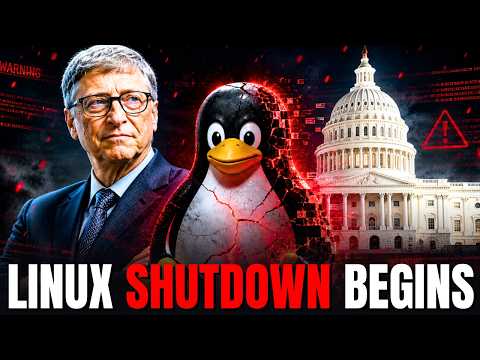
The Law That Could Wipe Out 600+ Linux Distros in America
Smart Investment Breakdown
10m 6s1,935 words~10 min read
Auto-Generated
Watch on YouTube
Share
MORE TRANSCRIPTS