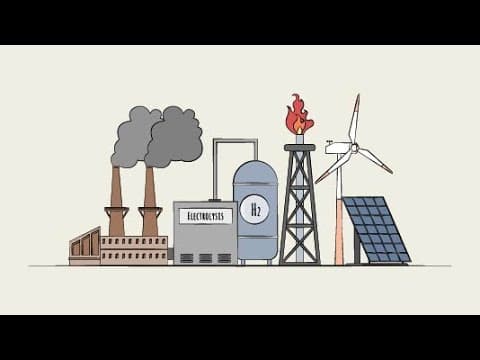
[0:06]We've said that hydrogen can function as a zero emissions fuel. That's because when the energy it stores is extracted, no carbon gases are released. Put another way, using hydrogen is zero emission. Producing hydrogen on the other hand is a different story. Energy from any number of processes can be stored in hydrogen molecules, and not all of them are low emission. And producing and using hydrogen is not a new concept. What's new is using it as green, aka low emission energy storage. But to understand how green hydrogen really is, we need to understand how it's produced. Hydrogen is described by the method used to produce it, and each method is assigned a color. Today, hydrogen from the various production methods form what is called the hydrogen rainbow. Darker colors indicate hydrogen from higher emissions production methods. But don't be confused, the resulting molecule in all these cases is the same, and by the way, it's colorless. The colors are defined by two factors: the incoming energy source being stored and the production technology used. There are two groups of energy sources: fossil fuels and electricity. Naturally, the fossil fuel-based methods are higher emitting. Turning a dirtier fuel into a cleaner fuel is, well, still somewhat dirty. The dirtiest fuels are black and brown coal. Black coal is the more energy dense, but higher emitting variety. Black and brown coal can be used to make black and brown hydrogen respectively, via a process called gasification, where pulverized coal is mixed with hot steam or air. This is an extremely low-cost method and is still in use, particularly in China. Other fossil fuels, like natural gas, can also be used to make hydrogen, and this is less polluting than using coal. There are two examples of this. One is where hydrogen is produced as a natural by-product of oil refining. By-product hydrogen can be captured and reused. The other is when hydrogen is produced intentionally from methane, the leading ingredient in natural gas, via a process called steam methane reformation, or SMR. In SMR, intense heat is used to split methane into hydrogen and a significant amount of carbon dioxide. In both cases, the resulting hydrogen is assigned the color gray. Gray hydrogen is low cost and commonplace. In fact, 95% of global hydrogen production today is gray hydrogen. The carbon footprint of gray hydrogen can be improved by capturing the by-product carbon gases. The resulting hydrogen is then rebranded from gray to blue. Next down the rainbow is what's often called turquoise hydrogen. This is also made from methane gas, but via a different technology, pyrolysis. During pyrolysis, carbon by-products emerge not as a gas but as a solid, called carbon black. And indeed, pyrolysis is a promising pathway for lower emission hydrogen. The other leading technology for low emission carbon is called electrolysis, and this doesn't rely on fossil fuels at all, but on electricity. In electrolysis, electricity is used to split water into oxygen and hydrogen, no carbon involved at all. Storing energy from electricity in molecular fuels in this way is power to X, or P2X. And power to hydrogen is the leading no emission P2X pathway. Of course, P2X hydrogen produced via electrolysis will only be as green as the underlying electricity source. And indeed, when the underlying electricity comes from renewable resources like wind or hydropower, it's called green hydrogen. Nuclear power derived hydrogen is often called pink or sometimes red hydrogen. And perhaps seeking a color to call its own, the solar industry has rebranded solar derived hydrogen as yellow, though this should be understood as a type of green hydrogen. Electricity generated from natural gas could also in theory be used to make hydrogen via electrolysis, but this wouldn't be green, nor would it be the most efficient. Energy would be lost at both the electricity generation and hydrogen production stages. The promise of these brightly colored, emission-free hydrogen fuels is compounded by the compatibility of electrolysis with renewable energy production. Renewables are intermittent sources. Sometimes they overproduce, sometimes they don't produce at all. And many modern electrolyzers, unlike other industrial processes, are easy to turn on or off. So, if wind is blowing strong, or the sun is high, surplus electricity can easily be routed to the production of hydrogen fuel storage. But there is a final arc in our rainbow to mention, a newer, still largely theoretical source, white hydrogen. This means extracting intact hydrogen molecules from the ground. This could be done using existing oil and gas infrastructure at existing sites. In many cases, hydrogen gas naturally escapes the Earth during the extraction of other fossil fuels, and some believe this could be captured and used as white hydrogen fuel. While the nuances of hydrogen production are indeed colorful, it can be helpful to think in more simple terms. Gray versus green. Most existing hydrogen production is for higher emission gray hydrogen. Most newer hydrogen production, driven by demand for clean energy storage, is for green hydrogen. Include yellow in this group. So, the shift in production to expect can be generalized to more growth in green, less growth in gray. In the following chapters, we'll explore the rest of the value chain, starting with offtake and then covering storage and distribution. If you like this video, please subscribe to our channel.
Hydrogen Industry Overview - How is Hydrogen Produced?
Primerli
5m 59s895 words~5 min read
YouTube auto captions
Transcript source
YouTube auto captions
This transcript was extracted from YouTube's auto-generated caption track. The transcript below is server-rendered so it can be read, searched, cited, and shared without opening the original YouTube player.
Pull quotes
[0:06]That's because when the energy it stores is extracted, no carbon gases are released.
[0:06]Energy from any number of processes can be stored in hydrogen molecules, and not all of them are low emission.
[0:06]But to understand how green hydrogen really is, we need to understand how it's produced.
[0:06]Hydrogen is described by the method used to produce it, and each method is assigned a color.
Use this transcript
Related transcript hubs
Watch on YouTube
Share
MORE TRANSCRIPTS


