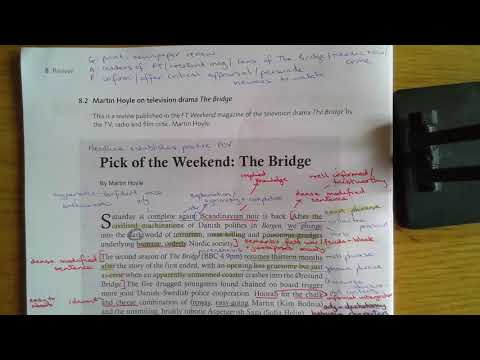
[0:00]Okay, so today we are looking at number 8.2, which is Martin Hoyle on the television drama The Bridge. So, let's think about the gap first of all. So, this is a print newspaper review and it's important to notice that it comes from the FT Weekend. So this is, um, the Financial Times, so a broadsheet newspaper, so straight away we're looking at a kind of educated readership. So in terms of the audience then, obviously readers of the FT are going to be picking this up or readers of the FT Weekend Magazine. Um, people who are fans of The Bridge might be reading it or people who are interested more widely in Nordic Noir or in crime. The purpose for the purpose of any review is to inform us and to give a critical appraisal. Because this is such a positive review, actually what Martin Hoyle's trying to do here is to persuade us as viewers to watch. So let's look at the opening. In terms of genre conventions, you can see, um, we've got the headline here and straight away this establishes the positive point of view. This is Martin Hoyle's pick of the weekend. Um, and that continues into the this opening sentence. So, he says, Saturday is complete again, Scandinavian Noir is back. So, straight away we can see his really positive feelings about the fact that The Bridge is going to be back on. Uh, in terms of sentence structure, this is an interesting one. This could be a complete sentence, "Saturday is complete again." and therefore this could be a semicolon. It's interesting that he chooses instead to use a colon. What that indicates is that his Saturday is complete again because Scandinavian Noir is back. I mean he could also have written it like that as a complex sentence. I think that here, what this colon does is it shows us that, um, it shows us the impact of the show. So it creates this little pause and it really emphasizes the fact that his whole weekend is fulfilled and it creates a kind of symmetry, a balance between the two separate clauses, which really shows us the completion of his weekend. Let's look at this first clause then. Saturday is complete again. That's hyperbolic, isn't it? Um, I doubt very much that this show being on is what completed his Saturday, but what that does is it shows us his enthusiasm and it creates this really confident voice. So here, complete is an adjective. And what that does is it really demonstrates the impact of the show, okay? This completely fulfills his weekend. Um, the adverb again, what that's showing us is it clearly this is a second season and that contextually helps us to know that, um, he's, he's obviously loved the first season and he's really excited that the second season is back. He then, um, goes on to use the term Scandinavian Noir. Now, what this does is it leaves a little bit of implied knowledge or assumed knowledge, uh, for the reader there. So, um, remember that this is the FT, this is an educated kind of readership and he is assuming that they are going to know what Scandinavian Noir is. This is quite a kind of educated point of view. Uh, remember it's a show on BBC 4, it's in another language. But because of his, um, assumed reader, he is, is going to assume that level of knowledge for them. We then get this very dense modified sentence which packs in information. After the civilized machinations of Danish politics in Bergen, we plunge into the dark world of terrorism, mass killings and poisonous grudges, underlying humane, orderly Nordic society. Now straight away that dense modified sentence with all of that information packed in helps to create this very well-informed trustworthy voice. He clearly knows about the show and knows what he's talking about and there's a level of formality to that as well, which befits the fact that we're finding this in the FT, um, magazine. Within that, we've also got these noun phrases, uh, that come through the opening section. So, after the civilized machinations, and then later on we've got this verb phrase, "resumes 13 months after." Then we've got this next noun phrase, "an opening less gruesome but just as eerie when an apparently unmanned coaster crashes into the Oresund Bridge." So I've highlighted these noun and verb phrases in yellow for you, so hopefully they stand out.
[4:41]Um, what that does is it helps to create again this kind of dense packing in of information, that on one hand tells us a lot about the show, uh, but does it also in a very kind of sophisticated way. So it's, it's helping to create this kind of intellectual, knowledgeable voice. Let's look at a few of the details within this kind of dense sentence here. We've also got this collective pronoun 'we', okay? So 'we plunge'. So straight away we as the reader are being engaged there and we're being involved. It's as if we love this show too and we're really excited for the second season. The verb 'plunge' is interesting, isn't it? Because think about plunging into a swimming pool, it suggests that you do it with kind of energy and enthusiasm, but there's also maybe a sense of it being uncontrollable, which fits in with this genre of there being this kind of sort of dark underside. He actually uses the adjective 'dark' just here in the dark world of terrorism, and we'll come back to that later on. Um, because that adjective later on becomes a noun, so that's why I've circled that there for you. We then get this semantic field of war and feuds that's built up in this triad of terrorism, mass killings and poisonous grudges. What that does is it builds a bleak mood. Um, and it also shows us how morally complex society is because that is then juxtaposed with the humane and orderly Nordic society. Now that juxtaposition is central to Nordic Noir. Um, and and that kind of filters all the way through the review. Okay, let's move this up a little bit and look at the second paragraph. So, what we have opening the next paragraph is another very dense modified sentence, okay? It's continuing on with that very well-informed voice. We also have a little bit of parenthesis here, BBC 4, 9:00 p.m. just adding in the information to let us know what time the show goes on. And that's just meeting the kind of genre conventions, you know, obviously if you're gonna review a show, you need to let your readership know what kind of time it's going to be on. Um, we've talked about those noun phrases and verb phrases, so what I'd like is to, uh, notice is that the whole register in this paragraph kind of evokes the Nordic Noir genre. There's this strange, unsettling, kind of morally complex society and that comes to your words like gruesome and eerie. It's then a slight change of tone, um, when we get to this, uh, bit, "Hoorah for the chalk" which is an exclamation or an informal interjection. Okay? And and what that does is it gives it a slightly less formal, more conversational tone. Um, and that's important because whilst he is very educated and whilst this is the Financial Times, he also needs to kind of engage his readership. Um, and then we get the idiom, hoorah for chalk and cheese. So by using a well-known phrase that, that makes it easier for the reader to kind of absorb the information and understand what he's saying, but it also, chalk and cheese means two completely different things, so it reinforces that juxtaposition and the dichotomy that is at the heart of this genre. Um, in terms of the discourse structure, we've had a little bit in this section here about the plot and then we come on to get a little bit about the characters. Now that is, um, what we would expect from a review. You know, if they're gonna tell us about the show, they have to gives a little bit about the plot and about the characters. Um, so really it's the, the choice of adjectives here and adjective phrases that that tell us about these characters. And interestingly, there's also a dichotomy between the characters. So Martin is frowzy, that means like sleepy, lethargic, a bit scruffy and easygoing, whereas in contrast, Saga is unsmiling, briskly robotic and Aspergerish. Now that's also maybe, uh, not the, most politically correct use of description, um, but I suppose it does quite precisely give us a sense of her character. Um, and what the adjectives are doing there is, uh, creating this dichotomy between the characters. Continuing with the more conversational, we then get this, this discourse marker here, "Things have changed, of course." Martin is still recovering from the murder of his son by last season's mass killer, who, though safely imprisoned, haunts him to the point of obsession. Uh, and that's another quite dense sentence, isn't it? Um, in terms of the discourse structure in this next paragraph here, we then get the background to the characters and the words. There's some quite interesting description that, um, comes in here. Again, I've highlighted this bit in yellow because it's another dense noun phrase with all of these adjectives there to describe her. And the use of the adjective 'antiseptic', now that's quite an unfamiliar collocation. What that means is it's a, it's a strange choice of words, okay? Normally we would describe that, um, a hospital or or a kind of clinical setting. But what it does is it, it gives a really clear sense of her character. And that shows us some of his kind of precision as a writer. So again creates this sense of a kind of educated, knowledgeable, precise voice that we can trust in his assessment of this show. Um, we get, um, in this section really a snapshot of the TV show. Via a commentary on the characters and he also, um, includes a little bit of direct speech here at the end, so, "I acknowledge their attempts to be amusing," she explains earnestly. Um, he has described her already as being robotic and there is something quite robotic about that direct speech. And having that reported speech from the show can help us to kind of understand a little bit more about her character and what the show is like.
[11:27]Um, I've also picked out some of the adverbs here, pre-eminently, heartily, unconvincingly, earnestly. And those adverbs really create a sense of her character and help us to understand what this kind of sort of robotic, unusual person. That's also reinforced by the, um, verb choice 'detect', she has learned to detect when people are making jokes. It's quite an unusual way of behaving and kind of fits in with this idea of him describing her as being, uh, as if she's got Asperger's, okay? That she's, she's functioning in a different way to the rest of us and it also fits in obviously with the idea of it being a, a show about crime, the idea of having to detect things. So, we now in terms of discourse structures for review that we need to open with a very clear point of view and close with one as well. And let's move this down for you. Um, at the end here, we get a kind of mirroring of of everything that's happened at the beginning. So we get the semantic field of kind of sensory opulence. "Saturday's brace of episodes is rich with subplots, vivid subsidiary characters." Um, and that really helps to reinforce his positive attitude, you know, that it's rich, it's fantastic. Um, he really finds this show to be a complete delight. And the mass terrorism here, okay, and a reminder that mass terrorism can be rooted in the skewed world picture of one unbalanced human. That reminds us of the terrorism and mass killings, that kind of semantic field of kind of war and tear and feud that we had at the beginning. So we're coming back to these kind of big thematic elements of the show. Uh, interestingly, filling in with that, you know, we've also got a whole range of poly, polysyllabic words here, um, all throughout the lexus that's being chosen. And again, that's showing us that this is a very kind of educated writer with a quite sophisticated voice that we can really trust in his judgment and it fits in both with the Financial Times audience and the fact that the show is, um, on on BBC 4 and it's in another language. Um, next, we get this list, "that emerges a common theme, connection, the failure to connect, the fear of abandonment and isolation, and the Nordic thriller's paradoxical juxtaposition of high principles and violent action, efficiency and murderousness." I mean I don't think he could have packed many more poly syllabic words in that list. Um, and the list juxtaposes all of these opposites that are at the heart of the genre. So all the way through this review, all the language has been picking out the juxtapositions that reflect the show itself. Um, we've also got an antithesis here, connection, the failure to connect, and that gives a kind of balance to that part of the list that again gives us that sophisticated, educated voice and reinforces that juxtaposition. Ending sentence is a really powerful one too. So we just had this really long complex sentence packed with information and description, and then we end with this short sentence, "The dark is all-pervasive." Um, so that kind of adds to the drama, brings emphasis to this kind of tone of darkness that he's choosing to focus on at the end by having that short sentence there. It's also a very pithy sentence, okay? What pithy means is that something is vigorously expressive, but also concise. And what that does is it informs us about the show, but it also mirrors and conveys the mood of the show and the review of itself. Um, I mentioned at the beginning, okay, that the, uh, the word 'dark' was used as an adjective, in the dark world of terrorism. And here, "the dark is all-pervasive." So the adjective has become a noun and what that does is it shows us that the kind of darkness has grown in substance, it's taking over. So what seems on the surface of things to be a kind of humane and orderly society, you know, once you peel back the layers, it's a very dark and bleak place indeed.