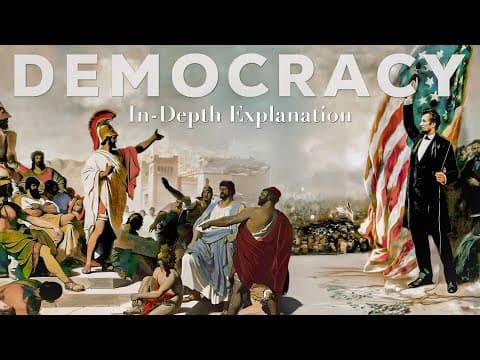
[0:00]This is a painting of life in ancient Greece, specifically in Athens during its political golden age. Its male citizens enjoyed, for the first time in the history of a state, near total control over their own political lives. They called their form of government Dêmokratia. Dêmos in Greek means people. Kratos means power to do things, which people usually translate as rule. Together, you have Dêmokratia, the rule of the people. After the fall of Athens, the word democracy wouldn't be linked to another state for more than 2,000 years upon the founding of the United States of America. But the United States created a very different form of democracy that to many isn't democratic at all. This video is going to explore these two democracies. We're going to talk about where they came from, what their ideas were, how they're democratic, and also how they're undemocratic. At the end, we're going to circle out and ask if the word democracy is appropriate for either society. So this video is designed to give you a better grasp on the concept of democracy and also how it relates to both societies. So, that's the plan and we're going to begin by looking at Greece. Ancient Greece wasn't a country in the modern sense with one state and one government. Instead, it was a collection of cities that were their own states called city states. These city states formed over hundreds of years when neighboring families, clans, and tribes joined together for protection. So these city states were basically just an urban area and to the surrounding countryside, all under one sovereign jurisdiction. The most famous city state, and also the best documented one, was Athens. In 507 B.C.E. the Athenians adopted a system of popular government that lasted nearly two centuries. With a brief interruption in 404 B.C., when Athens lost the Sparta at the end of the Peloponnesian War. The classical Athenian democracy permanently ended in 321 B.C. when Athens was defeated and subjugated by another powerful neighbor, Macedonia. The invention of democracy didn't happen in a vacuum. If you look at the position of Greece on a map and consider the prominent civilizations at the time, like the Persians, the Egyptians and the Phoeniciaans. You can see how it was positioned to be a sort of focal point among the flourishing civilizations at the time. As they interacted, traded and and even fought with one another. So from that came a sort of swirling mixture of genes, cultures and challenges that shaped Greek civilization and culture. A similar phenomenon continued throughout the Athenian Golden Age, which made Athens a remarkably alive city in its time. It's hard to definitively say more precisely how it happened since we're talking about ancient history here. But one thing that came to distinguish this flourishing Greek culture was its respect for wisdom. So the Greeks respected wisdom similarly to how 19th century Americans respected capitalist enterprise. So the Greeks made their sages into heroes and had popular sayings like wisdom should be cherished as a means of traveling from youth to old age, for it is more lasting than any other possession. In particular, they're interested in practical wisdom, wisdom that you can make function actively in the world. The Greeks focus on practical intellectual pursuits led them to develop a new philosophy of rule. You could ask the question of any society, who rules or where's the highest political authority? The answer to that question for most of history was a person, like a king or a Pharaoh. But to the Greeks, these were barbarians. They weren't free thinking people. The Greeks instead answered the question with law. That on one hand was thought to free people. It was thought that getting everyone in society, including its leaders, to be subject to the law, gave people a certain amount of protection in their lives from arbitrary uses of power. It was also thought to have a civilizing effect on people. It was thought that getting people to follow the law made people more driven by reason and less driven by emotional impulses. Here's how Aristotle put it. Just as man is the best of the animals when completed, which here basically means living in a Greek city state, when separated from law and adjudication, he is the worst of all. So the Greeks believed that they could civilize all of society, including its leaders, by making everyone in that society subject to the law. So that concept is called rule of law. You don't have to be a democracy to have rule of law. You can have a king, for example, who's also subject to the law. But it's a fundamental aspect of Athenian democracy as well as American democracy. It's also thought to be a necessary component of democracy more generally. If you think about it, you probably won't be able to rotate out unwanted people by election who are holding office, if those people in office are not subject to the law. So rule of law is understood to be the Western idea because the ancient Greeks are understood to be the people who discovered it. Again, we're talking about ancient history here and the further we go back in time, the less sure we can be about what we know. So we can't say definitively that the Athenians are the ones who invented rule of law. But we are pretty confident that it was a Greek invention and it certainly paved the way for the Athenian democracy that followed. Another major conceptual development that led to democracy is captured in the Greek word, isonomia, which translates to equality for all under the law. So you can think of democracy as a manifested expression of isonomia, an expression of political equality in a state with rule of law. But how did this come about? How did this become a thing? For one, rule of law is naturally somewhat egalizing. It brings people of all classes politically closer together. It's humbling towards those at the top and elevating towards those at the bottom. So once you have rule of law, calls for political equality might not be far behind. But we think the main reason why political inequality emerged as a popular concept in Greece and in its most extreme form in Athens, boils down to Greek military culture. In Greek culture, battle and conquest were glorified. The warriors who won battles brought honor and prestige unto themselves. Since armies were needed to defend every city state against potentially larger opponents, far more people served in the military than we're used to now. For example, even aristocrats might serve as cavalry since they were wealthy enough to own horses and the land that was needed to support them. If the cavalry prominently served in a battle and won, they'd bring glory onto themselves and with that power. So over time, a link developed between military service and political power, the power to administer the state. So that made the composition of armies in ancient Greece, inherently political. The types of people serving armies were positioned to win power. Athenian citizens were the ones who democratically capitalized on that. If you think about Greece, it's notably characterized by islands and the Aegean Sea. You can think of the Aegean Sea as the heart of Greece. Athens became unique in Greece when it used wealth from a silver mine controlled to take advantage of the Aegean Sea. Between 507 and 480 B.C.E., they build up a powerful navy. It was the greatest navy the Greek world had ever seen. And who, overwhelmingly, works in an ancient Greek navy? The answer is Orman. The people who literally rode the boats. So you might see where I'm going with this. The next question should be, what type of person worked as Normans in this ancient Athian Navy? The answer was poor Greek men. The Greek word for them was theths. We don't know how many theths there were living in ancient Athens, but there are suspiciously quite a lot of them. Athian literature sometimes refers to them as the masses. Athians also had a land army that was more standard for the time, consisting mostly of hop lights. Hop lights were heavy infantry. They were basically the middle class of Athens, people who were wealthy enough to own shields and weaponry. The important point here is that between the teeth and the hop lights, you have a clear majority of the adult male Athenian population. Again in circumstances where war can bring glory and power. In that same period, as you might have guessed, Athens uses its land army and its navy to win a stunning series of victories. Its hop light army unexpectedly defeats the much larger Persian army in the battle of Marathon, making them heroes around all of Greece. They also won a string of battles around Greece in 506. But probably the most important victory of all went to the navy in the battle of Salamis in 480. Again defeating the Persians and effectively saving Athens from subjugation. which was reported to have caused the masses to have gained a new found confidence in themselves. Which was directly linked to the Athenian democratic revolution. To the in of. That revolution is typically thought to have occurred in three major phases, three major reforms, and each reform is linked to a person. The first reform is linked to a man named Solon. Solon was responding to a class war that was ravaging Athens around 600 BCE. There was a massive wealth disparity between rich and poor and the government, the army and the courts were controlled by the wealthy. Many in Athens were deeply in debt and unable to pay it off. So Solon was brought in as a moderate to mediate between the classes and keep Athens from destroying itself. One of his main accomplishments was to convince all Athenians, regardless of class, to obey the law. So he created a new set of laws that were applied without distinction to all three men. So he's a good figure to peg the beginning of rule of law on in Athens. Solon also canceled the debts, but probably more importantly for the long run, he politicilly reorganized Athens. He broke Athens into four groups depending on their income, which is where we get the teeth from. Each group was then given a different amount of political privilege. The teeth were given the finest political privileges. They were given access to the assembly, which is a voting body, which we'll get to. And they were also given access to the courts. So teeth could now litigate and serve in the jury. Under Solon, the most powerful political authority was called the Council of the Areopagus, which only the wealthy could serve on and whose members served for life. The second reform was through a man named Cleisthenes. Cleisthenes was involved in a power struggle around 508 in Athens. There seemed to be simmering anger against elites at the time, which Cleisthenes used against his opponent. He aroused the people to revolt, overthrow Isagoras, and set up a popular dictatorship. He wanted to break the hold that powerful aristocratic families had over parts of Athens. So he politically reorganizes Athens into 10 tribes, which were further broken into sub-groups down to deans. So these deans are essentially local districts. It was through that infrastructure that Athenian citizens would go on to exercise many of their democratic rights. Each tribe could elect members to a newly created council of 500, which we'll get to. And they could also elect one of 10 generals to lead the military. But under Cleisthenes, you still had the Council of the Areopagus, and thetes, importantly, couldn't hold public office. The last major reform happened under a man named Pericles. Pericles came from a noble family, which was reported to have descended from Cleisthenes. He lived in the mid-fifth century, which was the era of Athenian naval dominance. There were calls for political equality, and Athenian opinion was split into two camps. One side believed that elites should govern Athens, and the other believed that the people, the demos should govern Athens. By allying with the people calling for political equality, Pericles rose to power and became the most influential man in Athens. He then worked with a colleague named Ephialtes to break the power of the Council of the Areopagus, which brought about the golden age of Athenian democracy. So without further delay, here's a description of what that society looked like. You could ask the question of any society, where are policy decisions made? Are they made in a throne room or in a private council somewhere? In democratic Athens, policy decisions were made on a hill not far from the Acropolis, called the Panx. 10 times a year, the citizens of Athens would come together and meet at the Panx. Once there, an issue would be raised and then a debate would occur. Everyone there would have equal right to participate in that debate, which was the Athenian basis of free speech called Isagoria. Once the issue was sufficiently debated, a vote would be held. The people there would then raise their hands to show their support for a particular position. Whatever side won, a simple majority would become new policy in Athens. What I just described was called in Athens, the Ecclesia, the assembly. The issues raised in the assembly were prepared by the Council of 500, whose members were chosen randomly from the public by lot. Of the two, the assembly was the far more powerful body. The assembly could vote down bills drafted by the Council. They could change the bills on the floor. They could send the bill back with instructions for drafting, or they could replace it with an entirely new one. So the real exercise of sovereign public authority rested directly on the assembly. The citizens gathered on the Panx could pass virtually whatever policy they wanted. So the most important policy decisions that had to be made in Athens were made in the assembly, which included foreign policy. So, as you might expect, that led to some dramatic assemblies. In the mid-4th century, for example, Philip of Macedon was marching on Athens. The assembly then had to vote on whether to fight or to try to negotiate. The wrong decision could have meant the fall of Athens and even the destruction of Athenian culture. So this must have been a deeply political society. And considering how long democratic Athens lasted, this must have been a fairly competent public. Speaking to that competence, there were very few elected public officials in this society. Short of a few exceptions, like generals, naval architects, and superintendents of the water supply. All public officials were chosen randomly from the citizenry by lottery. These officials all had their power tightly controlled by the assembly. The highest public officials were the generals. They only served one year terms and were subject to performance reviews by the public. If their performance was found lacking, they would be dismissed. That being said, they didn't have term limits. So generals like Pericles could be reelected for life. So the influence of a general over a lifetime could give a sort of continuity of purpose to Athenian politics. But all generals, including Pericles, had no formal power outside of the military. Their only ability to influence public policy rested on their ability to persuade the public. So what we're looking at here is a public that directly and thoroughly has control over its own political affairs, which is what we would now call a direct democracy. The Athenian public also directly expressed their political power through the dicasteria, the people's courts. I think it's worth spending a moment describing what it looked like because it didn't really resemble modern courts. For one, there were no lawyers in this system. You could hire a speech writer, but all cases had to be registered and argued by private citizens. There also were no judges. All cases were decided by the jury, and that jury was massive. The average size was around 500 people, big enough to be unble and also big enough to represent public opinion. The jurors were again chosen randomly from the public by lot. That meant that there weren't really any professionals in this system. You could even call it an amateur law system. So legal outcomes could be unpredictable. Speakers could fool the jury by, for example, incorrectly citing laws or distorting history. So those were the three main institutions, the Assembly, the Council of 500, and the law courts, all directly controlled and managed by the Athenian public. But who exactly was that public? Who had access to those institutions? Athenians, like all Greeks, saw the world in terms of binaries. You were either man or woman, free or slave, Greek or barbarian, citizen or alien. Within that, the Athenians permitted one half of those binaries into their democracy. They permitted free, male, Greek, citizens of Athens. So slaves weren't permitted, women weren't permitted, non-Greeks weren't permitted, and non-Athenian citizens weren't permitted. It's still normal today to exclude non-citizens from your politics. The rest of these exclusions were relatively normal for their time, but I think it's worth spending some time addressing them. The Greeks again, believed that their city states, civilized people and freed them. So they believed that they lived as free people in their city states. They also believed that people elsewhere in the world, the barbarians, lived as subjugated people. They lived as subjects to a ruler. So to them, foreigners and slaves were essentially the same. They both had the psychologies of subordinated people. So to the Greeks, their politics were incompatible with both foreigners and slaves. They saw their free politics as being incompatible with the psychologies of subordinated people. Speaking of slaves, the Athenians had quite a lot of them. Probably somewhere between 80 and 100,000 slaves, which was about a third of the total Athenian population. Athenian male citizens wanted to spend their time on things that they thought were valuable, but that don't necessarily create wealth. They wanted to spend their time on things like government, war, literature, or philosophy. But someone has to work to create wealth, and this was before machines were invented. So slaves were the Athenians answer to that. So the work provided by slaves made it possible for so many Athenian men to spend time in government or to serve in the military. That being said, the Athenians seemed to be relatively generous towards their slaves.
[18:19]In contrast to the United States of America, where slaves and their families were passed down from generation to generation, making their outlook on eventually gaining freedom, pretty hopeless. In Athens, it wasn't unusual for well-behaved slaves to be freed as their owners reached the end of their lives. Slaves in Athens also enjoyed some legal protections. If they were badly beaten by their owners, they could flee to a temple, and their owner might be forced to sell them. Slaves were also allowed to participate in business, provided they gave their owners a share of their earnings. And better off slaves reportedly dressed similarly to free Athenians. The Athenian government also employed a number of slaves. Many of them were given an allowance and were allowed to live where they pleased. Considering the standards of the time, Athenians were known for being mild to their slaves, and it was even common judgment that it was better to be a slave in Athens than a poor free man in an oligarchical state. But I doubt that was of much consolation to the slaves working in the silver mines. It's a bit more controversial how Athenian men regarded Athenian women. Thucydides, famously reported Pericles to have said at the end of his funeral oration, that female excellence meant to be least talked about among the men, whether for good or for bad. In keeping with that, average female citizens were rarely talked about in Athenian literature. Aristotle opened his politics, claiming that while on one hand, men and women need each other for reproduction. On the other hand, some are naturally rulers and others are naturally ruled. Rulers, he says, used their minds, and the ruled used their bodies, which seems to be implying that men are naturally a ruling class over women. Since women weren't invited into politics, that seems at least fairly representative of Athenian public opinion. So this was a deeply patriarchal society. The woman's place was understood to be not in politics, but in the home, out of sight. As probably the strongest piece of evidence for that, we don't even know the name of Pericles's wife. That being said, not all male citizens were always allowed into their democracy. Under Cleisthenes, a procedure was introduced that allowed the Athenian public to banish someone from their society. The procedure was called an ostracism. If 6,000 people in the assembly voted in an ostracism, then the person with the most names would be forced to leave Athens for 10 years. So that's something that happened to high-profile people, typically disgraced politicians, and presumably during tense times, considering how many votes need to be cast. So ostracisms probably worked to relieve domestic pressures. If someone was causing a lot of trouble in Athens, and the Athenian public wanted them gone, they had the means to do it. I think it's worth reflecting on that process and what it seems to say about Athenian society. When the Athenians wanted someone gone, they didn't kill them and they didn't throw them in jail never to be seen again. Instead, they just forced them to leave for 10 years, and after that 10 years, they'd be allowed to come back. So it was a fundamentally peaceful process, and I think a civil one. That being said, there is some evidence of fraud during those ostracisms. So the process might have sometimes been manipulated. Illiterate voters, for example, might have been used for political purposes. So, what happened to this system? What happened to Athenian democracy? Why do we talk about it in the past tense? Well, democracy in Athens became expensive. The assembly voted to institute pay for more and more public positions, namely in the military and the jury. Money for those positions had to come from somewhere, and Athens found the answer in empire. So democracy in Athens came to depend on empire. They increasingly stretched their power over the rest of Greece. They also sent ambitious campaigns abroad to Egypt and Sicily. Things reached a breaking point. Sentiment in Greece turned against the Athenians. Resistance to Athenian policy came from nearly every state in Greece. The viability of democracy was also an open question in Athenian time. It was notably rejected by aristocrats and the upper class. That led to divisions at home and a lack of intellectual support from many of the brightest minds at the time, like Plato, Socrates and Aristotle. By Aristotle's time, the most extreme oligarchs were reported to have sworn the following oath. I will be evil-minded to the demos and will plot whatever evil I can against them. Athens would go on to suffer a string of defeats that would lead to its fall. The end of the line for the old-style Athenian democracy came in 321. When Athens, subordinated under Macedon, added a wealth criterion for citizenship. Democracy disappeared in Athens and wouldn't reappear for thousands of years. This time in a modern form, influenced by the United States. We're about to turn our attention there, but I'd like to close the section out by reading a speech that Pericles was reported to give to the citizens of Athens. It was a dark time in the city. Plague had struck, and the tide of the war against Sparta seemed to be turning against Athens. I think it gives us sense of both the intelligence and the grandeur of the time. It reads, even if we should ever be forced to yield, for everything that grows great, also decays, the memory of our greatness will be bequeathed to posterity forever. that we of all the Greeks ruled over more Greeks than anyone, that in the greatest wars we held out against enemies in alliance and individually, and that we lived in a city that was the most ingenious and the greatest.
[39:00]I started this video out saying I would end it by squaring the concept of democracy against both societies. So, it's time to do that. Let's start with a definition. I'd say democracy is a form of political organization where the people living under political institutions simultaneously exercise control over them. To be transparent, I got that wording by reformulating a statement that Sean Willens made in The Rise of American Democracy. When he said, democracy appears when some large number of previously excluded, ordinary persons, what the 18th century called the many, secure the power, not simply to select their governors, but to oversee the institutions of government. Virtually all the definitions I've seen center around the same idea. The idea that democracy is government by the people, with the people being understood as broadly as possible. But I prefer definitions that are less abstract and more precise. Another way to say it is that you have democracy when the people living under a government control it. If we can accept that then the task of figuring out whether society is democratic or not becomes relatively simple. We have two main factors here. The people and their control. To figure out then how democratic a society is, you have to answer how broadly realized is this concept of the people. When we're talking about democracy, we're talking about realizing the people in terms of political equality. Are there exclusions? Is there one type of person being privileged over another? That reduces democracy. It makes that society less democratic. The second factor is control. How thorough is the people's control over their institutions? For our purposes today, we're only going to square this against Athens and America. And we're going to start by looking at Athens. The control that Athenian citizens had over their government was incredibly thorough. The citizens directly controlled the three most powerful organs of government, the assembly, the Council of 500, and the law courts. Its few elected officials were heavily constrained in their power, subject to the law, and supervised by the people. It's hard to imagine a society where the people have greater control over the institutions of their government. So in that way, Athens was highly democratic, even purely democratic. But who were the people? In Athens, only adult male, free citizens had political rights. So that's only around 10 or 20% of the population.
[41:41]So that means that between 80 and 90% of the Athenian population didn't have access to political privileges. If you could just parse that sentence, that pretty much tells the story. So, Athenian democracy was both remarkably thorough and remarkably narrow. It was thorough in the amount of control that the people had over the government and narrow in the amount of people enjoying those privileges. You also have to remember that those exclusions were normal for the time. So, you have to take historical context into account. If that society existed today, it'd be more controversial to call it democratic. But as it stands, it was an ancient society. Since their control over government was so thorough and their exclusions were normal for the time. I think it's safe to call ancient Athens democratic. America is basically the opposite story. American democracy began as a limited democracy. Similar to the democracy under Cleisthenes, if you remember him. As I described over the last third of this video, the control that the American people had over their government from the beginning was partial. Mostly just in the form of elections of representatives. The people who held those privileges in the beginning was like Athens, a narrow band of people, white male property holders. So given that, I think early American democracy was at best a limited democracy. The controls over government were too partial and there was too much political inequality. There were two main groups being excluded from politics. The limitations on the public's ability to control their government that I described in this video, all still exist.
[43:39]So the American public's ability to control their government is still, at best, partial. In some ways, it's become even more limited. For example, with the rise of institutions like the CIA and the FBI, which are effectively outside of the public's control.
[44:03]But the scope of people included in American politics has significantly expanded over the last, say, 200 years. Populous people, women and slaves were all seen as dependents in early America and therefore unworthy of political privileges. After a civil war and a string of civil rights movements, virtually all adult citizens in America now formally have equal political rights. Only a few exclusions still stand, like non-citizens and children and criminals in some circumstances. So the people in America is now realized about as broadly as it's been at anywhere at any time. But their ability to control the government is limited in that it mainly rests on elections. To make a judgment, I think America is a democracy. The ability to hire and dismiss your policy makers and your leaders is a powerful one. It's arguably the most powerful one, short of private citizens directly setting policy themselves, but the power of the public is limited enough to make me roughly agree with the democracy theorist Robert Dahl. When he said that he believed that Madison went about as far as it's possible to go while still remaining within the rubric of democracy, which is to say that American institutions are about as undemocratic as they can be, while still deserving the name. I think many hear that and automatically condemn the United States. But I think it's important to say, as a last note, that that's not necessarily the case. Democracy isn't a concept that has to be maximized at all times and under all circumstances. It's not self-evident that the more democracy we have, the more fully we're able to realize a democracy, the better off we are. So it could be that more democracy would be good for America, but also, maybe not. So, think for yourself. That's it for me today. Thank you very much for watching and goodbye.


