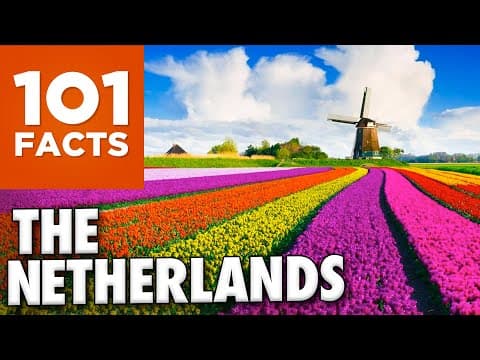
[0:00]Greetings mother factors. My name's Chris and I'm here to jettison you off today on an adventure filled with windmills, water, and lots of bicycles. Wait, do you think bicycles are like portable wind turbines? No way. That's a train of thought for another day. Anyway, we're talking about the Netherlands. Yes, this stunning country of you know what, you'll find out. But why would Elon Musk be very happy with how the Netherlands are progressing? What low-lying wetland where wood could be found now has big metal carrying cases capable of flight? And have you ever had a dream that that you um you had you could you do what you want, you could do so you you do you could you you want you want him to do so much that you could do anything? Two out of these two questions are going to be answered. So sit down, give us a like and subscribe. I'm going to take a nap right here. Good night, as we mouth wash our way through 101 facts about the Netherlands. Number one, the Netherlands, or the Kingdom of Netherlands to give the place its full regal title, is a state technically made up of four countries, Aruba, Curacao, Sint Maarten, and the Netherlands. Number two, the part most people are familiar with is the Netherlands, and this country is located in Western Europe. Aruba, Curaçao, and Sint Maarten can be found in the sunny climes of the Caribbean. Number three, while each of those countries are technically equal within the Kingdom, it wouldn't be unfair to say that the Netherlands rules the roost, as it makes up 98% of the Kingdom's population and land area. Number four, there are actually quite a few different currencies in the Kingdom as a result of this four-way split. In the Netherlands itself, they use the Euro, but in Aruba, they use the Aruban Florin, and in Curacao and Sint Maarten, they use the Netherlands Antillean Guilder. Number five, the Kingdom has a population of roughly 17.7 million people, and roughly 17.5 million of those people live in the Netherlands. Yes, I know having the Netherlands as part of the Kingdom of the Netherlands isn't the clearest, but just try and stick with me. Number six, the Kingdom has a total land area of 42,500 square kilometers if you include everything. However, if you just include the Netherlands part, that bit would be roughly 41,900 square kilometers, otherwise known as most of the Kingdom. Number seven, the biggest city is Amsterdam. Oh, hey, look, there's the thumbnail of the video that we did on Amsterdam. It has around 870,000 people living there, and up to 2.5 million if you include everyone in the metropolitan area. It serves as the capital of the Netherlands. Number eight, but it's not the only capital. Another city, The Hague, serves as the administrative capital and is also home to the Dutch Royal family. It's the third biggest city with around 500,000 inhabitants behind Amsterdam and Rotterdam. Number nine, and since we've mentioned the second biggest city Rotterdam, we may as well tell you that this city of 650,000 people is home to the busiest seaport in Europe. It handles 440 million tons of freight a year, twice as much as the next busiest port of Antwerp in Belgium. Number 10, the Netherlands is busy in the international community too. It is a founding member of big organizations like the United Nations, NATO, and the European Union. Number 11, From here on in, we'll keep it simple and refer to the European part of the Kingdom, the Netherlands bit, unless we say otherwise. The European part is bordered by Germany in the east and Belgium to the south. Number 12, speaking of Belgium, it used to be part of the Netherlands until a revolution in 1830, saw it declare its independence and go its own way. Number 13, anyhow, the name Netherlands reflects the country's physical attributes, as the Netherlands means lowlands. Pretty accurate since most of the country is flat and is located slightly above or at sea level. Number 14, that doesn't stop the place taking an award for the lowest-lying country in Europe. The Netherlands has a mean elevation above sea level of 30 meters. The lowest point in the Netherlands, and I'm going to try my best here, is the Zuidplas polder at Nieuwerkerk aan den IJssel, and it's 6.76 meters below sea level. Number 15, around one third of the Netherlands is below sea level, so no wonder the mainland has a lot of water. Around 17% of the total surface consists of water. Number 16, the Netherlands is made up of 12 provinces. And I can only apologize so much, Noord-Holland, Zuid-Holland, Zeeland, Noord-Brabant, Utrecht, Flevoland, Friesland, Groningen, Drenthe, Overijssel, Gelderland, and Limburg. And I don't doubt I've said every single one wrong. Number 17, out of all the 12 provinces previously mentioned, only two of them make up Holland, and they are Noord-Holland and Zuid-Holland. So yes, the Netherlands is not just Holland. Number 18, people from the Netherlands are called Dutch, but in the Dutch language, they would say they are Nederlanders. People from the Hollands can be referred to as Hollanders too. Number 19, one of the highest points in the Netherlands is the Vaalserberg. This mountain is located in the southeast, and its peak rises approximately 323 meters above sea level. It's not the highest point in the Kingdom of the Netherlands, though. Over in the Caribbean Netherlands, on the island of Saba, there is Mount Scenery, a volcano clocking in at 877 meters. Number 20, unlike most places, it's possible to travel around the Netherlands via water, since there are over 6,000 kilometers of waterways. Amsterdam alone is home to 165 canals, and these waterways have been declared a UNESCO World Heritage site. Traveling around the city via the canal tour is a major tourist attraction too, with 3 million passengers taking a cruise every year. Number 21, since there were roughly 100 kilometers of waterways in Amsterdam, you won't be surprised to learn that there are a lot of bridges too, about 1500 in all. Since the city is over 25% water, it's also not a shock to learn that there are over 90 islands in the city too. Number 22, I don't know about you, but I hope the heck you do. Because of the huge access to water in and around the Netherlands, it's understandable how they are the home to some of the world's best engineering firms for water project management. For example, there is the directorate general for public works and water management, and is responsible for the construction and maintenance of waterways and roads, the flood protection and prevention. Which is pretty neat considering 21% of the population live under sea level, and I'm like 90% sure they're not merpeople. Number 23, despite the Rhine River being the longest, Lake IJsselmeer, which the Rhine flows into, is the largest lake in the Netherlands as it covers approximately 1100 km² and has an average depth of 18ft, which is like three m stacked on top of each other. Number 24, there's a village called Giethoorn in the Netherlands that has no roads, as it's just filled with canals. This place is also known as the Venice of the Netherlands, since the canals are used for transportation too. Number 25, a lot of Amsterdam is built entirely on poles that are hammered deep into the ground due to the low-lying land. For example, the Royal Palace is built on approximately 13,659 wooden poles, and outrageously the central station has half that, at 8,687 poles. It's a train station. I feel like there should be more because trains are heavy. Number 26, Amsterdam receives over 4.2 million travelers every year, which is ironic as the reference couldn't be any closer to 420. Number 27, based on the type of environment the Netherlands is built on, you know, the large bodies of water and their big old poles. You won't find a lot of high-rise buildings or skyscrapers. For this reason, it's definitely a good place to visit for a change of scenery from a traditional urban city. Number 28, Now, Rotterdam in the Netherlands has the world's first floating farm. At first I thought that meant it was like a sky farm, but no, it floats on a dock on the New Mass. It has roughly 40 cows in it and robots to help the farmer collect manure and distribute fodder, and even better, it's completely self-sufficient. Number 29, North Holland has a picturesque flower bulb region, which is similar to all those movies you've watched that have a romantic couple running through a field of lilies in slow motion. 1.7 billion of these shiny flowers bloom across the country annually. Number 30, if you take a lot of interest in flower bulbs, you may like to know that around 80% of all the flower bulbs around the world are originally from the Netherlands. That means approximately 2 billion tulips leave the country every year. Sounds like they've got postmen who solely specialize in delivering flowers. Number 31, there are over 37,000 kilometers of cycling paths in the Netherlands, which are a lot of paths. And with some quick maths from my big boy brain, we can figure out that the average bike rider could cycle all these roads in um just over 11 weeks. I'll meet you there, I'm going to get the bus. Number 32, there are more bikes than people in the Netherlands, as there are over 22.9 million bicycles. However, bike theft is still a big problem leading to over 100,000 bikes being reported stolen each year. Number 33, the Schiphol Airport is scarily 4 meters below sea level and it happens to be the biggest international airport in the Netherlands. I bet you're wondering, though, what does Schiphol mean? Well, etymologically speaking, it originated in the 15th century with the language of that time, indicating that the area was the low-lying wetland, hol, where wood, skip, could be found. Number 34, since there are over 4800 direct flights facilitated through Amsterdam Airport Schiphol, it offers one of the most direct flights to Europe, which is good news for anyone that wants to go to an impromptu trip to the Netherlands. Well, I guess the convenience of this will be more obvious when, you know, there isn't a pandemic actively ravaging the world. Number 35, taking a look at some annual figures, in 2018, Schiphol Airport handled more than 70 million passengers. Let's compare this to a different airport, say, Heathrow. In 2018 it averaged 80 million, but Schiphol Airport is a little bigger than Heathrow, so it makes, wait, no, hang on. Number 36, the Port of Rotterdam came into existence in 1283 and became a major seaport in 1360. It is also one of the oldest ports in Europe. Number 37, there's not enough space for graves in the Netherlands. I mean that literally. Cemeteries are cleared out every decade or so as they are actually rented, so when the lease expires they end up clearing out. Out with the old and in with the less old. Number 38, even though Amsterdam is the capital of the country, The Hague in South Holland has been the political capital since 1588. Therefore, it too holds huge significance to the Dutch.
[11:06]I know it's the Netherlands, but this just sounds like Switzerland to me. They even have a lot of water like in Geneva. Number 40, there are up to 20 national parks in the Netherlands. Some of the more popular ones include prepare for bad pronunciations, the Weerribben-Wieden National Park and Loonse en Drunense Duinen National Park. Number 41, Hoge Veluwe National Park has up to 5,400 hectares of woodlands, dunes, and Heathland. Approximately 5% of the park is preserved and it's seen as one of the largest lowland natural terrain in Northwest Europe. the meaning of life. The National Parks aren't just home to woodland trails. There are actually Shetland ponies and rare birds like the Eurasian Golden Oriole. Do you think they go on adventures like Disney movie style? I hope they do. Number 43, there are close to 36,000 animal species that are found in the Netherlands. 500 of these are protected animals to prevent them from becoming extinct. Some of these beautiful creatures include the European Hamster and turtle Dove. Number 44, if you visit the Wadden Island of Texel, you may find that there are actually more sheep than people. So it seems like one of the best places to become like Dr. Dolittle, or maybe graze with them, be sheared with them, become one of them. Number 45, there are more than 2 million stray dogs in the world, yet the Netherlands was able to become the first country in the world to be free of stray dogs. Number 46, before they were the Dutch people that we know today, the Netherlands was filled with Celtic and German tribes during the ancient times. What made the Netherlands ideal for them is the vast rivers and wetlands as they offered protection from invaders. Number 47, during the first century, the Roman Empire came knocking and disrupted the Celtic German unity, by ruling for a fairly short period of time. You know, just 300 years. Number 48, steaming through the Middle Ages, the Franks invaded the territory and by the 800s, the Netherlands was part of Charlemagne's Carolingian Empire. Number 49, after Charlemagne died, the territory was split up by the dukes and counts. The split came with an increasing amount of wealth, as the Netherlands was one of the richest areas in Europe at the time, due to its agricultural trade doing well. Number 50, in 1555, Charles I of the Habsburg Empire, must have been feeling pretty generous, as he gifted the Netherlands to his son Philip II, who was the king of Spain at the time. So, I guess, oh la, Netherlands. Number 51, in 1558, Philip II needed some money. So, William of Orange, who was a well-statholder of Holland, persuaded the Estates General to grant Philip a nine-year subsidy. In return, the Spanish Netherlands would benefit from Philip having to accept a remonstrance, which set out liberties that would be given to the Spanish Netherlands. Number 52, Philip II's character was perceived as being very cold and arrogant. He didn't seem to have any crazy interest in pleasing the people of the new Spanish Netherlands, as he never visited after 1559. Adios Netherlands. Number 53, after some time, the people of the Netherlands revolted and it lasted for 80 years, up until the moment they gained their independence in 1648. Number 54, I'm not sure about their singers, but 1932 was when the Wilhelmus was adopted as a Netherlands national anthem. And on that day, history was made, as it's the oldest national anthem in the world, as it was written between 1569 and 1572. Number 55, based on what you know about the Dutch flag, what do you think is their national color? I'll give you a few seconds to think about that. No, it's actually orange. This is because the Dutch monarchy is from the House of Orange. Number 56, Vincent Van Gogh is actually from the Netherlands. Zundert in the North Brabant province to be exact. When he was nine, he was sent to a boarding school in Zevenbergen, in the northwest of the province. Number 57, during World War I, the Netherlands remained neutral ground, but during World War II, the Germans invaded. For a time, the Nazis chose a very loose grip during their occupation, but yeah, that didn't last very long. Number 58, a popular war story is Anne Frank with her captivating diary and all the accounts of her life. The canal house Anne Frank took refuge in during World War II is located in Amsterdam, and has now been turned into museum for all to visit. Number 59, even though Anne Frank's house is popular, the National Museum, Rijksmuseum, is the most visited museum in the Netherlands. However, out of its millions of objects, it only displays 8,000, but much more can be viewed online. Number 60, so it turns out, them lions that you see on a fair few countries' coats of arms have different names for their poses. I know. You learn something new every day. The ones that are on the Netherlands coat of arms is called the rampant pose. Lions are often used in coat of arms as they symbolize courage, nobility, royalty, strength, stateliness, and valor. Number 61, if you are a fan of gin, I bet you didn't know that it was invented by the Dutch between the 16th and 17th century. Number 62, carrots were originally yellow, white, or purple. It was only in the 17th century that they became orange, all because of the Dutch. The Dutch began to cultivate orange carrots as a tribute to William of Orange, who fought for the Dutch independence. But many say that these claims lack enough convincing evidence to be true, so maybe orange carrots came from space. Number 63, even though we are moving further and further into the digital age, we still can't forget the past. Remember those weird circles called discs that we used for CDs and DVD players and you know, well, they are all Dutch gadgets, which started in 1963 by the corporate giant Philips, which originally started making cassettes, then moved on to CDs, DVDs, and finally Blu-ray. A Nintendo 64. In order for science to progress, it has a lot of research that has to be done with the use of microscopes to really get up close and personal with all these little organisms. Due to this, we can give some thanks to the Dutch people as they were the ones who invented the microscope, as the first one was made in Middelburg in the Netherlands. Number 65, speaking about poking your eyes into different things. You may be familiar with Herman Snellen's letter chart, which is what we use for eye tests today. However, we've adopted a modern version. The original eye test by Snellen was developed in 1862 in the Netherlands. Number 66, Dutch scientists were the first physicists to use math formula in their work. By doing this, physicists like Christian Huygens were able to invent things like the pendulum clock, and improve the design of telescopes. He also discovered Saturn's moon, Titan. Number 67, nowadays, many people have a thirst for power. But Queen Beatrix ruled in the Netherlands for around 33 years, and she ended up handing over the throne to her son in 2013, even though she was still alive and well. Due to this, many people went to the streets to pay homage to the former Queen. Number 68, following the change of leadership in the Netherlands, what was previously celebrated as Queen's Day on the 30th of April, turned into King's Day. Queen's Day was then changed to the 27th of April, or the 26th, if the 27th is a Sunday. Number 69, April. Yeah, that'll do. You may have thought that you haven't met a royal before, so you'll be surprised to know that the Dutch King, Willem-Alexander, used to fly as a co-pilot for KLM Royal Dutch Airlines for two decades. So, who knows, you may have had the privilege of experiencing a royal flight. Number 70, do we have any Dutch babies in the building? According to data collected from the World Health Organization, in 2019, the average Netherlands male life expectancy from birth was 80.4, and the female is 83.15. Pretty freaking high. Number 71, when you think about having a baby, you probably picture yourself screaming in a hospital, going through crazy amounts of pain, or maybe Bohemian Rhapsody. On the other hand, in the Netherlands, one in eight babies are born right at home. Dutch women must have a ridiculously high pain tolerance. Number 72, the Netherlands is the second largest beer exporter in the world. In 2019, the Netherlands exported 13.7 million hectoliters of beer. That's almost 2 billion Euros worth of beer.
[19:15]Get the beer bong, I'll get started. Number 73, the Netherlands are so incredibly beer-friendly that they service the beverage in McDonald's. Being alongside Germany, France, Greece, and South Korea, that also serve the fizzy happy fun time beverage under the golden arches. Number 74, Dutch people like their cheese, and that statement might even be an understatement. On average, Dutch people consume 14.3 kilos of cheese per person per year, which is roughly 41,000 calories. That is if we're just talking about Gouda, which is the most popular cheese in the Netherlands. Number 75, the Dutch's interest in cheese has stood the test of time, as cheese has been made in the Netherlands since 400 AD. I imagine there still isn't cheese rocking around from that time, but I also can't prove that there isn't. Number 76, some more cheese history is that the Netherlands has cheese markets that are older than 300 years old. Due to this, top-selling cheeses can be found throughout Alkmaar, Gouda, and Woerden markets. Number 77, if you are a fan of pork, you may have munched through thousands of different bacon strips without realizing that 70% of the world's bacon comes from the Netherlands. Number 78, in the Netherlands, they consume close to 32 million kilos of licorice every year. So, the Dutch dentists must be very pleased with a constant stream of customers they get. Also based on the Netherlands population that is roughly 2,000 grams per person, per year. Number 79, we all have our fixed to keep going in this world, and for Dutch, it's coffee. In the Netherlands, the Dutch drink more than 140 liters of coffee a year, which is equivalent to around 3.2 cups a day. This makes Netherlands one of the world's biggest coffee consumers. Number 80, the Netherlands is rich in a number of natural resources, including natural gas, petroleum, limestone, sand, salt, and a number of agricultural products. For this reason, it's not a surprise that it makes a lot of money through exports. But how much in the world dollars is it does it cost? Well, it was estimated in 2017 that it made $555.6 billion from exports. Number 81, the Netherlands is the third largest agricultural exporter in the world after China and the US, which is an amazing achievement considering the size of its population. Number 82, the Dutch are the tallest people in the world. The average height is approximately 175.62 centimeters. And compared to their 80 kg average weight, it begs the question, what in the world are they eating over there? Number 83, the Netherlands has the largest amount of people that work part-time in comparison to any other country in the EU. In the Netherlands, close to 27% of men and 77% of women work less than 36 hours a week. Number 84, most of the time you might just come across you may and just wave. Hello. In the Netherlands, it's normal for Dutch people to greet one another with three kisses. So as a foreigner, if you met up the first two kisses, third time's the charm. Number 85, around 6 million souvenir clogs are created in the Netherlands every year. Clogs were worn regularly in medieval times, but now most people just purchase them for display purposes. As I guess they're not as fashionable anymore, or comfortable. Are they comfortable? Can you tell me if they're comfortable and asking for a friend. Number 86, many countries are developing efforts to be more green nowadays, but the Netherlands seemed to have been on that route for a while. As its wind power generation accounted for over 11% of the country's energy consumption in 2020. And if we're talking watts per hour, it produced just shy of 14 trillion of them zappy boys. Number 87, speaking of them windy boys, in 1221, the first Dutch windmill was built in a town called Wilnis Kerke. However, this place has been floated, so it is no longer around. On the other hand, the oldest windmill that is still intact was built in 1441 and is known as Graafelijke Korenmolen. Number 88, the Netherlands created the first solar cycle lane in the world. The solar panels embedded in the cycle path could generate enough electricity to power three houses. Therefore, making it a great sustainable way to change how we get energy today. Number 89, steps further in innovation that the Netherlands have begun to take include tackling climate change with a goal to reduce greenhouse gas emissions by 49% by 2030, which they are currently on track to achieve. I think these sorts of goals would make Elon Musk stop break dancing. Number 90, Netherlands currently has plans to ban petrol and diesel cars by 2025. Which would be a huge step in the right direction for the environment, and no, you're smiling right now, Elon. Number 91, but the Netherlands isn't just home to sick nasty windmills, lots of water and an amazing ability to pave the way in tackling the climate crisis. It's also the home to Heineken, Unilever, Dove, Shell, Spar, and so much more. Number 92, roughly one in every five people in the Netherlands are immigrants, and in Amsterdam in particular, around one in three people are of non-Western origin. A number of popular backgrounds people come from include Turkey, Suriname, and Morocco. Number 93, outside of the Anglosphere, that's countries that have been or are currently associated with the British Crown and or have been under US rule, the Netherlands has the highest English proficiency. As a result, more than 90% of the population can speak English as a second language. Number 94, other than English, over 50% of the population also speak German, and just over 20% speak French. Netherlands also has its own sign language, called NGT, and has 17,500 users, though it's still waiting for recognition. Number 95, related to religious denominations, more than half of the population does not identify with any religion. 35 to 40% are Christians with Catholicism being the highest denomination. 5% are Muslim and the rest identify with other religions. Number 96, I don't know how in the world this is quantifiable, but the Netherlands has officially been declared as the sixth happiest country based on the World Happiness Report in 2020. It got shafted by Norway between 2019 and 2020 as it was moved down from fifth by the big Nord. Number 97, by use of a survey, it's possible to calculate the best country to raise your kids in. They've done this a few times over the years, but last year in 2021, it was calculated that, and maybe you can guess given the video, that it's Sweden. Yeah, it's not our flat boy Netherlands. It was ranked fourth by scoring 95.56 out of 100. Number 98, in 2001, the Netherlands became the first country in the world to legalize same-sex marriages. Well, at least they're changing the lives of people, even if they're potentially lying about carrots. Number 99, some people want equality, while others want equity, but what we can all agree on is that fair trade is needed. In 1988, the Dutch invented the first Fair Trade label. So it's official, the Dutch are certified innovators and the Netherlands is the home of greatness. Number 100, I've never been the best with numbers, but Amsterdam on the other hand, seems to be super okay with his super confusing symbols. Amsterdam is home to the first stock market through the creation of the Dutch East India Company, which became the first publicly traded company. Well, be careful. Watch out. You're going too fast. It's the number 101. I know what you're doing right now. Don't look away. I caught you in the act. Yes, you, I caught you using it. Anyhow, you like to do it whenever you want. Oh, you disgust me. What you have been manipulating to your will was originally created in the Netherlands, and it's called Wi-Fi. An early forerunner of the technology was invented in 1997 in the Netherlands and Dutchman, Cees Links is known as the father of Wi-Fi. So that was 101 facts about the Netherlands. Did you learn anything? Are you from the Netherlands? Do you want to go to the Netherlands? It seems pretty neat there. Let me know in the comments down below. Also, while you get down there, why not give us a like and then subscribe, maybe? That would be pretty sick. I'd like that a lot. Um, binoculars. There she is. Anyway, on the screen right now, there are two videos that you can enjoy with your face. Maybe watch both of them, if you want a computer with multiple monitors, you can crack one upon one, and then and then you and then Bye.