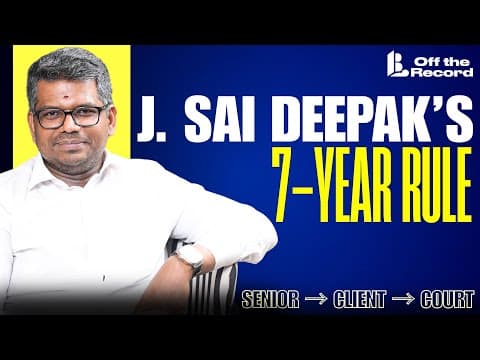
[0:00]My general calculation is, and I've said this to a lot of people who have bothered to listen to interns or whoever it is. First three years, you make yourself useful to your senior. Okay. Two years thereafter, the client should become aware of your existence and say, he's good, or she's good or they, whoever it may be. Two years after that, the court should say, they know what they're talking about. This is somebody I know. Like I, I'm used to this part. This person is not fibbing or faffing here. So, senior, client, court. If you're serious about what you want, that is the seven-year track. Saal mein log at least associate partner to ban jaate hain. So what am I saying that's different?
[0:45]Two different things. Anyway. See, the point is, there's also the question of the individual that you bring to the table. That you have, you will. I was very clear that I will not hide my views, but it's not as if I'm going to wear my view constantly on my sleeve all the time, unless it was necessary. And as long as I was associated with another entity, the simple funda was, nobody else should pay the price for your opinions. Exactly. And so, be a bit more restrained. When I went independent, I said, I will take responsibility for whatever I say from here on. And to be honest, in my previous stint as an employee of Sai Krishna Associates, my views were never stifled. Political or otherwise, I was never stifled. I was capable of and I was allowed to speak my mind on the law and things outside the law. To the extent that if I felt that something was wrong in terms of an opinion or whatever it may be, whether others felt it and didn't have the guts to say it, or they didn't feel it, that's a different issue. I would certainly make it a point to to make it known that I disagreed. And the place and especially Mr. Sai Krishna was largehearted enough to accept it. So there is a, there's a lot, I think the formative years play in terms of a role in terms of who you become as a litigant, what kind of values you grow up with, what kind of values you pass on, and what do you wish to be associated with or identified with? ki khud ki pehchan toh hogi but what your your professional purview also makes a huge difference. Yes. 2016 September is the first time I went public in terms of a proper speech on freeing temples from state control at the Press Club of India. That's when the whole thing started. So that I decided to take it up very seriously saying, now I will not hold it back because I think I've proven enough to the profession in terms of what I can do. And the profession had started reciprocating as well in terms of opportunities. I was able to go independent at the age of 30, on the 27th, 28th June midnight 2016, precisely because by then the profession had started saying, Because when you're associated with a firm, there are limitations to you being engaged obviously. Yes, yes, yes. And then there's obviously the perception of conflict, so on and so forth. So, therefore, once they started saying it, I said, okay, therefore the profession is saying, now is the time. In my own headspace, the ideal time that I wanted to go out was in 2017 because I had loans to pay back. A lot of for my brother's education so on and so forth, I was trying, he's a product of Carnegie Mellon. I was helping at least my family in whatever little I could. So I thought 2017 should be a good time because by then he'd have graduated. that's that was the goal. People, a lot of clients said, we'll help you set up a filing practice. I said, why do you think I'll do that? I want to argue in courts. I think I can do it. And that's what I will do. I will either sink or swim with this decision, that's what I was very clear about. So the initial retainers that had come my way, within six months I gave them all off, saying, I don't want a retainer. The profession will feed me, or I will not. Oh, wonderful. I gave it back. So I retained only two sets of matters with me. One is the Basmati litigation, and the second is the standard essential patent litigation for Xiaomi and uh, yeah, Gionee and Intex. And I gave them up also by 2018, I'd given them up, maybe 2020, 2021 I'd given them up. Okay. Basmati just before I became a senior, I'd given them up. In the sense the retained client was given up even then.