[0:00]Hey everyone, it's Justin again. In the last video, you learned about different types of numbers in the number system, including integers. Remember that integers are whole numbers that are either positive or negative, and also zero. Now, I want you to prepare your mind for some of the intense math we are about to do with integers in this video. Are you ready? Are you sure? All right. Here's our first challenge. I know, I know, you're probably thinking, Justin, I learned how to do this like a million years ago. And sure, you probably already know how to add two numbers together, like two plus two. But remember, these are the concepts that are working hard behind the scenes to help you get to our next lesson. And future lessons, and future math classes. So, let's make sure we have a strong understanding of the basics. In today's lesson, we'll review how to add and subtract positive integers. Notice that we are specifically talking about positive integers today. Whole numbers larger than zero. In our next lesson, we'll work with negative integers as well. Before we get started, be sure to have your PDF ready for some practice problems. Ready? Let's get into it.
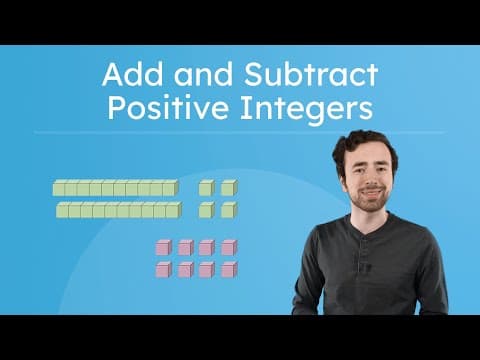
[1:47]24 + 8. This is maybe something you could do in your head, but now that we're back to the basics, let's break down what's really going on when we add positive integers. First, let's visually represent it with base 10 blocks. 24 is made up of two tens and four ones. And eight is just eight ones. Now, when we add these together, we have two tens and 12 ones. But what's another way we can think about 12 ones? 12 ones is the same thing as one ten and two ones. Now, we regroup our ones into a ten and we have a total of three tens and two ones, which is 32. Therefore, 24 + 8 = 32. Of course, you don't want to draw a picture every time we need to add numbers together, so we can represent this process of regrouping in another way. First, line up the numbers vertically, matching the place values. Then, we add each place value together, starting with the smallest place value, in this case, the ones place. 4 + 8 is 12, but since this represents one ten and two ones, we put the two below the line to show that our final answer will have two ones, and we carry the one to show that we have an additional ten. Now, we add the tens place, being sure to incorporate the additional ten from our regrouping of the ones. And there you have it, 24 + 8 = 32. Let's try some larger positive integers and see our block representation one more time. If we want to add 265 and 148, start by lining them up and adding the ones place. 5 + 8 is 13. So, we have three ones and one ten. Carry that extra ten to the tens place and add the tens together. We have 6 + 4 + 1 more ten, making 11 tens total. Just like how 10 ones makes one ten, 10 tens makes one hundred. So, we regroup in the same way, carrying the extra hundred. Last, we add the hundreds place. We have 2 + 1 + 1 more hundred, making 400. And there we have it. Our final answer is 413. These blocks are a great way to visualize what we're doing, but again, not the most practical way to add. So, let's try one more using just the vertical method. Pause the video now to try this next problem in the PDF before watching the next part of the video. This problem says to add 907 and 349 together using the vertical method. Begin by lining the numbers up vertically, being sure to match up each place value. Start with the ones, remembering to regroup if needed. 7 + 9 gives us 16, regroup the extra ten, and then add the tens together. 0 + 4 + 1 more gives us five tens. No regrouping needed here. Now, we add the hundreds. 9 + 3 gives us 12 hundreds, which means we have 1,000 and 200s. Notice that when we carry the 1,000 there is nothing else to add to it and that's okay. That just means we have 0 + 0 + 1 extra thousand, giving us 1,000. And there we have it. The final answer is 1,256.
[5:47]Now, let's talk about subtraction. Let's try a familiar problem from earlier in the video using some visuals. 24 - 8. Again, 24 is two tens and four ones, and we want to subtract eight ones. If we start taking away ones, we're going to run out of them before we subtracted the eight we need to subtract. So, what do we do now? In order to fix this, we'll do something we did earlier: regroup. But this time, we'll turn one ten into ten ones, like this. We've turned 24 into one ten and 14 ones. Now, we can take away eight ones, leaving one ten and six ones, or 16. We can also represent this with vertical subtraction. Start the same as addition by lining up the numbers vertically, remembering to line up the corresponding place values. Notice when we start subtracting, we try to take the eight away from four, like we did with the blocks. To fix this, we can borrow ten ones from the tens place. To signify this, we change the two tens we had to just one, and then turn the four into 14. Now, we can start subtracting. 14 - 8 is 6. And 1 - 0 is 1, giving us 16. Let's look at another example where the borrowing gets a little trickier. 304 - 67. Let's look at a visual while we subtract vertically. Right away, we are trying to take seven away from four, so we're going to need to borrow and turn one ten into ten ones. But we don't have any tens to borrow from. We need to go all the way over to the hundreds place and borrow from there. Let's turn one of the hundreds into 10 tens. Change the three into a two and the zero into a ten. Now, we could turn one of the tens into ten ones. Change that ten to a nine and the four to a 14. Now, let's actually subtract. Take seven ones away from 14 ones, leaving seven ones. Take six tens away from nine tens, leaving three tens. We have 200s left, giving us a final answer of 237. Just like with addition, the blocks are a great visual model, but they're not the most practical way to quickly solve a problem. Let's try one more subtraction problem just using the vertical method. Pause the video now and try this next problem in the PDF before watching the next part of the video. This problem says to subtract 2,176 from 3,004. Woo! Start by lining up the numbers vertically and by place value. Right away, we'll have to borrow, but we've run into a familiar problem. We don't have any tens to borrow. On to the next place value, but again, nothing to borrow. Let's keep moving to the thousands place. Now, we can actually borrow something. We turn the three into a two and the zero in the hundreds place to a ten. Now, we can borrow a hundred and give it to the tens place. Change the ten to a nine and the zero to a ten. Finally, we can borrow a ten from the tens place and give it to the ones. Change the ten to a nine and the four to a 14. Phew! Now, we can actually subtract, and when we do all that, we get a final answer of 828. Let's recap what we've covered today. When adding or subtracting, start by lining up the numbers vertically, matching the place values. When adding positive integers, be sure to regroup by carrying to the next place value if needed. When subtracting positive integers, watch out for situations where you need to regroup by borrowing from the next place value. Now that we've reviewed this and this, how do you think we'll do this? Or this. We'll start to learn about these types of problems in the next lesson when we incorporate negative integers. So, get ready by practicing your addition and subtraction skills with positive integers using the practice game. See you next time.


