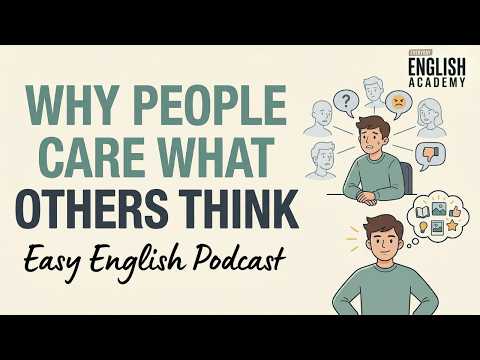
[0:06]Hello everyone and welcome back to Everyday English Academy, where we make English simple and enjoyable. I'm Sarah. And I'm Mike. Hello to all of our wonderful listeners, wherever you are in the world right now. How was your week, Mike? It was okay, but something happened at work that is still in my head. Oh, what happened? We were in a meeting. The team was discussing a project, and I had an idea. I thought it was actually a good idea, but I didn't say it. Why not? I kept thinking, what if they think it's a dumb idea? What if everyone looks at me and thinks, why did he say that? So you just stayed quiet? I stayed quiet, and then 10 minutes later, someone else said almost the same thing and everyone loved it. Oh no. Yeah, and I sat there thinking that was my idea. I was just too worried about what people would think. You know what, Mike? I think that happens to so many people more than we want to admit. It really does, and honestly, it made me wonder, why do we do this? Why do we care so much about what other people think? That is a really good question, and I think almost everyone listening right now has felt this before at work, at school, with friends. Even at the supermarket? The supermarket? Yes. I once put something back on the shelf because I thought the person next to me was looking at what I was buying. Were they? No, they were looking at their own shopping list. See, that is exactly what we need to talk about today. And by the way, listeners, has this ever happened to you? You had something to say but kept it inside? Or you changed your behavior because of a stranger? Tell us in the comments. We really want to hear your stories. Okay, so Mike, why do we care? Like where does this come from? I think a big part of it is that we want to fit in. Fit in. Yes. To fit in means to feel like you belong in a group, like you are part of the team, part of the people around you. Right, and that is actually very normal. Humans are social. We need other people. So our brain says, don't do anything weird. Don't be different. Just blend in. And it starts early, right? Like in school, you want to wear the same shoes as your friends. You want to like the same music, you want to laugh at the same jokes. Oh, totally. I remember in school I liked a band that nobody else liked, and I just never told anyone. You hid your music taste? I hid my music taste because I thought people would think I was strange. I even pretended to like songs I didn't like just to fit in.
[3:28]That is so sad, but also I did the same thing. I think we all did. We will come back to your band story later, by the way. Oh no.
[3:42]And the thing is, fitting in feels safe, but sometimes we lose a little piece of ourselves to fit in. We say what other people want to hear. We wear what other people think is cool, and slowly we forget what we actually like. That's true, and I think another big reason is, we are afraid people will size us up. Size us up. Good one. What does that mean? When someone sizes you up, they look at you and quickly make an opinion about you. Like they look at your clothes, your face, how you talk, and they decide something about you in seconds. Exactly, and that is why we get self-conscious. Self-conscious. That means feeling worried that people are watching you or thinking about you. Like when you walk into a cafe alone and suddenly you don't know what to do with your hands. Yes, or when you're eating alone and you think everyone is looking at you like, oh, that person has no friends. Nobody is thinking that, Mike. I know, but it feels like it. And that feeling actually has a name by the way. It does? Yes. It's called the spotlight effect. Ooh, the spotlight effect. Like a spotlight on a stage. Exactly. Imagine you are on a stage and there's a big, bright light on you. Everyone is watching. That is how it feels, but in real life, there is no spotlight. Nobody is watching that closely. So the spotlight effect is when we think everyone is paying attention to us, but they are actually not. Right. Scientists studied this. They found that we believe people notice us much more than they actually do. That makes sense. Because think about it. When was the last time you noticed what a stranger was wearing? Hmm. I can't remember exactly. Exactly. We don't notice other people, but we think they notice us. It's a little bit crazy. It really is. And here's something I want everyone to try. Think about your most embarrassing moment. Something that happened maybe last year. Okay. Now, do you think the other people in that moment still remember it? Probably not. They probably forgot the next day. Exactly. Your embarrassing moment lives in your head, not in theirs. They moved on. You didn't. That is so true. I still remember when I tripped in front of my colleagues two years ago, but I promise you nobody else remembers. Have you ever asked them? No, and I'm not going to because if they forgot, great. And if they didn't, I don't want to know. Fair enough. But seriously, the spotlight effect, it tricks us into thinking the whole world is watching. But the world is busy watching themselves. Everyone is the main character of their own story. They're not thinking about your story. That's a nice way to put it. Now, here is where it gets interesting because I think social media makes this whole thing much worse. Oh, I agree a hundred percent. Because before social media, you worried about what? Maybe 20 or 30 people thought about you, your friends, your family, your coworkers, and now you can worry about what hundreds of people think, or thousands, right? You post a photo and then you wait. How many likes, how many comments? Did people like it? Did they ignore it? And if you get a lot of likes, you feel good. But if you don't, you start to wonder. Is something wrong with me? Is this photo bad? Am I boring? And that is what we call validation. Validation is when other people give you approval. When they say, yes, this is good, you are good. And it feels amazing when you get it. But the problem is if you need it, if you can't feel good without it, yes. If your happiness depends on other people's reactions, that is a lot of power to give away. It's like giving a stranger the remote control to your mood. Here, you decide if I'm happy today.
[8:50]That is a scary picture. Quick question for our listeners. Do you check how many likes you get on a post? Be honest, tell us in the comments and no judgment. I check two. See, we all do it. The important thing is to notice when it starts to control how you feel. Right? Likes are fun, but they shouldn't decide if you have a good day or a bad day. Exactly. And I think social media also makes us compare ourselves too much. Oh, the comparison game. That is dangerous. You see someone's life online and you think, their life looks perfect. Mine doesn't, but you are comparing your real life to their best moments. That's never a fair comparison. That's a good point. Nobody posts the boring Tuesday afternoon, they post the vacation, the nice dinner, the perfect sunset. Nobody posts a photo of themselves eating cereal on the sofa in old clothes at 10:00 PM. But that is what real life looks like most of the time. Exactly. And then we feel like we need to do the same thing. We want to stand out. Stand out means to be different. To be noticed, to be special, but trying to stand out for other people is exhausting because what do they even want? Everyone wants something different. Exactly. You can't make everyone happy. Okay. But Sarah, I want to say something, and you might disagree with me. Oh, this is going to be good. Go ahead. I think sometimes caring what people think is actually okay. Hmm. Explain. Well, think about it. If you never cared what anyone thought, you might say rude things. You might show up to a job interview in your pajamas. You might hurt people's feelings without even noticing. Okay. You have a point, right? A little bit of caring keeps us polite. It helps us read situations. It helps us be kind. So you're saying caring about what others think is like salt. Salt? Yes. A little salt makes food taste better, but too much ruins everything.
[11:32]I like that. Yes. A little caring is healthy. It means you respect other people. You think about their feelings, but too much caring and you stop living your life, you become a people pleaser. A people pleaser is someone who always tries to make other people happy, even when it makes them unhappy. And people pleasers often say yes when they want to say no. They agree when they actually disagree. They change who they are, depending on who they're with, like different personality with different groups. That sounds tiring. It is tiring. And honestly, I used to be like that. I would say yes to everything, go everywhere, agree with everyone. And at the end of the day, I felt empty, like I spent the whole day being someone else. Because you were living for other people, not for yourself. Exactly. When I finally said no to something, it felt strange at first, almost guilty, but also a little bit free. Yes, a little bit free. And that feeling gets bigger every time you do it. And that is something I had to learn. It takes practice. So Mike, what can people actually do like, if you know you care too much, how do you start caring a little less? Good question. I think the first thing is to notice when you are getting in your own head, getting in your own head. I love this phrase. It means thinking too much until you confuse yourself or stop yourself from doing something. Right, like me in that meeting, I got in my own head. I had a good idea, but my brain said, no, no, no. Don't say it. It's probably stupid. And it wasn't stupid. Someone else said it and everyone liked it. Exactly. So step one, notice when your brain is being too loud, when it starts telling you stories about what might happen. Because usually those stories are not true. We imagine the worst, but the worst almost never happens. And step two, learn to shrug things off. To shrug something off means to act like it doesn't bother you and just keep going. Like if someone says something about your clothes or your hair, instead of thinking about it for three days, you just shrug. Move on. It's not that important. Not everything needs a reaction. And I know that sounds easy, but it is hard sometimes, especially the first few times. It is, but it gets easier with practice. Every time you shrug something off, the next time is a little easier. It's like a muscle. The more you use it, the stronger it gets. Yeah, and honestly, most of the things we worry about, in one week, we don't even remember them. So true. The comment that ruined your Monday, by Friday gone. And I think the most important thing is to just own it. Own who you are. Own it. I like this one. What does it mean exactly to own? To own it means to accept who you are with confidence, without saying sorry for it. You like something that's different. Own it. You have an opinion, own it. You made a mistake. Own it. You are who you are. Own it. Like my secret band from school. I should have just owned it. Yes. You should have said, I like this band and I don't care what you think. And you know what's funny? The people who own it, they are usually the people we respect the most. That's true. Think about someone you admire. Are they trying to fit in or are they just being themselves? Usually they're just being themselves and that confidence is what makes them interesting. Exactly. So maybe the secret is not caring less. Maybe the secret is caring more about your opinion of yourself and a little less about everyone else's. I like that. I'm doing that from now on. No more hiding. Good, because here's the truth, most people are too busy worrying about themselves to worry about you. And that is actually very freeing when you really think about it. Okay, before we finish, quick question for everyone listening. Are you more of a people pleaser or are you someone who doesn't really care what others think? Tell us in the comments. Yes, and there is no wrong answer. Maybe you are somewhere in the middle. That is normal too. So what did we learn today? We care what people think because we want to fit in. We want to belong. But the spotlight effect tricks us. People notice us much less than we think. Social media can make it worse because we start looking for validation from strangers, but a little bit of caring is actually healthy. It keeps us kind and polite. The problems start when we become people pleasers and stop listening to ourselves. So notice when you get in your own head, learn to shrug things off, and most importantly, own who you are, even if it's a weird band from school, especially if it's a weird band from school. All right, everyone. Thank you so much for spending time with us today. If you enjoyed this episode, please subscribe to Everyday English Academy and give us a like. It really helps us keep making these episodes for you. Share this with a friend who needs to hear it. Maybe someone who gets in their own head a little too much. We'll see you in the next episode. Keep practicing your English. Stay confident, stay curious, and remember, nobody is watching as much as you think. Bye everyone. Goodbye.


