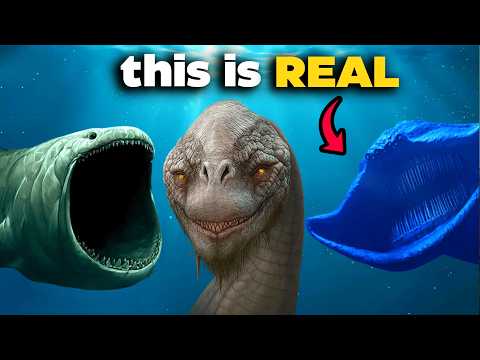
[0:00]Have you ever wondered what's hiding in the 80% of the ocean we've never explored? What if some sea monsters from legends were actually real, hiding there? Today we're looking at 10 mythical sea creatures that really existed. Four of them showed up in my older videos, but six are totally new discoveries. So stick around, the craziest ones are waiting at the end. Number 10, Kraken. As far back as the 12th century, sailors and people living near the sea told scary stories about the Kraken, a giant sea monster that looked like a squid. They said it attacked ships and pulled them underwater. The story probably began in the waters around Norway, Iceland, and Greenland. It spoke of a huge creature with long arms that could grab whales or smash large ships. The Kraken didn't just attack, it pulled ships down and made a strong whirlpool that sank everything and everyone on board. Like many old stories, this one was probably made bigger and scarier over time. But the first report of someone seeing the Kraken goes back to the year 1180. At that time, sailors didn't know about giant squids, so when they saw something strange in the water, they thought it was a sea monster that ate people. But what if the stories were true? In 1853, something big washed up on a beach in Denmark. It was a huge sea animal, the first time something like that had been seen up close, and it looked a lot like the Kraken from the old stories. Since then, scientists have asked, how many kinds of giant squid exist and how big they can get? But can any of them reach the size people talked about in the past? Think about this, animals like the Megalodon and Nothosaurus were real, and the biggest squid found so far was 43 feet long, about 13 meters. So many believe a squid that big could be real. But that's not all. In 2011, scientists found bones from very old sea reptiles. The bones were placed in a strange way. Some scientists said only a huge octopus or Kraken-like squid could have done it. One scientist, Professor Mark McMenamin, has spent years trying to show that these giant squid were real. He looked at the bones of a sea reptile called a Shonisaurus, which lived 200 million years ago. The bones weren't spread out, they were grouped together. He also saw marks that looked like they were made by squid suckers, and the neck looked broken. So he believes something big attacked it. The way the bones were placed is like how today's octopuses pull food to their homes. But this sea creature would have had to be over 30 meters long to kill and eat that big reptile. That's more than twice the size of any squid we've ever found. So, was the Kraken real? Maybe. The old stories from sailors might not be all made up. And the deep ocean, which we still don't fully understand, could have been, or maybe still is, home to a creature like the Kraken. Number nine, Leviathan. Leviathan wasn't just a myth. It's mentioned in the Bible as a sea monster so strong, nothing could tame it. But here's something even weirder. People all over the world talk about huge sea monsters. Old Greeks spoke of snakes with very long necks. But sailors in Asia and the Pacific said they saw massive shadows slipping beneath the deep dark waves. These people never met, yet described nearly the same monster. That's not a coincidence. Why did so many believe something like this existed? About 50 million years ago, a real sea snake named Palaeophis ruled the oceans. It was over 30 feet long, the size of four small cars. It lived in warm coastal waters, so people long ago could have found its bones or seen rare survivors. But scientists say, it's gone now. Still over 95% of the ocean is unexplored. So some believe distant cousins may still be alive in the deep, causing modern sea serpent stories. But Leviathan might not have been a snake at all. Some stories describe it as something even bigger. There was a giant whale called Livyatan. It had teeth as long as your hand and hunted other whales. Some believe it even fought the Megalodon and won. So, scientists named it after the famous Leviathan. Leviathan wasn't just a myth. It was inspired by real monsters like giant whales and giant serpents that once ruled our oceans. And maybe something just as terrifying is still hiding deep below the waves. Number eight, Giant Sea Serpents. Do you like snakes? Probably not. But imagine spotting one over a mile long slithering through the sea. Myths of giant sea serpents stretch across cultures, from the South Asian Naga gods to Japan's Ryujin to the Norse Jörmungandr. One of the most chilling cases comes from Gloster, Massachusetts, between 1817 and 1819. Dozens claimed they saw a monstrous creature with a long body and snake-like head. The reports described it as huge, too big to explain. Some say these sightings were just misidentified animals, the Basking shark maybe. From above, this 40-foot fish glides through water like a serpent. In fact, back in 1808, a 55-foot carcass of one washed ashore in Scotland. Locals were convinced it was a sea serpent, but the Basking shark isn't the only suspect. In 1860, another so-called sea serpent washed up in Bermuda. It turned out to be an oarfish, a creature even stranger. Oarfish can reach 50 feet long, with thin silver bodies and eerie red filaments along their spines. They lack scales, they ripple like ribbons, and they rarely surface unless they're sick or dying. At night, they rise toward the surface to feed, making them seem even more mysterious. So, what was the Gloster serpent? A Basking shark, an oarfish, or something else entirely? One thing's for sure: at sea, distance and size are hard to judge, especially at night. But every glimpse of something long, dark, and twisting through the waves has kept this legend alive. Number seven, Naga. You might have heard about snake worship in India and thought it's just an old strange tradition. But really, it's a belief based on ancient myths. The legend of the Naga goes back thousands of years in Hindu and Buddhist stories. The Naga is described as a creature that's half-human, half-snake, sometimes with a human upper body and a snake tail. Or as a giant snake with five or even seven heads. According to these stories, Naga's guard rivers, springs, treasures, and even the rain. People used to believe that respecting a Naga could bring them wealth, wisdom, and protection from snake bites. But if they insulted it, they thought the Naga might punish them with floods, drought, or sickness. Snake worship still exists today in some parts of India. The Cobra is especially important in this belief. During the Nag Panchami festival, people offer milk to snakes, following an old custom based on legend. Many temples still show carvings of Nagas with their hoods raised as symbols of this ancient practice. Some historians believe this legend began when ancient tribes saw snakes living near rivers and streams. So they imagined Naga's as guardians of water and land. Over time, this belief became part of rituals. Even today, Naga stories are everywhere, from temple art to modern TV shows like Naagin, where the Naga is shown as a mysterious, shapeshifting being. Some say these are just old stories, but others wonder, was it based on something real? Either way, the legend of the Naga still wraps around our imagination, waiting. Number six, Umibozu. A shadow from Japanese legend, a sea monk feared not for its roar, but for its silence. The sea goes still. No wind, no waves, nothing. It feels peaceful, but that's exactly when you should worry. Without warning, boom, a towering wall of water rises from nowhere. Ships vanish in an instant. But the real horror comes after. Some say if you speak to this figure, it quietly asks for a bucket. Simple, right? But hand it a regular one, and it begins filling your ship, calmly, steadily, until you sink beneath the waves. Almost like it enjoys watching your panic. There's only one way to escape. Trick it, give it a bucket without a bottom, and you might buy enough time to get away. What does Umibozu look like? Legends disagree. Sometimes he's massive, taller than sails, sometimes as huge as a mountain, rising faceless from the deep. Other times he stretches snake-like arms from the mist, reaching like wet black tendrils. Some tales even describe smaller versions that attack in groups, like evil mermaids hunting together. No matter what form he take, one thing stays the same. His arrival means danger. Today, Umibozu haunts anime, movies, comics, and video games. Science says he's just a story, but when the sea goes quiet and fog swallows the horizon, Japanese sailors remember one thing. Silence is a warning. Number five, Moby Dick. Moby Dick might seem like just a story, but it's rooted in grim reality. On November 20th, 1820, the American whaling ship Essex was sailing the Pacific when a massive sperm whale rammed it with shocking force. The ship sank, leaving 20 crewmen adrift in small boats. Hunger and thirst set in quickly. Weeks passed, and their journey turned into horror. In the end, only five made it back alive, and after being stranded for 89 days, driven to cannibalism just to survive. Therefore, while Herman Melville's Moby Dick is fiction, it's no wild fantasy. Melville drew heavily from real stories of 19th-century whalers. Sailors back then didn't just hunt whales. Sometimes, whales fought back. Whales were being slaughtered for oil, but these giants weren't helpless. Sailors told tales of furious whales that attacked ships without warning, overturning them or dragging them beneath the waves. One tale especially captured Melville's imagination, the legend of an enormous albino whale, pale as a ghost, stalking the Pacific. Sailors swore it was clever and violent, attacking ships with terrifying precision. This beast earned a chilling reputation as the terror of the seas. Melville wove these brutal truths into his masterpiece. His white whale, Moby Dick, wasn't just a creation of imagination, but a patchwork of real-life horrors, a symbol of nature striking back. Number four, Ogopogo. Deep in British Columbia, Lake Okanagan hides a creature that's kept locals curious for generations. Ogopogo, Canada's very own Loch Ness Monster. Ogopogo is described as a dark, green-black serpent, 15 to 25 meters long, with a thick scaly body, a horse-like or horned head, and a flexible neck. It moves in smooth, undulating humps, powered by a strong tail and fins, often leaving a foamy wake as it zips across the lake. The first official sighting was in 1926 when a group claimed they saw a strange shape moving through the water. Since then, blurry photos, shaky videos, and stories have kept the legend alive. In the 1980s, a $1 million reward was offered for proof. Greenpeace even argued Ogopogo should be protected like an endangered species. What's clear is that Ogopogo became a tourism magnet. Kelowna even put up a playful cartoon statue. A strange contrast to something people once feared. So what is Ogopogo? Some say it's a massive fish. Maybe a prehistoric relic. Scientists dismiss it as waves, light tricks, floating logs. But here is the thing, no one can prove it exists. But no one can prove it doesn't. Every ripple and strange shape beneath that glassy surface keeps the mystery alive. Maybe one day, someone will capture undeniable proof. Until then, Ogopogo stays right where it thrives, between legend and reality. Number three, Cthulhu. Cthulhu is a creepy sea monster from a 1928 horror story, said to haunt dreams from the depths of the ocean. But long before that tale, real sea monsters ruled the deep. One was Tusoteuthis, a massive squid-like creature that reached 40 feet long, that's two giraffes laid end to end. It had a hard shell inside, which made it stronger and faster than modern squids. It hunted giant fish and even baby marine reptiles. But like many others, it disappeared when the asteroid hit 66 million years ago. Cthulhu might be a story, but Tusoteuthis was real. And here's something to think about. We've explored only 5% of the ocean. So if monsters like that existed before, what else is hiding in the dark? Number two, Nixie. The Nixie comes from old Scandinavian and German stories. Most of the time, she looks like a human woman, but her appearance isn't always the same. Some tales describe her as an old lady with green skin, green teeth, and seaweed-like hair. Others say she's a beautiful woman, but still tinted green. She's often covered in moss, seashells, and slimy plants from the water. In some stories, she has a fish tail while swimming, but when she steps on land, she appears fully human. Still, one clue gives her away. Her clothes are always soaked, wet, dripping. People call Nixies many names, water sprites, nymphs, even mermaids. Technically all those names fit, but if you saw one, you'd probably just say, that's a mermaid. So what makes the Nixie different? Her legend goes back much further than most sea myths, and she's surrounded by ancient beliefs. Like mermaids, she's said to use beauty and song to lure sailors, often leading them into danger. But not all stories end that way. Some say she demands a human sacrifice every year. While others tell of her falling in love with people, with those stories ending in romance instead of tragedy. That might sound like pure legend, but here's where it gets interesting. For hundreds of years, fishermen in Northern Europe told stories of beautiful women rising from rivers or lakes, calling out in strange voices. Whole villages believed they were real. In some places, people even left offerings near water to avoid angering them. Historians think these stories might be linked to sightings of real aquatic animals or rare encounters with human-like shapes in the water that no one could explain. Even today, there are reports of people seeing mysterious women near lakes or rivers. Figures that vanish the moment someone gets close. No one has solid proof, but the same descriptions keep showing up over and over across time and countries. That's why some believe the Nixie was based on something real. Number one, El Gran Maja. Out of all mythical sea creatures, one beast recently emerged online, and it's quickly become the scariest legend of our time. Its name, El Gran Maja. Witnesses claim it lives somewhere deep in the Arctic Ocean, so deep that no sunlight reaches it. According to descriptions and illustrations, El Gran Maja is huge, over 2,000 feet long. That's the size of six football fields end to end. Its mouth, a nightmare, packed with hundreds of sharp teeth, wide enough to swallow a whale whole, and its face, lined with six glowing white eyes that pierce through total darkness. But here's what made people start believing. A few years ago, researchers recorded eerie sounds from deep underwater in the Arctic.
[14:16]Scientists said it was probably just ice breaking apart, but others disagreed. They heard something alive, something mysterious, calling from below the ice. The most chilling story comes from a deep ocean trip. As the team lowered a camera into the deep hole, something massive passed by. Not clearly visible, but big enough to block out the light. The footage never went public, but crew members reportedly left the mission and never returned to sea. So, is El Gran Maja real? Science says there's no proof. Yet the ocean is huge, deep, and mostly unexplored, especially near the frozen Arctic. Our fear of strange sounds, hidden creatures and endless darkness makes El Gran Maja seem not just possible, but terrifyingly real. Therefore, until we explore every hidden corner of the sea, El Gran Maja is still a scary mystery. Maybe just a myth, or maybe the greatest secret hiding beneath the ocean waves. But El Gran Maja is just a drop in the ocean. There are countless other creatures once dismissed as myth, yet proven to be real. Click here to uncover more, and prepare to question everything you thought were just myths.