[0:04]So this unit, uh unit nine is on global change. It encompasses um climate change, stratospheric ozone, ocean warming, um ocean acidification, invasive species and biodiversity loss.
[0:20]So, um global change is basically talking about any chemical, biological or physical property change of the planet, um such as uh the cold temperatures causing ice ages, climate change, global climate change is changes in the climate of the Earth.
[0:37]And global warming is one aspect of climate change, uh the warming of the oceans, land masses and atmosphere of the Earth.
[0:46]So the greenhouse effect, um is not necessarily a bad thing. It probably is what has kept our planet from becoming a frozen ice ball and has allowed life as we know it on Earth.
[0:58]However, because of the increasing amounts of CO2 due to the burning of fossil fuels, we're putting in the atmosphere, it is, um, speeding up this process greatly.
[1:07]Um, but when radiation from the sun hits the atmosphere, about 1/3 is reflected back. Some of that UV radiation is going to be absorbed by the ozone layer, um, and some strikes the Earth where it is converted into low-energy infrared radiation.
[1:21]Um, so this heat then goes back towards the atmosphere where it is absorbed by greenhouse gases that radiate it, uh, mostly back towards the Earth, to the troposphere and the surface.
[1:36]So there are several greenhouse gases. Uh water vapor, carbon dioxide, methane, nitrous oxide, ozone, and CFCs are all greenhouse gases.
[1:49]Uh some are better at trapping heat than others. Um this table shows you, uh, the, the main ones, um, that are associated with trapping heat.
[2:00]Notice that chlorofluorocarbons have a great potential for, um, caps, capturing heat and cause causing warming.
[2:11]However, thanks to the Montreal Protocol in Montreal, Canada, where the world's leaders got together and realized they had to do something about the growing hole in the stratospheric ozone layer, uh, they agreed to ban the production and use of CFCs for the most part, worldwide.
[2:29]So, uh, they are not as large of a problem as they could have been if we had not banned them.
[2:35]Um, we are trying to do the same thing with carbon dioxide emissions, but, um, because we have not had the political support here in the United States, that has not been successful as the, um, Montreal Protocol.
[2:50]But, uh water vapor is also a greenhouse gas, but it does not stay in the atmosphere that long, notice its duration in the atmosphere is only nine days.
[2:59]And that is not the, uh gas that we are producing, um in excess, that would be carbon dioxide, uh due to, uh the burning of fossil fuels mainly, and also deforestation as we cut forests.
[3:12]Methane, um we'll talk a little bit about methane. It, uh, is more powerful at trapping heat than CO2, um, and when you have anaerobic digestion going on, those anaerobic bacteria are not using oxygen like we do and the aerobic bacteria do.
[3:30]So they're not oxidizing and producing oxides like carbon dioxide, uh they are producing methane and still instead.
[3:38]And methane is a powerful, uh greenhouse gas. We are worried about the permafrost thawing because, uh, there's a lot of organic material and methane frozen, uh, in the permafrost in the Arctic region.
[3:54]And as the permafrost thaws, that means more methane being generated and released into the atmosphere. So that is a another concern.
[4:03]So there are, uh, natural greenhouse gases that will be produced and it's important to make sure the students know the difference between anthropogenic and non-anthropogenic.
[4:15]Um anthropogenic, anthropos is a Greek word meaning human, and or man, referring to humans, and GEN is a Greek and Latin word that means to produce.
[4:25]So if you see anthropogenic, that means that it is produced by man, but non-anthropogenic are the natural greenhouse gases, uh such as those emitted by volcanic eruptions, uh methane from decomposition, uh nitrous oxide from denitrification, by denitrifying bacteria, um, and water vapor.
[4:48]So this is a drawing of showing what happens to the incoming, uh, solar radiant energy, uh from the sun.
[4:57]A lot of it is reflected, well, first of all, all of the heat energy, excuse me, all of the energy that comes to us from the sun, eventually goes back out into outer space.
[5:07]It's a one-way flow of energy in and out and, uh, that's why we say that with respect to energy, Earth is an open system, because pretty much all the energy, uh, that we use here on Earth is coming from the sun, it flows in and then out in a one-way direction.
[5:24]Um, as I said, a lot of it is reflected, um from clouds or from Earth's surface, such as ice and snowpack, uh, but some of it is going to be captured or turned into, um, heat energy.
[5:39]And, uh then a very even smaller percentage would be captured by photosynthetic organisms that are producers. By the way, that reflection, the percent of energy reflected, um back into space is called the albedo effect.
[5:57]So the more albedo you have, the less heat being produced, you have.
[6:02]So anthropogenic sources of GHGs are going to be deforestation, uh from the cutting and burning of trees, uh fossil fuel combustion and cattle digestive gas emissions, um producing methane.
[6:17]This is just showing you some of the other GH, uh greenhouse gas emissions, um fossil fuels, deforestation, factories, agriculture, um and landfills as the things we have thrown away decompose.
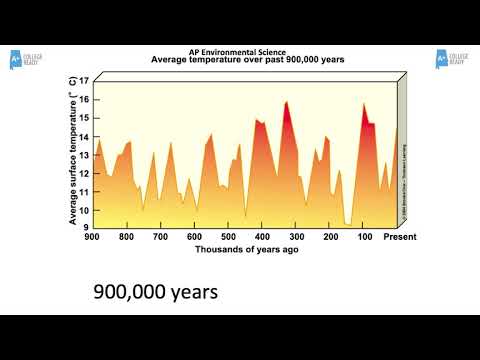
[6:35]So, um we know, um that over Earth's existence, um Earth has been around for about 4.6 billion years, and of course, in that time period, it has, uh changed greatly, going through natural cooling and warming periods.
[6:53]As you can see from, uh, this graph, uh of average surface temperature in degree Celsius is going back to hundreds of thousands of years ago.
[7:07]And so obviously, it, it has warmed and cooled, um, of course, what we're seeing now is an unnatural, uh warming due to the burning of fossil fuels and excess CO2 we're putting into the atmosphere.
[7:18]So, um this is showing you yet another, um graphic of uh temperature over the past 22,000 years.
[7:32]And over the past 1,000 years, this is the average temperature over the past 130 years.
[7:45]So just different time periods that you can use to show your students. Um, notice that at the present time, it is extremely, uh, warm.
[7:54]So some of those, uh, natural climate variation, uh factors are going to be volcanic eruptions. Uh we can actually, uh predict a cooling of, of, uh overall atmospheric temperature due to sulfur oxide particles that, um, will block some of the energy coming to the sun and small particulate matter that only lasts for a couple of years, uh somewhere around in there.
[8:22]The wobble effect, um that would be the Earth wobbling on its axis and variations in cloud cover, because clouds can reflect, uh, some of the energy, um, and of course, uh ocean currents.
[8:35]So, where does this evidence come from? Um, well, going back hundreds of thousands of years, uh students, of course, would want to know, you know, how do we record, there were no humans back then?
[8:47]And, uh there are several ways we can do this. Um, one of the ways is by drilling into the Arctic snowpack and ice, um just like when a scientist digs down into the ground, in general, they're going further and further back in time, the deeper they go, in time, I mean.
[9:07]And the same thing with, uh, the ice pack. And so you can drive a, a hollow, uh, metal pipe down into the Arctic ice pack and withdraw it, and you have a cylinder of ice that basically goes back hundreds of thousands of years.
[9:23]And every time that snow falls, um, it will capture small little air bubbles, um that is like a snapshot in time of the atmosphere during that year.
[9:36]And so by withdrawing this ice tube out, um you can go back in time and take a, uh syringe and withdraw small amounts of the atmosphere from those little trapped airspaces.
[9:51]And then inject into a gas chromatograph or a GC mass spec spec, mass spectrophotometer, or even a GC mass spec, HPLC, and get a really, really accurate idea of the CO2 concentrations and NO2 concentrations in the atmosphere at those times.
[10:10]And then doing a, uh, ratio, you can also determine very accurately the temperature. So we not only have the CO2 concentrations going back hundreds of thousands of years, but also an accurate, uh temperature as well.
[10:25]So, um the equator, uh is at zero degrees latitude and that is where you have, um, the most energy per, uh square meter striking Earth.
[10:38]And so, obviously, more heat is generated there, and this heat is then spread north and south away from the equator, um, in large part due to ocean currents.
[10:50]Uh they carry warm water with them, um, and that actually can warm the air above them, so you may have some areas in the world where you think it would be extremely cold, but are not or are fairly mild, such as, uh, the British Isles.
[11:07]Thanks to, uh, the warm current of water that that goes from, uh, across the Atlantic Ocean north.
[11:17]So, um what, what is it that we breathe? What is in the troposphere?
[11:22]The troposphere, of course, is that layer of the atmosphere where weather occurs and it's where we're located.
[11:29]And, um it is made up primarily of nitrogen gas, diatomic nitrogen, or sometimes called atmospheric nitrogen, makes up 78%. Oxygen 21%.
[11:39]And all the rest are going to be less than 1%, but that would include carbon dioxide, water, carbon monoxide, uh, etc.
[11:48]This graph, um has been on the AP Environmental Science exam, uh several times, but this is showing you the CO2 concentration.
[11:57]A scientist started measuring, um, CO2 averages decades ago, um, in Hawaii.
[12:06]He wanted to, uh find an area that was not close to, uh large amounts of traffic, cars, factories that might skew the CO2.
[12:16]And so, uh he chose the middle of the Pacific Ocean. But, um, notice that it rises and falls, and of course, uh one of the questions one year was, why is it that this, you see this seasonal fluctuation?
[12:30]And of course, uh that would be due to the fact that in the spring and summer in the northern hemisphere, um, you have large amounts of trees that will absorb the CO2 in the spring and summer.
[12:43]And many of these trees are deciduous. So, in the fall and winter, they drop the leaves, they're no longer absorbing CO2 for photosynthesis, and so, you see the CO2 go back up.
[12:57]Um, the, uh, thing you should also point out, however, is that even though there is a fluctuation seasonally, that every year it rises a little bit more than what it falls.
[13:08]And so you have a overall trend upward in CO2, uh due to, um CO2 emissions from cars and trucks and the burning of fossil fuels in general.
[13:20]So this is an overlay of carbon dioxide and temperature. We know for a fact that carbon dioxide traps heat and this shows you that, um, they are very closely linked together.
[13:34]If the carbon dioxide concentration goes up in the atmosphere, the temperature will also.
[13:41]This is showing you, uh January to December, December, global mean temperature over land and ocean.
[13:49]Uh this is from NOAA.
[13:52]And this is showing you the albedo effect that I was talking about. So clouds are going to reflect, uh a significant amount.
[14:01]Um snow and ice will also reflect a lot of the energy coming from the sun back into space, um, and that is called albedo.
[14:10]So, one of the, I do want to point out that a positive feedback system is one in which, uh, basically, you are increasing in one direction.
[14:24]Um, so an example would be, uh, if you, if there is snow and ice pack melting because of a warming Earth, that means less reflecting of the light energy, um, due to albedo, um, which means more heat generated, which means more melting and less ice and snow, and so on and so forth.
[14:51]This is just kind of a summary graphic of all the things that can emit CO2 and greenhouse gases into the atmosphere, but also where some of them are stored.
[15:03]So the direction of the arrow shows, uh, that happening.
[15:08]Um, the negative feedback, um would be, uh, if you increase the atmospheric CO2, that could increase plant growth, and plants will absorb, uh CO2 for, um, for photosynthesis.
[15:23]So increased plant growth increases uptake of CO2 from the atmosphere, thereby decreasing the amount of CO2 in the atmosphere. That would be a negative feedback system.
[15:32]However, many scientists have pointed out that there is a limit to how much CO2, um plants can absorb.
[15:40]Um, once you get up to a certain concentration, it's maxed out.
[15:45]And this is the positive feedback system that I was referring to, the permafrost and, um, glaciers and snowpack melting.
[15:58]Uh, one thing I'll do want to point out, and you can point this out to your students, um, if you take a glass of water with ice cubes floating in it, and mark the level of the, the water.
[16:09]Um, and then allow the ice to melt and come back and look at where the water level is, it will be the same place. And that's because of the unique characteristics of water of and ice.
[16:19]However, um, any ice that is on land that melts and runs off into the ocean, that would contribute to, uh a rising sea levels.
[16:31]Now, if it's a iceberg floating in the water, no, that will not.
[16:36]However, um, we also know that the Antarctic, which is a continent of land covered in ice, and Greenland are both melting and losing ice cover every year.
[16:49]These are pack ice predictions. You can see that they are decreasing and predicted to, uh continue to, to decrease and alarmingly at a faster and faster rate.
[17:02]This has actually, um, some has some people seeing that as a good thing, uh because this may open up a Northwest Passage instead of East West.
[17:12]There's also a race now to claim the bottom of the ocean floor in the Arctic region, uh for possible drilling for oil and natural gas, which, of course, would exacerbate the problem of CO2 emissions.
[17:26]But one thing that I would definitely point out to my students, and this I've seen on an AP exam, is that the number one cause of increasing sea levels from a warming Earth is going to be the thermal expansion of water.
[17:42]So, uh, as the ocean surfaces warm up and expand slightly, the ocean is so vast, it, it ends up being a significant expansion and therefore a rise in sea level.
[17:55]Um, there's another, uh, created another PowerPoint, um, and narrated specifically on ocean acidification.
[18:04]Um, but basically, as more CO2 is emitted into the atmosphere, that means that more CO2 will be dissolved into the water, and, uh, we know that when CO2 just like sulfur oxides and nitrous oxides, when they react with water, uh, they can turn into their acid forms, such as sulfuric acid, nitrogen, uh, nitric acid, and of course, carbonic acid.
[18:27]So due to carbonic acid increasing in the world's oceans, they are acidifying, and they refer to that as the acidification of the world's oceans.
[18:36]And, uh this limits the ability of marine life, um, from creating shells from calcium carbonate, and, uh, this is, uh, alarming.
[18:47]One of our most productive regions on Earth are our coral reefs. Corals are actually, uh, animals in the phylum Naria that are soft-bodied animals, but they're able to secrete calcium carbonate shells for protection.
[19:00]And they live symbiotically with algae, and so they're very productive areas of the world's oceans, um, but we are seeing our, uh coral reefs around the world, uh decline.
[19:12]Um, and another phenomenon due to, uh, temperature increase and acidification would be, uh coral bleaching, where the coral release the algae, um, and it appears as if they have been bleached, because the algae was giving them their color.
[19:34]Another, uh, result from warming, um is going to be not necessarily an increased number of storms, but the, uh, increasing intensity of storms and hurricanes.
[19:46]As predicted by the IPCC, which is the, uh, International Panel on Climate Change. That is a collection of scientists from around the world that get together every few years and compile and pour over all the data that has been, uh, collected since the last meeting that they've had.
[20:05]And I have been, uh, reading these, uh, for about two decades now, and the wording, uh, in, in these writings, uh, the, and they publish a report.
[20:15]Um, I'm becoming more and more dire, and their confidence in what is happening is, uh, becoming greater and greater as well.
[20:23]Uh, another result of warming would be the increased incidence of El Nino, which, of course, can cause drought in some areas and flooding in others, uh, dust storms and forest fires.
[20:34]Another result would be changing, um, range of many species.
[20:44]And one of the things that we have, uh, been looking at is how many species cannot tolerate, uh, freezing.
[20:53]Or, you know, they have a minimum temperature that they can tolerate. So, as the Earth warms, uh the range of some of these species that at one time were relegated to areas closer to the equator, they're warmer, now they're expanding.
[21:21]And some of these species are insects that could be vectors for disease. Of course, a vector is not what causes the disease, but carries it. So, the mosquito, we know is a vector for many diseases, including, um, malaria, West Nile virus, and the Zika virus that we've heard about more recently.
[21:40]So, with warming weather or warming Earth, uh the spread of these infectious vectors and the diseases associated with them.
[21:50]Saltwater intrusion, um we, uh actually could see that here in Alabama, um, and Florida and Australia along the coastlines, typically is where you see it.
[22:00]Um, but you have freshwater aquifers below ground, um, even on the coastline.
[22:08]However, because, uh, of the sheer presence of the freshwater in these aquifers, it, it creates a force that is that counteracts, uh, the tendency of saltwater to intrude in from the sides below ground.
[22:23]So, if we create a situation where these, uh, underground aquifers are in an overdraft, an overdraft is, uh going to be the same thing like when you have an overdraft in your bank account, you know, you're taking out more than what you're putting in.
[22:38]Well, that's bad also in if you're talking about rainwater and surface water, uh feeding into the aquifer system below ground.
[22:47]So, basically, if you're withdrawing more water from the ground than what nature, faster than what nature can replenish it, then you're going to put, uh it into an overdraft and, uh the water table will begin to drop.
[23:01]And if it, it can drop to a point where it's no longer holding back the sea, the salty seawater, uh from the sides and it can move into the remaining water that's in that aquifer and, uh, um, basically, ruin it because now it has salt in it.
[23:20]And that's called saltwater intrusion. Now, of course, you can remove the salt from saltwater, but that's, uh very expensive.
[23:27]You can do that through distillation or through, uh reverse osmosis, basically a type of microfiltration, but both of those are extremely expensive.
[23:37]So, what can we do? Well, we can reduce deforestation, uh we can plant trees, we can, uh reduce fossil fuel combustion, that's probably number one.
[23:47]We can conserve energy, uh switch to renewable fuel sources, and eat lower on the food chain.
[23:54]Um, it takes a whole lot more energy and water and pesticide and herbicide and fertilizers and land area to raise a pound of beef than it does a pound of wheat or corn or vegetable.
[24:07]So global biodiversity is, uh, another part of, of unit nine.
[24:14]And I would like to point out that Alabama is in the top five in biodiversity in the United States, and that is not by land area, that is just by state.
[24:25]So if we were to go by land area, it would be even higher. And there are many reasons for that. We have five major different geologic regions, that's one reason.
[24:36]Um, but we also have many rivers that have become isolated from one another over time.
[24:43]And so, because of the geographic and therefore reproductive isolation, you end up with many different species of, of these freshwater organisms.
[24:54]So, resulting from that, Alabama is number one in freshwater fish species, uh number one in freshwater mussels, uh number one in freshwater turtles, and several others as well.
[25:06]And so we are a very diverse state, uh biologically speaking, and we should be protecting it.
[25:14]Um, unfortunately, not only are we in the top five in biodiversity, we're also in the top five in extinction rate.
[25:21]So, when we lose something locally, when we lose a species from a local area, that is called extirpation. That does not mean they're wiped off the face of the Earth.
[25:29]That means you have lost them from a local area. Um, if you lose them globally, however, that means they are extinct, they are gone forever.
[25:40]So, endangered species, uh means that there's so, uh so few individuals left that they soon could become extinct if something is not done.
[25:48]Threatened means that they're still abundant, but they're likely to become endangered soon. Um, and many of these endangered and threatened species are, uh K-select species, which typically have a more narrow niche, uh lower reproductive rate, and so on and so forth.
[26:16]So, um, these are just some of the endangered species. Uh there are many, many more than this, of course.
[26:26]Um, many people are familiar with the giant panda. Basically, the large animals get more attention than the smaller animals.
[26:33]Uh the Whooping Crane, I would like to point out, is a, is a very endangered species, but we have, um one of the largest, uh migratory flocks, uh that comes through Alabama.
[26:44]In fact, they're in Alabama now at the Wheeler Wildlife, uh, refuge near Decatur, Alabama.
[26:52]These are percentages of species involved in the sixth great mass extinction. We have had five mass extinctions on Earth, and we are currently in the midst of the sixth great mass extinction, but this time it is not because of meteors slamming into Earth.
[27:06]It is because of the activities of humans, mainly the habitat destruction due to human activity.
[27:12]Um, why should we be concerned about this? Well, they perform many ecological services for us. They keep the system functioning as we know it.
[27:24]Um, these endangered species are not just animals, they're also plants. Um, some of them could be sources of medicine.
[27:30]Um, some of them and of course, they produce a large amount of O2 and absorb CO2. Um, and produce oxygen. Uh, we also need them for economic worth, uh, like ecotourism, for example.
[27:45]Uh the country of Costa Rica has been very good about protecting large sections of the rainforest, so that they can get, um, not just a one-time occurrence of influx of money like if they were to deforest like many countries around them do.
[27:57]But, uh, it's a yearly thing because they know that there are many people that will come to see their rainforest because they're diminishing very quickly on Earth.
[28:10]Um, and then, of course, there's the intrinsic value. As EO Wilson says, um, he coined the term biophilia, and I would like to point out that EO Wilson is a native of Alabama.
[28:22]He's one of, uh, our most famous, uh, scientists in the world, and he actually discovered, um, at the age of 13, the fire ants in Mobile.
[28:34]They were introduced in Mobile, uh, and at the age of 13, he actually was the one that discovered them, but anyway, he went, he graduated from the University of Alabama, got his PhD from Harvard, taught there for over 20 years, and is a professor emeritus there now.
[28:49]But, he claimed, uh, he coined the term biophilia, um, you know, things deserve to exist, uh by right.
[28:58]So I changed the slide up a little bit. I had to add a C in HIPPO. Uh these are causes of premature extinction.
[29:07]Um, personally, I think they're a little redundant. However, I will go over each one. Habitat destruction, degradation and fragmentation, um is number one.
[29:17]So these are in order of importance. Uh fragmentation has really been highlighted in the, the new curriculum for AP Environmental Science.
[29:25]And basically, it's talking about how you take one, uh, one habitat and carve it up into separate habitats that are smaller, either by building roads through them, or neighborhoods, or whatever.
[29:41]And now you, instead of having one large population of a species that can roam throughout the range and reproduce, now it is carved up into many smaller populations, which is not healthy, uh because you have, uh, lowered their diversity genetically.
[29:57]You can, however, build corridors to join those, uh fragmented areas, and that is one of the things that E.O. Wilson also has been pushing.
[30:06]And one thing Costa Rica has been doing, um is joining the habitats that have been fragmented by protecting corridors so that you can have migration and movement from one habitat to another to help them, uh get together to reproduce basically, and, uh, mix those genes.
[30:25]I is invasive species, uh as we've already, uh mentioned, uh the the fire ant came into the port of Mobile.
[30:35]And it's been spreading very quickly. I think on average of five miles a year. It is, it was halted, um, well, let me rephrase that.
[30:44]Uh the African honeybees that were hybridized were, uh, I remember as a kid in the 70s, there were many movies made about these aggressive, highly aggressive bees, and I was convinced that's how me and all my family and friends were going to die one day.
[30:59]But their spread was halted by cold temperatures. And so, uh, we haven't heard a whole lot about them over the past 20 years or so, but now with, uh, our temperatures increasing, that may become a problem again.
[31:17]Probably the most familiar here in the state of Alabama, uh as far as invasive species go, will be the Kudzu Vine.
[31:26]I would like to say that introduced species are introduced sometimes, uh by accident, sometimes on purpose.
[31:32]Um, so many times they're introduced by accident when they come over with shipments of plants or other things, cargo, um, or in the, uh, you know, they may be on the holes of boats and whatnot.
[31:46]Um, but Kudzu was introduced on purpose to try to control soil erosion, and it grows very well, um, and it actually causes problems by growing over plants and trees and blocking out the sun and the plant's die because they cannot get the energy from the sun for photosynthesis to stay alive.
[32:05]Also, I would like to point out that just because a plant or an animal or introduced, that means it's normally not found in that area. Uh, it does not mean that they will become invasive.
[32:17]In fact, most plants and animals do not become invasive. Um, but some of them do.
[32:21]It's when they cause an ecological disturbance that they are, um considered to be invasive.
[32:34]All right, the population growth of humans. Um, our population is growing exponentially and has been, uh since the Industrial Revolution. And, um, more humans means more consumption of resources and more pollution, um as well as more fragmentation of habitat.
[32:53]And we just talked about pollution. I added C for climate change. Um, that's one of the biggest, longest-term, um, problems that we will have to depend, I mean, uh, deal with.
[33:07]And then O is for overharvesting, that could be, uh, overfishing, overhunting, overconsumption, overexploitation in general, um,
[33:19]Cites, there are cites is the convention on international trade of endangered species, that's to prevent, uh the sale and trafficking of endangered species across international lines.
[33:31]Uh 1975, 169 countries listed 900 species that cannot be commercially traded.
[33:36]The Endangered Species Act was, uh passed by the United States and, uh it forbids federal agencies, uh to carry out or fund projects that would jeopardize an endangered species.
[33:48]It also made it illegal to hunt, kill or collect endangered species or threatened species.
[33:55]So, we can attempt to maintain species in many different ways.
[33:59]Those that are endangered, we can, uh we've started gene banks, um, zoos have changed their mission statement over the years. Now, it's not just to go look at, uh animals.
[34:11]But it also, they have, um, breeding programs for endangered species, but also they have created gene banks that will store, uh DNA, um, and then botanical gardens are doing the same thing.
[34:25]The problem I would like to point out with this is that, um, what good is it if you ever have a, a breeding program for an endangered species if there's no way to release them back into, uh because we've of, you know, we've destroyed their habitat.
[34:44]So we're finally realizing now that you can't just try to breeding programs, you have to protect the habitat.
[34:50]Or not for one, there's nowhere to release them to if, if you don't protect the habitat, but also there's a lot of other species that, um, an endangered species will be dependent upon, so we need to protect them as well.
[35:03]Um aquatic biodiversity, uh, we've already talked about coral reefs are extremely diverse. Estuaries are where freshwater, uh meets salt water and creates, um, an a very unique, uh area. You only find animals and plants, uh living in those, they're indigenous to those areas.
[35:24]The water there is called brackish water because it is not as salty as salt water, not as fresh as fresh water, and then the abyssal zone is the deep, deep, deep ocean where we see all those strange other worldly looking animals like anglerfish.
[35:38]But all these provide ecological and economic services to us.
[35:42]And these are just some of the marine examples.
[35:46]And freshwater examples.
[35:50]So approximately 20% of the coral reefs are gone. Um the past 100 years sea levels have risen 10 to 25 centimeters. Um 33% of our mangrove forests have been destroyed for shipping lanes, mainly.
[36:05]Um bio-invaders caused 66% of recent fish extinctions in the US. Uh 50% world populations lives near a coast. 80% of ocean pollution is from land-based human activities, which is surprising to some students.
[36:20]They would like to say it's, uh, you know, uh oil spills or, uh, cruises that dump trash or human waste.
[36:30]But by far, the the leading cause of ocean pollution is going to be run off. Those are non-point sources of water pollution that have resulted in, uh things such as the dead zones at the mouth of the, uh, Mississippi River and the Gulf.
[36:44]Overfishing, 75% of fish species have been overfished. Uh big fish are becoming scarce. Uh smaller fish are next. 30% of all fish catch is bycatch.
[36:55]That is, uh, where you may be fishing for tuna, but you catch shark instead. And a lot of times, the sharks are just killed and thrown back in.
[37:04]So there are different ways you can do this, uh to try to avoid that. There have been special traps that have been, uh, designed.
[37:13]Um, there are, uh, you know, now we have aquaculture to raise fish instead of capturing them.
[37:20]And, um, that is it. Thank you very much.