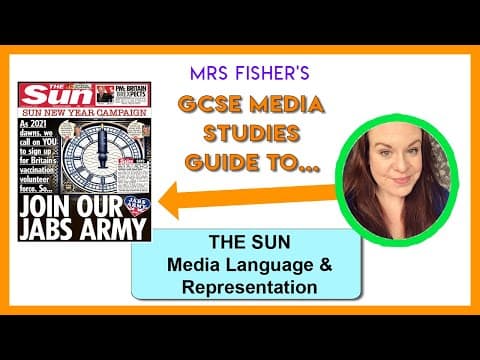
[0:00]Hello and welcome to my easy to understand guide to this Sun front cover with a particular focus on media language and representation. This video is going to be particularly relevant for you if you are studying the Educast GCSE exam board, as this front cover will be a set text from 2024 onwards. So the first thing to look at is the masthead. The masthead the sun suggests that this newspaper is powerful, much like the sun in our universe. It is the center of our universe and it is something that gives us life, so that gives you a little bit of an idea of how they want you to view this newspaper. Because the sun is hot, might also suggest that all the news in this newspaper is very hot and therefore very up-to-date. There is a kind of tagline or slogan, um some people call it a strapline, just underneath the masthead, which says the people's paper. And that makes it sound like this newspaper is aimed very much at British people, um that it's somehow patriotic and nationalistic, and that ties in with a lot of the values of the Sun newspaper. The price is here too, it's quite small. I guess they're trying to make that seem quite insignificant and therefore a low cost. And the fact that this is a reasonably inexpensive newspaper, it's suggests that um it's going to appeal more to a kind of working class audience. The red colors of this newspaper make it very identifiable as a tabloid. Some people know them as red tops. And so the red and white kind of color palette here on the newspaper in general uh will really kind of stand out and be familiar to an audience looking for a tabloid style paper. In the top right-hand corner of the front cover, there's a kind of small article featured with Boris Johnson doing a kind of thumbs up um body language pose here. Because this article is about Brexit, um and he's got the thumbs up, it does kind of suggest that, um, you know, this is something quite positive. And it reflects the context that the Sun was very much in favor of Brexit when uh we were leading up to the referendum. The use of the word uh promise in the caption underneath the photo makes him seem quite trustworthy, um makes it seem like um, you know, he's going to do something good for us and that he's going to keep his promises. And uh that kind of anchors the meaning of the picture for us. And then in the actual kind of copy of the uh article, the small snippet of the article itself, it uses the word turbo charged. Um, and that kind of makes it seem like he's going to be super powerful at getting things done. The way they put these kind of little snippets of stories and then they say like for the full story, turn to page. That acts as a kind of enigma code for audiences, it it hooks people in, it draws them in, it makes them want to read the full story. So these are almost like adverts on the front cover of the paper. Hoping to engage readers, make them buy the paper and therefore read the full article inside. The strapline above the main cover article says uh the Sun New Year campaign, which makes it seem like this is something they've organized. And that gives the illusion that this um company that this newspaper is powerful, that it's involved in in setting policy for the country, and that they are a very proactive newspaper that um is all about campaigning and getting things done. The headline itself, uh is obviously very large, but quite bold, attention grabbing in its kind of sans serif font. Um, and that's a great way of drawing in readers. It's very simply worded as well, um doesn't use long words or complex terminology, so it perhaps reflects the fact that the readers of the Sun have quite a low literacy level on average. And that's backed up by the fact that there's lots of big images and large headlines, but actually very small amounts of copy, I.e. text on the front cover as a whole. The phrase Jabs Army is a kind of pun or a play on words in relation is kind of an intertextual reference to the TV show Dad's Army.
[4:09]Um, and so uh this TV show was about kind of soldiers fighting for Britain uh during the war, um and so it perhaps targets, because it's quite an old TV show, perhaps targets an older target audience, who would potentially understand that reference. But it also makes it feel as though this campaign is very British and patriotic. And it reflects this whole theme that they're setting up, this narrative on the front cover, of the idea that this is a war. Um, and that Covid is the enemy and that we are the soldiers, we are the heroes fighting against Covid. The use of the word "our" in that um headline makes it feel like the Sun again is very involved and as though they organized the vaccine. So it's supposed to, I guess, represent the newspaper as being quite powerful. In the other text as part of that headline, they use direct address towards the audience and that helps the audience to make him feel as though they're very involved in the campaign. We get lots of British references and British iconography on this cover as well. As Dad's Army, we've got a reference to Britain's vaccination volunteer force. We've got an iconic image of the face of Big Ben and we've got the British flag down there as well. And so all of this is creating the idea that this newspaper, um, and its readers are very focused on British values. The use of the clock, um is is a kind of metaphor to make it feel as though um time is ticking. It makes it feel very dramatic, um with the kind of needle pointing to midnight and it talks about how as 2021 dawns. Um, so it's this idea that we're counting down that this is very urgent. There are several quotes, pull quotes from celebrities on the front cover. Um, and these celebrities have been chosen first of all because use of celebrities is quite engaging for an audience. But also you've got both a male and a female uh TV presenter, um and Gary Lineker is also been a sports person in the past too. Um, and so um that's going to draw in people who generally tend to watch daytime TV, people who are interested in sports. Their age, um, you know, you're talking about people who are in their kind of fifties, um, and so, um that's going to draw in it kind of targets that audience of the sun as well. Both of the celebrities mentioned have also been quite personally involved in the fight against Covid too. So Gary Lineker actually raised a large amount of money and donated quite a lot of his own money towards fighting Covid. And so he's quite known for being outspoken um against the virus. And Kate Garraway um is quite famous because her husband contracted Covid and ended up incredibly seriously ill in hospital. And she talked about this quite a bit when she was presenting on television. And so it's this idea that these people have been very involved in the virus, and therefore, that they um are somebody that we should trust. The use of the words the Sun says, suggests that the Sun's opinion is very important. They use some flattery here in the beginning, in the kind of um lead paragraph here, they say our fantastic readers. Um and of course flattery is a good way of engaging your readers. There's some emotive language going on here as well. They use the word terrible, for example, just makes it feel more dramatic and more urgent as well. They actually say within this um kind of small introductory part of the article that this campaign is backed by the NHS and the government. And that gives gravity and seriousness to the campaign, it makes it feel like we can trust the campaign and we can trust the vaccine. They reference some numbers within this section as well. They talk about the number of volunteers, the number of vaccines, and that use of statistics makes it seem very persuasive as though this is a very big campaign. The heart shape here um really again suggests that if you were to go out and get this vaccine, you would be going to become part of this kind of Jabs Army, that you would be doing it out of love for your country, and that you would be the kind of loving, caring person. There's lots of military references here creating this real narrative. So really creates a narrative that is themed around war and fighting. And that kind of creates these binary opposites between Covid, which is essentially being painted as the villain or the enemy here, and us as the general public alongside the newspaper, the Sun, who are the kind of heroes or protagonists. So that was my easy to understand guide to the copy of the front cover of the Sun newspaper. Don't forget to check out my channel for more videos that might be relevant for you for GCSE media studies, and indeed also uh lots of videos about theories, keywords, and other set texts. If you've got any questions, just leave a little comment below and I will see what I can do.


