[0:06]Welcome back to ScienceClic. Today, quantum electrodynamics.
[0:14]When two electrons get close, they repel each other. This explains why we don't fall through a chair when we sit down. Why we can exert a force on an object. And why the air exerts friction on a feather. Apart from gravity and radioactivity at the nuclear scale. Almost all phenomena in the universe can be explained by how electrons behave. At first, one would be tempted to describe this repulsion by a force, the electromagnetic force. But electrons are not small marbles that would obey classical mechanics. They are quantum objects, particles, and to describe their interactions, it is necessary to reconcile electromagnetism with quantum physics. To this end, in the middle of the 20th century, the most precise model ever created in the history of physics was developed. An elegant model, which allows the use of simple diagrams to calculate with astounding precision, the most fundamental phenomena of physics. Quantum electrodynamics.
[1:28]Quantum electrodynamics is an example of a quantum field theory. We consider our universe as a sort of box, space-time, which contains two fields, fluids made up of mathematical objects. The electron field and the electromagnetic field. Within these fields move about small packets of energy that can appear or disappear, called particles. Electrons, for example, are disturbances that propagate like waves inside the electron field. The electromagnetic field also contains disturbances, quanta of energy, which can appear or disappear. Photons.
[2:21]The field of electrons and that of photons are of a different nature. The mathematical objects from which they are made up are not of the same type. The electron field in particular is made up of spinners. Rather abstract objects that are described by complex numbers. To simplify, we can imagine a complex number as having a size, as well as a color, its phase. When an electron propagates in the field, the phase of complex numbers rotates over time. This is called the electric charge. Electrons have an electric charge, which transcribes the fact that their phase turns as they move towards the future. Apart from electrons, this same field can also contain disturbances whose phases turn in the other direction, towards the past. In a way, we could say that this is an electron, but which is moving in the opposite direction, towards the past. From our point of view, the phase of this particle seems to turn in the opposite direction. We perceive an opposite electric charge. This is called an anti-electron, a positron.
[3:53]On the other hand, the photon field is formed of vectors, which are expressed with real numbers. They are just ordinary numbers which have no phase. So photons have no electric charge.
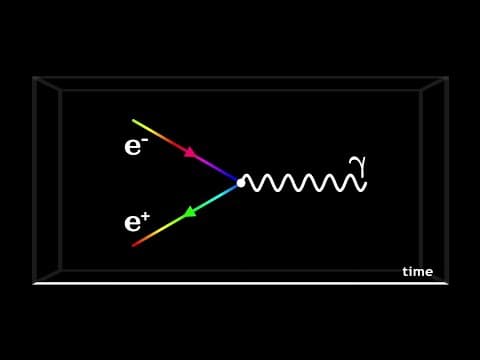
[4:18]To understand how electrons interact, imagine that we place two of them at the start of our quantum field. In order to schematically represent the content of the universe, it is convenient to use lines to symbolize the movement of particles. A line with an arrow towards the future, to symbolize an electron. With an arrow towards the past, in the other direction, to symbolize a positron, and a wavy line to symbolize a photon. To describe how particles evolve, quantum electrodynamics allows our two fields to interact using interaction vertices. An interaction vertex involves a photon and two particles of the electron type. These can be electrons or positrons, depending on their orientation with respect to time. Such a vertex can symbolize an electron which emits a photon. An electron which absorbs a photon. A positron which emits a photon or absorbs a photon. Or even an electron and a positron which annihilate into a photon, or a photon which converts into an electron-positron pair. All these interactions are allowed, provided that for each vertex, the overall momentum of the particles in space and time before and after the interaction remains the same. The electric charge must also be conserved. Each interaction necessarily has an arrow that enters, and another that leaves the vertex. By allowing our two electrons to interact with these kinds of vertices, we can then imagine a whole variety of different scenarios. In the simplest scenario, the two electrons continue in a straight line. In another, more interesting scenario, the two electrons exchange a photon, which acts as a messenger carrying part of the momentum of the first electron to the second electron. It is important to note that particles behave like waves. They can be exchanged along one direction, even though they carry a momentum which is oriented differently. That way, in some scenarios, the exchange will bring the two electrons closer.
[6:59]And in other scenarios, the exchange will push them apart.
[7:10]We can then imagine more complex scenarios, which involve many points of interaction. Electrons can exchange several photons, at different places and at different times. Sometimes, a photon converts into an electron-positron pair, which annihilates to form a photon again. We call this a loop. An electron can also emit and then reabsorb a photon. As long as the overall momentum and electric charge are preserved. All imaginable scenarios, an infinity of more or less complex possibilities can occur. And if we stop the evolution of the field after a certain time, to look at the outcome of each scenario. We sometimes find our two electrons, and sometimes more particles with some having appeared between the initial and final instance. Each of these scenarios, which start from an initial situation and reach a final situation is called a Feynman diagram. Feynman diagrams transcribe the different possible evolutions of our quantum fields from a given initial situation. Apart from the initial and final particles, which are real particles that can be detected, the particles that act as messengers within these diagrams are said to be virtual. These are particles that cannot be detected, and they can exhibit some rather strange properties. They only serve as intermediaries to describe how our two electrons interacted at a distance. Mathematically, each scenario, each Feynman diagram, corresponds to a very rigorous equation. And virtual particles are only a way of interpreting intuitively certain parts of the equations. That said, although they are only intermediaries, resulting from our mathematical model, it is essential to consider these virtual particles because they account for the interactions of the fields and therefore, how electrons behave. Let's summarize what we have so far. We describe a space-time which contains two fields, that of electrons and that of photons. From an initial situation with two electrons. We are interested in all possible evolutions, allowing interactions that link a photon to two particles of the electron type. From this, we can create a catalog, a list of all the possible diagrams. There are infinitely many. Some are simple, contain few interactions, and others are more complex, involving many interactions. But this doesn't help us too much. If we wish to predict the actual behavior of electrons, we'd like to know which of these scenarios actually occurs. If we carried out the experiment, is it this scenario, or this other scenario that would occur? The answer to this question is subtle and may seem counter-intuitive, but it is precisely what makes quantum theory so powerful. Our universe does not follow just one of these scenarios. It evolves at the same time according to all possible scenarios. In a way, starting from a given initial situation, all possibilities occur at the same time, in parallel, as a superposition of every imaginable scenario. To describe the behavior of electrons, it is necessary to take into account all Feynman diagrams.
[11:21]In quantum electrodynamics, each diagram corresponds to an equation, which allows us to calculate a number for each scenario, an amplitude. We can imagine the diagrams as layers and their amplitude as a sort of opacity that sometimes adds up constructively, and other times destructively. The many different scenarios have different amplitudes, but for the sake of calculations, we can usually neglect the more complex scenarios, considering only the first few simplest diagrams, and still get reasonably accurate results. It is by performing the sum of all these scenarios with their different amplitudes, as if we superimposed more or less opaque layers, that we obtain the real evolution of the physical system. When we carry out the experiment in the real world, if we throw two electrons and observe them a little later, the amplitudes of each diagram allow us to calculate the overall probability that we observe a specific outcome as the output of our experiment. And in particular, the most likely outcome is that we observe our two electrons with slightly different momenta. They repelled each other. In a way, Feynman diagrams are not so much descriptions of real phenomena, but rather very powerful tools that allow us to calculate the probability of observing such or such an outcome. We have a greater chance of finding our two electrons with outward momenta. The most likely outcome is that they repelled each other, thanks to the exchange of virtual particles. At our scale, we have the impression that the two electrons undergo a continuous force. While fundamentally, this force is only the probabilistic synthesis of all possible interactions, in which the electrons exchange motion through virtual particles.
[13:36]To conclude, quantum electrodynamics is a complex theory. But it allows us to predict in an astounding way how electrons, positrons and photons interact. By synthesizing all possible scenarios with their different amplitudes, this theory explains and predicts at the fundamental scale all the laws of optics, the behavior of light when it interacts with a material. Maxwell's equations, which govern electric and magnetic fields, and interactions between electrons, from which at our scale, almost all forces arise. Historically, this model was the first great success of quantum field theory. By describing matter as quantum fields, interactions as virtual particles, and proposing a very elegant calculation method based on diagrams and amplitudes, quantum electrodynamics has in particular allowed scientists to predict with an unprecedented precision the way in which an electron reacts to a magnetic field. Through virtual photons, the magnetic field causes the spin of the electron to precess. And this precession motion is perfectly predicted by quantum electrodynamics to almost 10 significant figures. To this day, all theories considered, this is the best verified experimental prediction in the history of physics, the anomalous magnetic moment of the electron.


