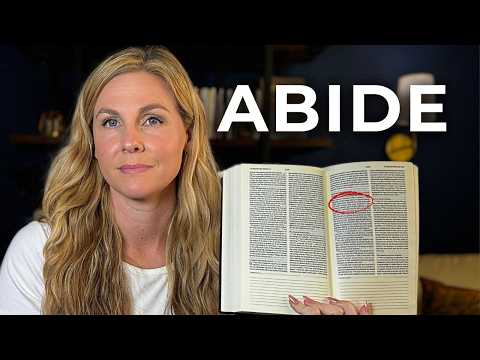
[0:00]So, your brain was actually wired and designed by God to abide. Just like the leaves that are connected to this stem here, your brain was designed to be connected to God, to be connected to another person.
[0:17]In this video, I want to talk about how scripture invites us to abide with Jesus and how neuroscience actually supports this.
[0:27]And then I'll give you practices to actually learn to rewire your brain with the Lord that I have done countless times that have transformed the way I relate to God.
[0:39]For those of you who don't know me, my name is Maryl. I'm a spiritual director and I walk with people as they're journeying in their relationship with the Lord.
[0:47]Most people think that just doing spiritual disciplines, memorizing and meditating on scripture, fasting or serving, doing the things that Jesus did by just imitating Jesus that you were going to be transformed.
[1:03]And yes, those things can transform you.
[1:06]Habits are formed with repetition, but ultimately there is one habit and one foundational relational experience that actually helps us abide.
[1:21]That is before the Bible study, that is before the habits, the serving, the doing. And that is learning to be loved and love God.
[1:31]This hangs on the first commandment to love the Lord your God with all your heart, mind, soul, and strength, and the second just like it, love your neighbor as yourself.
[1:43]Love is the ultimate pathway to abiding. Our brains can be rewired to love, in love, and that I believe is actually what transforms us, not the spiritual disciplines.
[1:57]They support that, they definitely do shape our character, but they are not what it takes to abide in Jesus and to walk in the spirit as Paul talks about in the book of Corinthians, Galatians and other parts of scripture.
[2:11]When we just think that it's about the activity that I do, it puts us in the position of controlling God.
[2:17]If I just memorize and meditate on scripture, therefore I'm a good Christian.
[2:22]I've sat with countless people who have done the right things for years and long to know Jesus and long to experience his presence or be in a connected relationship with him, but they feel so distant.
[2:36]And that's because their brain has literally wired in a way that isn't allowing them to experience God.
[2:43]What is neuroscience and how does neuroscience kinda fit into all this? And then I'll get into the scriptures.
[2:48]Neuroscience basically says that our brains have something called neuroplasticity, which means they can change that's kind of this plastic element that they can actually shift and mold over time.
[2:59]They talk about how there's neurons that fire in our brain and that actually wires together. Neurons that fire together, wire together and they're kind of like this.
[3:07]And so when you do something repetitively, it creates a neural pathway or a habit. For example, you go to the gym, you get endorphins, you feel better.
[3:17]You keep going back even though it's uncomfortable because you have that high. You're becoming the type of person that goes to the gym, that is a habit that's part of who you are.
[3:28]It's not fully who you are because our identity is not our habits, but they do form our habits.
[3:34]How do we grow with neuroplasticity? I found the fastest, most effective way to grow to have our brains rewired is to have two things present.
[3:41]Number one, a strong emotion, and number two, a safe relational presence.
[3:48]There's been studies where someone is anxious in a room, maybe a client with a therapist, and the therapist who is a non-anxious presence, who isn't stressed, can hear what this anxious person is going through.
[3:59]And because there's a non-anxious person here in the room, that anxious person can actually be regulated and their anxiety can be lessened because someone else is an anchor.
[4:12]They become an attachment figure to use psychology language.
[4:16]Attachment is one of the most powerful things that that determines how we act and we behave. Attachment is formed in early childhood and always forming attachments as we grow.
[4:27]When a baby is born, for example, there are mirror neurons that are happening, they're going back and forth between mom and baby or baby in the environment.
[4:35]Those neurons go back and forth and are forming the baby's experience of himself. Have you ever smiled at a baby and the baby smiles back?
[4:41]Have you ever raised your voice and the baby cries? Well, that's because the baby is mirroring what it's seeing.
[4:49]And that's how we grow. Our body is imprinted by what we see.
[4:52]Scripture talks about how our eyes are the lamp of the body.
[4:56]So there's something about seeing that actually rewires our brain. Paul even says this in first Corinthians 13, the famous passage on love where he talks about even if you do all these things and have prophecies and do everything in God's name, but you don't have love.
[5:13]I'm paraphrasing that, but if you do all these things but don't have love and he lists what love could look like, then it means nothing.
[5:21]And so love is what actually transforms us.
[5:24]Love is what motivates us to keep Jesus's commandments.
[5:27]Jesus is our main attachment figure, and that's what he invites us into when he says to abide.
[5:32]Hey, don't go after the political parties, don't prefer your family over me, don't prefer anything over me, put me first because I'm putting you first. And because true life only comes through me.
[5:45]And you can live your entire life then from that flow.
[5:48]What is this biblical habit? Hebrews 12. Hebrews is one of my favorite books of the Bible. The invitation from the Lord is always to draw near, draw near to him.
[5:58]And it says in Hebrews 12, I'll read the verse right before it. Therefore, since you are surrounded by so great a cloud of witnesses, let us also lay aside every weight and sin which clings so closely, and let us run with endurance the race that is set before us, looking to Jesus, the founder and perfecter of our faith, who for the joy that was set before him endured the cross, despising him shame, and is seated at the right hand of the throne of God.
[6:38]There is so much in that passage, but I want to focus on the neuroscience of actually looking at Jesus and how it actually rewires your brain to abide.
[6:48]When you look at something or someone, you actually respond with mirror neurons, if you yawn, and I see you, I might yawn too.
[6:56]Because you are created in God's image, you actually image God.
[7:00]So there's something about looking at him that actually rewires our brain. How do we look at Jesus if we don't see him?
[7:09]We have been given the Holy Spirit and he's the one through the spirit that we actually abide in.
[7:14]I'm going to tell you just my experience of learning to abide and then I'll give you a practice that you can use yourself.
[7:19]When I was about 22, my face started deconstructing, and as I was meeting with people in the church, trying to get answers, people would ask me about my past and I would see this blank black cloud when I thought about my past.
[7:33]It was actually because my brain was repressing memories that were so painful that I couldn't even see the images anymore in my brain of my memory, which is stored in the hippocampus.
[7:43]So I just felt anxious, I felt out of control, I felt like I wasn't loved, but I couldn't really even articulate that.
[7:50]Life just felt really hard. It wasn't until I was around people who loved me as I was and who listened to me and invited the strong emotions out and were able to mirror back to me the love of God that my brain started to change and I started to experience healing.
[8:11]Because they actually were being Jesus with skin on.
[8:16]They were participating in this process called mirroring. I remember being part of a group one night where I was sharing a story about my past and they paused and said, would you mind if we prayed? And I was like, sure.
[8:26]They know they're going to say some prayer that's going to fix it all.
[8:30]And they actually invited me into the prayer and asked me to go back to a specific memory that I was thinking.
[8:37]Immediately I got a memory of when I was being bullied as a child.
[8:40]And they said, what are you feeling? And I was crying. I was like, I'm feeling humiliated, I'm feeling small, I'm feeling scared.
[8:47]And he said, imagine where Jesus is in that memory.
[8:52]And sure enough, right away, he appeared in that memory right to the left of where I was.
[8:58]And he said, go to Jesus. And I said, I can't go to Jesus. There's this dialogue as they were going on.
[9:03]And they said, okay, what is Jesus's expression on his face?
[9:06]And I was able to say, well, he looks concerned.
[9:09]Okay, well what might Jesus say to you?
[9:13]And I heard him say immediately, I'm here.
[9:16]Ask Jesus a question. And I said, Jesus, can I come to you? It was my own fear working itself out. Long story short, that exercise probably went on 10 to 15 minutes.
[9:27]But what happened in that moment was I actually re-experienced this painful experience in a new way.
[9:34]A non-anxious presence, the presence of God showed up in that memory in my brain.
[9:39]And the thing about our brains is they don't know whether you're experiencing something or it's imaginary.
[9:44]And I might think, well, that's kind of weird, you're not living in reality, but our brains lie to us all the time.
[9:49]We think 60,000 thoughts a day, most of them aren't true, 95% of them are repetitive.
[9:53]So just because you think something doesn't mean it's true. Have you ever been wrong about something theologically? Have you ever been worried about something that didn't come true?
[10:03]Yeah, that's because our brain doesn't know. And that's not to be afraid of the brain, but that's just the reality that we live in.
[10:09]God has wired our brain and I trust that he's working things out for the good of those who love him as Romans tells us.
[10:15]What I noticed this memory shift over time, I did that with more and more memories.
[10:22]My childhood, while it still had pain and there's definitely still some dark clouds there, what I did notice is that my attachment to Jesus, my love for him started growing because I was loved in my experience.
[10:35]Neuroscience proves this that if we actually re-experience our memory in a different way, it becomes a new memory.
[10:41]So my imprint of my body was different than just the memory without Jesus.
[10:48]I actually got to experience God there. And if you're like, well, what if Jesus really wasn't there? Scripture tells us that God is everywhere.
[10:55]That in him we live and move and have our being, that we are sealed with the Holy Spirit, that our body is the temple of the Lord.
[11:02]God is with us all the time. It's just to what degree are we aware of his presence?
[11:07]And so the invitation to learn to abide is continuing to gaze upon Jesus, to abide in him and to look for him.
[11:15]One of the powerful ways we can do that is through imagination. I have so many more stories where that is true and I won't bore you with that because this video is getting long.
[11:24]This isn't just metaphorical, this is actually neurological.
[11:28]Jesus becomes your main attachment figure.
[11:31]You actually are attaching to the vine and you're getting your nutrients from him, your love from him.
[11:36]The right brain is where we feel our feelings, where we have emotional experiences, where we have memory that that actually encodes and controls all of our emotional well-being.
[11:47]So how might you actually do this in your life? What would it mean to practice abiding?
[11:52]And I don't mean to try to conjure up emotions about God or to try to manipulate God to love you.
[11:59]How we actually transform is by actually experiencing Jesus, having an encounter, but not just that, having the experience of being experienced, realizing that you are impacting God, that God is moved by you.
[12:18]Moved, I'm talking about emotionally, that you matter to him, that he is connected to you and you feel that connection.
[12:26]That actually transforms us.
[12:30]You experiencing God experiencing you. That's what babies feel when a kid does something funny and a mom laughs and a baby's like, oh, so fun. Mom and mom and I are connected.
[12:44]And then mom leaves the room and baby cries and oh no. When a mom goes kind of deadpan faced, the baby gets so stressed.
[12:51]And we're so stressed because we're not connected to the vine, we're not connected to the loving, the eternal presence of Jesus.
[12:58]And how do we do that is by attuning, attuning in our imagination and in our minds.
[13:02]There's something that you can actually practice called imaginative prayer.
[13:07]I love using scripture with this. Yeah, you can go into a memory. I encourage you to do that with a spiritual director or a therapist or a community or maybe you can try it yourself, whatever feels good.
[13:17]One of the things that we can do is we can take a passage of scripture, particularly the gospels, Jesus is the image of the invisible God.
[13:24]Pick one story of Jesus and read it slowly a few times, then put yourself in the story, imagine that you're watching the story unfold.
[13:37]And this is where your brain actually rewires because you can start to actually awaken your senses and notice how your body responds.
[13:44]Then walk around in the scene and notice these five things.
[13:50]What do you hear? What do you see? What do you smell? What can you taste? And what can you touch?
[14:01]Using your senses, what that does is it lights up the neurons in your body and you actually are immersed in the story and you're encountering Jesus.
[14:11]And here's why this is a safe practice is because you have the scripture to anchor you.
[14:17]If your mind wanders into something and you see Jesus look at you, it's like, well, that's not biblical, but that doesn't matter.
[14:24]If you're not building a theology on it, you're rewiring your brain.
[14:28]I've done imaginative prayer for Advent for the last couple years and I've had people say that they will often think about the image of Jesus and that it had been nourishing them spiritually for years.
[14:40]Now, this is not a guarantee, this is not magical.
[14:44]This is just putting our eyes and our mind onto Jesus and then we let Jesus lead and teach us through scripture, through the word and through our imagination.
[14:56]God designed your imagination and science proves that if you reimagine and you imagine Jesus with you, that you actually have a relational experience.
[15:06]This is something just to test. This might feel a little uncomfortable or totally odd, but remember Jesus spoke in parables.
[15:13]He uses imagery and imagination all the time.
[15:18]And God who made your mind can lead you, and we have the scriptures, the church mothers and fathers to guard our theology, but it's a way to learn to abide in Christ.
[15:26]So the invitation from the Lord is to continue to draw near, to contemplate.
[15:32]We end up attaching to things that we give our attention and our time to.
[15:37]We become like who we watch and who we're connected to.
[15:40]If one of the people that you're interacting with the most is God, you will become like him.
[15:45]When we see scriptures like imitate me, he's not just talking about just robotically just doing the things that Jesus did.
[15:51]How do we bring our heart to God? We bring our attention and our loving attention to God so that we learn through that to love God with all of our heart, mind, soul and strength.
[16:01]We learn neurologically by watching and witnessing God. And so much of scripture talks about this and supports this.
[16:09]While there's no guarantee, I imagine that you will experience over time more and more connection with God as you continue to work this muscle, as your memories form more in Christ, you are going to stay more attached to the vine than you were by yourself.
[16:26]I go deeper on a lot of these things over on substack.
[16:29]It's free to subscribe if you want to down below. And if you're also wondering, how does spiritual growth actually work?
[16:35]I created a video where I talk about the hidden heart. So if you want to check out that video next, I'll see you in the next video.