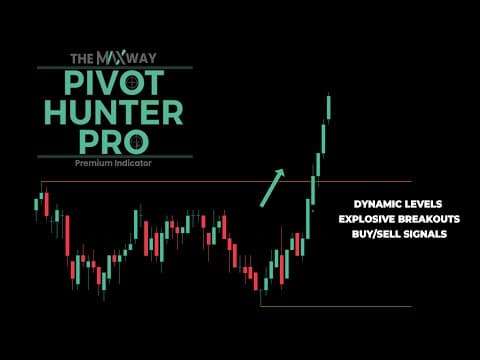
[0:00]Today, we're going to go in-depth on everything Pivot Hunter. So, as we know, as of more or not recently, I've been also focusing on gold. Gold and NQ, right? Gold and NQ. Now, we'll talk about one in general, but I want to point this out first. This is very, very important. You will not need to change any of the settings. You will not need to change any of the settings at any point in time. You don't need to turn things on or off or anything. Now, I personally, there's one exception actually. There's one exception. Back test mode. I like to do back test mode because what it does is it gets to show you previous signals, right? I like to see previous signals. So, I will put back test mode on, but that's it. Everything else, I just leave how it is. I do like to make some things, you know, larger, you know, I'll I'll change the signal sizes to large, whatever, to large. I change my blue line, my dotted lines to blue. But besides that, I leave everything how it is. Yeah, Owen did push a new update for gold, which we'll talk about momentarily. So, let's do this. We're going to focus first on NQ, or I'll go on MNQ, because I think that'll be for most of you guys, and then we'll go into gold. So, what exactly is this indicator? All Pivot Hunter. It's Pivot Hunter Pro. It's an indicator that I came up with. Well, I didn't come up with the indicator, but I came up with a strategy, right? And um, and it all started here. Let's look at the market open Friday. Start new. So as a new trader, not even as a new trader, but I just as a trader in general, I learned the max way, right? And I was very successful with it, and I wanted to find a way to tighten up my trade. Add a little bit of more. Something that Max always pushed out to myself and all his other students, this is an individual career. And what you want to end up doing is kind of at some point in time, finding what works for you and deciding whether or not you want to stick with that, or if you ever come up with something else, you'd add something to it, right? So, I'm a mastermind student. I ended up developing the Pivot Hunter strategy. Javi is a mastermind student. He ended up developing the Quantum strategy. Jamie is a mastermind student, she has her gold strategies, right? And so we still take what we learned from Max, and then we kind of implemented and move it into our own strategies and the way that works for us. So, for me, there was a certain point in time when I was playing certain areas of interest when I was trading. And I started to notice over and over again, these big peaks. certain areas that were going on, right? And I started to notice, you know, the market all of a sudden would go and do these pump ups or pump downs and it would just stop. I was trying to think, well, why was that happening? Well, we got to remember, we are just the retail traders, and we're actually not even really trading in the market, right? Everything we do is just simulated. We're not, we have no impact on the market, right? If there was all of us right now clicked buy and sell, let's say the market was open, nothing would happen to the market, not a fraction, because we are all simulated. Now, the hedge funds, the institutional traders, the big money people, they move the market, right? So when we start to look at these levels, we start to pay attention to it, right? The same reason we have orb or certain other strategies, previous day highs, previous day lows, all that stuff. We start to pay attention to, well, why is that happening? Well, the institutional traders, the hedge funds, they probably have a large amount of buy orders here, right? It's probably why the market won't continue to go down. Or in this situation, a lot of sell orders. So I started to pay attention to these levels, right? And I started to pay attention seeing, okay, well what works, what doesn't work. And as I started to see these levels, I thought one or two things are going to happen. One, we're going to have a strong rejection off of it. Or two, if there's a good enough break, there's a good enough continuation. Now, I'm not going to go fully in depth on what the exact logic and everything I have involved in it because that's secret sauce. And you don't need to understand how I developed it, and Owen's not going to give you the coding for it, so don't ask, right? All that matters is that we have an indicator that processes and builds certain key levels based off of pivots and certain qualifications that decide, okay, this meets the requirements to build a level, right? So these levels were building, and then at a certain point in time, they would either have good rejections in the general area, or with a good enough break and continuation, there would be a solid move. So I started paying attention to that, and I started developing different areas of interest and looking and determining what's a good enough break, what's a good enough continuation. And as I was drawing out these levels, and I was playing off of them, it was a pain in the ass because at some point in time, and some of my original students know this, is I was sitting here, and I was having to constantly draw out levels over and over again, and then delete, and then determine what's a good qualification, and doing all the stuff. And then fortunately, boy genius Owen, tuned in, said, hey, I can take your mind, put it onto an indicator. So you don't have to fucking keep drawing and deleting these lines, right? Man genius, right? Man genius. And so he was like, yo, your strategy's dope. Instead of you constantly drawing the lines and finding the proper breakouts and the qualifications, he was like, well, why don't I just set up an indicator for you? So, Owen and I spent lots and lots of time building this indicator, and here we are, right? We did lots and lots of back testing, and we started to tightened it up and tightened it up, but the problem was is that the indicator worked really well for somebody who understood why these levels and everything was forming. But it doesn't help the general population, you guys. So I thought to myself, okay, Owen, Owen and I sat down, we said, all right, how do we make this better and better and better? So, first and foremost, we wanted to have the levels form. Got it, right? Why do the levels form? Again, don't worry about that, they form. Right? We're going to have the numbers set up for people to understand. Got it. Now, what is a general break level consideration? Well, we want to have it based off of the average size candle, something like an ATR, right? Got it. So, we'll pump on ATR. We'll throw ATR on there. Okay. So, then we had something like this show up, where there was a reasonable break. Okay. So now we got a break, that's a good break. Now we have a signal. Great. So now I started to say, okay, guys, you see the signal. You see a strong continuation, you get in. Well, the problem was is people were struggling to find out what's an exact continuation. Now, you got to understand, I have my sauce, I have certain things that I don't want to share with all stuff. And I said, at this point in time, I got to spread the word. I want people to understand how pivot works, right? It's one of the best indicators out there. So, Owen and I got together and said, you know what, screw it. We're going to show exactly what's a potential good entry. So now we've implemented these dotted lines, right? So now, not only do we have a signal, we have the dotted lines, which is a potential entry. So let's talk about what we see right here. First and foremost, let's go back to the settings real quick. I have mine blue. Just like to have it stick out. Line colors, green, red, blue. Some people like why don't you have them flip the other way? I could, it doesn't really fucking matter, right? You could have them flipped around, green, bullish, bearish, fine, right? Same thing. It's all the same relatively. So, when we get a decent break of one of these levels, right? And not every time does it break, will it signal, right? Because I want a good break. I am a breakout momentum trader. Breakout momentum trader. I have no problem catching it midway in the move, right? Now, the signal's kind of give you an eye, saying, hey, pay attention. Something's going on here. You do not enter on the signal candles, ever. It is always the continuation, right? Because what we fall for, more often than not, is a fake breakout. So what we have now is we have a signal. Perfect. Now we want to see a strong continuation. So in this example, we had a strong continuation. However, it hasn't met my qualifications for a continuation yet. Now, I want to point this out, and I cannot stress this enough. Do not put a limit order on these dotted lines. Do not put a limit order on these dotted lines. More often than not, my entry criteria is so fucking precise that it will literally tap these dotted lines, flip and reverse. This is how precise my entry point is. So then you're like, well, Logan, I thought that's our rendering. Yes and no. The dotted lines gives you a general idea of where a potential good entry is. But remember, I am a breakout momentum trader. So what I want to see is a print through past these dotted lines. I want to see a candle rip through these lines. Now, we got to remember Friday was incredibly volatile. I mean, the average candle size was 34. That's insane, right? This is what ATR is. In case you guys didn't know, average true range. Right? Average range basically means the average size of a candle based off of a certain amount of candles, the average of them. Right? So what we want to see is a print through. Friday was pretty nuts, but there was a print through, right? Now, I want to say this over and over again, guys. Do not ask me what should my stop loss, what should my TP be, what should my contracts be, all that stuff. That has nothing to do with the Pivot Hunter. That is your own personal risk, your own risk management. Right? A lot of people go about this different ways. You can set your stop loss and TP however you want. Do your own little back testing. What works for you. I don't go for massive moves, but what I do pay attention to is the ATR. You got to think, right? ATR, for normal market situations, and let's go back to a normal day, not Friday. Let's go back to Thursday, I guess. Let's go to, not even Thursday, let's go to Wednesday. Normal market conditions is anywhere between seven to about 25. Average candle size is anywhere between 7 to 25. This is normal market conditions. Canles are normal size. It's going to be green when it's between seven and around 25. Even above 25, it might be. Actually, Owen, I just thought of a new update, we should push this out. If we push above 25, let's change the color. Let's change the color if we can do that. Cool. No problem. Perfect, even better. We're constantly updating, guys. This is this is what's so great about our indicators and the businesses that we we got going on here, is we're constantly improving it, constantly making it better for you guys. Just thought of that, once it pops above 25, we're going to do something like we got red, we got green, let's do, I don't know, what color are you guys thinking? Yellow? Caution? All right, I like yellow. Yellow's reasonable. Let's do yellow. That makes sense, right? Because yellow, why are these candles highlighted in yellow? Well, when a candle's highlighted in yellow, means there's a lot of volume involved. So I think this is a great idea. Perfect. So, when we see it's red, that means it's low volume. So when you're thinking about a TP and a stop loss, you're not going to do something crazy, right? You're going to go for a smaller TP, smaller stop loss, maybe increase your size. When it's green, you're going to go for standard market conditions. Normal TP, normal stop loss. When it's extreme, 25 and above, like we saw Friday, I think it got up to 40, 50, it's going to be yellow, saying, hey, be aware, there's a lot of volume. Just like these candles. Right? Saying, hey, there's a lot of volume. Okay. Now, the rules are going to be a little bit different with gold. Gold, 99% of the time, it's going to be red. For gold, normal market conditions are anywhere between 1.1 to about 4, 4 and a half. Now, Friday, we saw it hit 10, which is insane. Double market conditions, incredible volatility. Now, with the algorithm and the logic, it's difficult to have it set for NQ and for gold and the numbers to adjust. You guys got to also understand, what is so great about the Pivot Hunter? I have students of mine, who use the Pivot Hunter on options, CFDs, forex, multiple different ways that you can use this indicator. So the general standpoint for us to constantly change the colors across the board, it'll be too difficult. However, NQ, I can confidently say, 99% of us trade. So we're just going to stick to the guidelines there for NQ. Don't ask us to change everything, guys, for gold. It's not going to happen. Gold is fun, gold is great, but NQ is our baby, it's our primary, it's our focus. Okay. So gold, anything around one and under, it's considered low volume. 1.1 to about four, four and a half, normal volume. Once we pass four and a half, that's large volume. Okay. Let's get back to NQ. So, again, we get these levels form. Now, if you guys pay attention enough and you're watching, these levels only hold their value for about an hour or so. The reason for that is with enough studying and back testing, you guys got to understand, I personally have spent hundreds and hundreds of hours building this strategy. Hundreds and hundreds of hours, back testing, front testing, forcing myself to lose a lot of money on props to live trade it and test it out to get something so concrete and successful. And then Owen had to listen to me for hours and hours and hours and hours telling him how I want things back and forth as well, right? And we had to go and fix it and everything. So, these levels only hold their value for about an hour. I'm a scalper. I've always been a scalper, I'm always going to be a scalper. I have looked into swing trading on this. Some people like using it on the five minute timeline. But generally speaking, I always focus on the one minute. Always focus on the one minute, 90% of the time. We'll talk about when we do other timelines. 90% of the time. So after an hour, these levels will disappear, right? And whether a new one will form. Usually, 90% of the time, there should always be a minimum of two. Break, not a good continuation. So what happens here? Generally speaking, if I see in this example, a bullish candle with a signal, next candle closes red, or if it's bearish, closes bullish, and it's showing bearish incentive or bullish incentive, depending on our direction, no trade. There is no opportunity. We are breakout traders. Again, I want to see a strong continuation. So what'll usually happen is that level will disappear. Now there is no trade. What we want to see, and again, this one did pop up, but what we want to see is a strong move and a strong continuation. Now, we have made a recent update, where if we see some type of doji or something that's showing like, hey, let's say it's a bearish candle, and the next one is like, it's bullish, but it's showing failed bullish, and what I mean by that is one either a doji, or something like, let's say, something like this, right? Yes, it's a bullish candle, but it's a bullish, it's a hammer, right? It's showing incentivization that, hey, we're probably still going down. Okay. So let's just scroll through here, and let's see if we can get some good trade setups so I can kind of give you guys an example of what we're looking for. Break. I'm set up yet. Let's wait for another one. Let's wait for another one. Here we go. Okay, so here's a good example, right? Break, signal, level forms, didn't print through yet. So now we just wait. It's still bearish, so there's still potential there. Boom, print through. Now, at any point in time, if you were to jump in here, let's say you jumped in at 20. It's a 20 point trade. 20 point trade, not a bad move. Let's say you're still in it. Boom, boom, boom, massive movement. That's a really big trade. Now, I want to point something out to you guys. The Pivot Hunter is not a 100% win rate. Nothing in this world is 100% win rate. If this was a 100% win rate, none of you would know who I am because I would own an island right now. Okay. I want you guys to remember that. What is so great about the Pivot Hunter is the RR. The RR. Students and I have been trading Asia and London the last week. We're at probably, what would you guys say, we're at like a 70% win rate, I think. Probably, give or take, around a 70% win rate. But here's what's funny. We're at a 70% win rate, but we're all up so big. For every loss, if you're have solid risk management, for every loss you have, the average win is two, three or four times that size. The RR is insane. In a lot of situations, the RR can be one to six. I can sit here, and I can watch and see how the candles are moving and say, hey, this doesn't look like it's going to continue. I'm not going to get in. But a bot will go by an exact number or percentage and say, hey, based off calculations, this is an entry point. The bot could lose. That is what is so insane about the Pivot Hunter. It's the RR. So when you guys are trading this, and you're like, I took a loss, I took another loss. Keep your head up, get your psychology, right? That's why, by the way, I developed this indicator. You guys see me say it all the time, wait, wait, wait, because I'm waiting for that strong move. That continuation, the validation that that breakout is happening. And sure enough, we catch some bangers. Who cares if you lose? Statistically, which I've spent hundreds of hours of testing, the RR is insane on this. I've done it, students have done it, the bot has done it, Owen has boiled his brain building it. I'm telling you guys, it's the RR. Stop focusing on the losses, start focusing on the wins. And if you have the right risk management, you will become very profitable. This is the only indicator that I use, the only strategy that I use. I have shown proof of tens of thousands of dollars of payouts every single month just from this indicator. FFF alone, last month, our last week, $40,000. $40,000 on FFF alone last week. I will show the payout this coming Tuesday, and you guys will see it. You guys will see the payout, right? Now they have consistency rules, technically, I can only pull out $3,000, so it's still going to be about a $12,000 payout, and then seven days later, I'll do another something. 3,000 per account. Sorry. So it's going to be about anywhere between $12 to $13,000, right? And this is just from this indicator. That's it. So, let's look for some more setups. And look at this. You guys look here, right? It just teetered that line. This is why we say, wait. I want to see a strong print through. That was another good one. Look at this. Let's back that up a little bit. You guys see here? Signal, didn't quite touch it yet. We're waiting, we're waiting, we're waiting. Boom, print through. Now we get in, right? Get in at any point in time here. You would have been good. You would have hit at least, that was another 25 point trade, right?
[20:44]Even if you got in pretty late, 900 to 81, that's still 19 points. Even if you got in, you know, 15 points, you got in super late, 15 points. Most important part of this indicator is patience. Exactly. Being patient, waiting for the trade to set up. Now what I want to try and show you guys is what I consider an A+ plus setup. And let's see if we can get one. Let's just fast forward throughout the day, see what we can find. Well, that was a phenomenon. Here's another one. This is one of those patience trades, right? Again, break, it has to get a print through here. Not yet, not yet, not yet. Boom. Now we're in. Look at the RR on this trade alone. Look at the RR on this trade alone. Let's say you're just fucking crazy late and you get in all the way at the close. 97. This pulled up. Let's say you got out here.
[21:50]You still got a 50 point trade. 50 point trade, right? And that's middle of lunch. I'm pretty sure we caught this trade. I'm pretty sure the students and I caught this trade. Middle of lunch. Right? And if you're still in it, you might have even caught out a little bit more after that.
[22:08]Now, let's see if we can find an A plus plus trade. We're just going to fast forward, fast forward. Not yet, nothing yet. All right, let's go back. Let's hear what we'll do. I'll show you something here. Okay, this is what I want to show. This is a great example. Okay. This was a Trump tweet, right? So we obviously didn't expect this to happen. Actually, you know what, let's show another good example. Let's do, let's find something here. 330, see.
[22:45]Some of these trades are insane. And look at these lunch trades. The lunch trades have been phenomenal. Another good trade. Let's see if here is a good example. Nope, not a good example. Perfect. Okay.
[23:02]If you guys, this is a little little trick with the pivot hunter. Market open, the Globex open, which the students and I were kind of looking into. Market open, 930, right? 930 market open. Globex open, which is when the whole market opens, which will happen in an hour. And right before major economic news, what we know is there's going to be potentially a giant candle. It's going to look something like this. Now, obviously, most of us didn't trade this candle, but it's just an example. Giant candle. Now, if you guys remember, per our rules, we need to see break continuation for a potential entry, right? You need to see the signal, we wait for the continuation past the dotted line. Right? However, if you know at market open, Globex open, or major economic news, I'm going to have a giant candle. What I'll do, I'll switch to the 30 second time frame. So now, look where my entry is here. Now, I would have been able to enter around here at 80. I enter if I'm looking at the 30 second time frame, I would have entered at 80. And that's just an exaggeration, you know, I would assume maybe I wouldn't miss out on 20 points, but let's just say the market's moving fast. I get in at 80. This is if you're looking at the 30 second time frame, for market open, Globex or major economic news. Pretty cool, right? Now, some of you are thinking, well, Logan, I don't have the 30 second time frame. I don't have premium. You don't need it. You could do this. Leave it on the one minute time frame. You see this signal, go on trade of eight. Your trade of eight will have a 30 second time frame. So what it'll show is you'll see a one minute candle, but when you see a signal, right? On trade of eight, it's going to close 30 seconds earlier. It's going to close around here. Then you're going to see a strong enough continuation, and then you can enter on trade of eight. Now you're good. So you don't need premium, right? It's just, it'll make it a little bit easier, but you can still use trade of eight to get your entries earlier, market open, Globex or news. Pretty fire, right? Now, some of you are thinking, well, Logan, I don't have the 30 second time frame. I don't have premium. You don't need it. You could do this. Leave it on the one minute time frame. You see this signal, go on trade of eight. Your trade of eight will have a 30 second time frame. So what it'll show is you'll see a one minute candle, but when you see a signal, right? On trade of eight, it's going to close 30 seconds earlier. It's going to close around here. Then you're going to see a strong enough continuation, and then you can enter on trade of eight. Now you're good. So you don't need premium, right? It's just, it'll make it a little bit easier, but you can still use trade of eight to get your entries earlier, market open, Globex or news. Pretty fire, right? Now, I want to remind you guys this. Only use the 30 second time frame for the first two minutes. First two minutes of those market open, Globex open, and major economic news. The longer you stay on a shorter time frame, the longer it tends to have you get into trades a little bit earlier. I cannot stress this enough. I would rather get in late to a trade than get in early. I would rather get in late to a trade than get in early. How many times have you guys heard me? Hobby gets into a trade, I'm not convinced yet. Now Hobby's also a scalper, so Hobby shoots for like 5 to 10 points. I shoot for much larger than that. But you guys hear it a lot of times where I'm like, no, not yet, not yet, not yet. Hobby's already in a trade and now I'm getting into it and then it rips down. And I get into these massive movements and massive trades. But on the 30 second time frame, do you get the dotted line on trade menu because you would miss that, wouldn't you? Yes, you wouldn't see the dotted line, but that's where you go back to the original rules where when you see a strong enough continuation past it, so it would look like this. Once you see a strong enough continuation, you would have been good. Because if you look here, right, it's right there. So as soon as you saw the strong enough continuation, you would get in. You're good. I promise you, you would still be fine. Yes, you wouldn't have the dotted line, but as soon as you have a strong enough continuation, you're good.