[0:00]Cults may look very different on the outside, but on the inside, they are frighteningly similar. The names change, the leaders change, the messages change, the promises change, but the mechanism is almost always the same. Because every cult, in the end, must fulfill the same function, to pull you away from the truth of the gospel. And that is exactly what I want to show you in this video, the pattern, the logic, the structure they repeat over and over again. And once you see this pattern, it becomes much easier to recognize the error, no matter how spiritual it may seem. First characteristic: Another source of authority besides the Bible. Every cult must deal with biblical authority, without exception. But notice this. Cults usually do not openly reject the Bible because that would push people away and be too easy to detect. What they do instead is more subtle. They keep the Bible, but place another source of authority alongside it, above it, or as an indispensable aid to interpret it. It may be a new book, as in the case of the Mormons, who present the Book of Mormon as a restoration of truths that were supposedly lost or taken out of the original biblical records over the centuries. It may be a special revelation, such as the writings of Ellen White, which in Adventism hold a position of great spiritual authority and are considered a distinctive mark of the remnant church. It may be the official interpretation of an organization, as in the case of Jehovah's Witnesses, where Bible reading comes accompanied by the authorized explanations of the institution itself. In the end, the message is always similar. The Bible alone is not enough. You need another source to understand it correctly. And here is the key point. Whenever the Bible ceases to be the final authority, someone else takes its place. Cults know that if people are free to read scripture and compare their teachings with the true gospel, many things begin to collapse. That is why they must control the source, the access and the interpretation. They are not bringing more light. They are diminishing the light that God has already given. And this is exactly why learning to interpret the Bible well matters so much. If you don't know how to read scripture in context, it becomes much easier for someone to twist verses, control your conscience, and make the Bible say what it never meant to say. So, if you want to learn how to interpret the Bible with more clarity, depth, and confidence, check out my Biblical Interpretation course. In it, I'll show you a simple, practical, and straightforward method to understand difficult passages while respecting the context, the author's intention, and the message God communicated through scripture. The link is in the description. Second characteristic: A leader or system above correction. Every cult needs a special human being. A prophet, a founder, an apostle, someone who speaks for God in a way that ordinary people supposedly cannot access on their own. This is the case with Joseph Smith in Mormonism, who presented himself as the restorer of lost truth. It is the case with Ellen G White in Adventism, whose writings end up functioning as a parallel authority. It is the case with Sun Myung Moon, who is treated as the Messiah who would complete Jesus's unfinished mission. And do you know why this is so effective? Because it seems humble. It looks like they are honoring God by recognizing a special representative. But what they are really doing is replacing the only mediator the Father has authorized. First Timothy 2:5 says clearly, For there is one God, and one mediator between God and men, the man Christ Jesus. One, not Christ plus a prophet, not Christ plus a prophetess, not Christ plus a founder, not Christ, and an organization with final authority over your soul. The moment any group places a human being, alive or dead, between you and direct access to God through Christ, that group has crossed a line that scripture itself explicitly forbids. Third characteristic: Another Jesus. This is the decisive test. The question here is not whether a certain group uses the name of Jesus. The question is who is Jesus within that system? Because the true gospel is not sustained merely by Christian vocabulary. It stands on the truth about Christ. And this is exactly where cults always distort. They almost never reject Jesus directly. They prefer to reduce him, reinterpret him and reshape him. This is the case with Jehovah's Witnesses, for whom Jesus is not God incarnate, but a created being. It is also the case with Christian science, which makes a clear distinction between Jesus, the man who lived in history, and Christ, the divine idea or spiritual principle. Do you see it? They speak about Jesus, but not about the real Christ. And this is devastating because the true gospel depends on who Christ is. If he is not the eternal son, God incarnate, the only mediator and the only savior, then the entire system has already gone off the rails. That is why this point is non-negotiable. You can be wrong on many secondary issues and still remain within the Christian faith. But if you are wrong about the identity of Christ, you are no longer dealing with a small deviation. You are dealing with another religion with similar vocabulary. And perhaps this is one of the most tragic aspects. Many people inside cults sincerely love the name of Jesus, speak about Jesus, sing to Jesus, and dedicate years of their lives to Jesus, but to a Jesus redefined, diminished, and distorted by the system. Fourth characteristic: Salvation by works. This may be the most subtle characteristic because it sounds pious. Of course you should practice good works. Of course you should obey God's commandments. The problem is not works. The problem is when works become the price of salvation. The sacrifice of Jesus loses its value and grace ceases to be grace because it has to be earned. In a cult, salvation always depends on your merit. This is the case with Jehovah's Witnesses, where spiritual life is measured by performance, preaching, and submission to the organization, with reports and tools to track it. It is the case with Mormons, who mix faith with secret rituals, baptism for the dead, and requirements involving even sacred undergarments. But Ephesians 2:8-9 is unmistakable. For by grace are ye saved through faith; and that not of yourselves: it is the gift of God; not of works, lest any man should boast. In other words, salvation is a gift, it cannot be bought. Good works are a reflection of the transformation accomplished by Christ, not the requirement for earning salvation. When salvation becomes something you achieve instead of something you receive, the gospel has been replaced by religion. It no longer depends on Jesus. It depends on you. And here is the dark reason behind this lie. It keeps people working inside cults forever. Because how do you know when you have done enough to be saved? How do you know when you have earned it? You never know. This anxiety, this constant uncertainty, this need to prove your worth all the time, that is what keeps people trapped and working inside cults. Fifth characteristic: Exclusivism. Cults always need to convince people that they are the only legitimate source of spiritual truth. They present themselves as the faithful remnant, the restored community, the special work of God on Earth, the only structure that truly understood the divine plan. This is how Mormons think, since they were born from the idea that all churches were wrong and needed to be restored. This is also the case with Adventists, who have historically seen themselves as the remnant people with a unique mission. But this is not how historic evangelical churches think. As different as Presbyterians and Assemblies of God may be, for example, they recognize one another as brothers in Christ, because they know that salvation is not found in the label of a specific church, but in the work of Jesus. The exclusivist mindset gives the member of a cult a sense of spiritual privilege, of belonging to something pure and superior. But at the same time, it creates a gap between that person and everyone else. This is where exclusivism begins to produce isolation. Any criticism from the outside is treated as persecution, and even friends or family members may be seen as spiritual threats. Little by little, the person closes himself inside the group's bubble. His support network is replaced, his world of reference grows smaller, and his contact with real questions becomes increasingly limited. And here it is important to make a distinction. Biblical Christianity affirms that Jesus Christ is the only way. That is the exclusivity of Christ. Cults do something else. They turn their own organization, their structure, and their interpretation into exclusive access to truth and in practice even to salvation. It is no longer Jesus who saves. It is the cult. Sixth characteristic: Mechanisms of control. Cults seek to teach their members that leaving the group means abandoning God, that questioning the leadership is spiritual rebellion, that doubting certain teachings is a sign of pride, and that listening to outside criticism is opening a door to the devil. In other words, the structure is not sustained by biblical arguments, but by emotional pressure. Fear holds the person in place, guilt silences them, and dependence keeps them trapped. And this process is even stronger because many times the person did not enter that group out of malice or rebellion, but out of pain, confusion, emotional need, loneliness, disappointment, or the need to belong. The cult knows exactly how to exploit these human vulnerabilities. At first, it offers ready-made answers, friendship, acceptance, identity, purpose, and a strong sense of community. For someone who is wounded, this can feel like healing. But over time, all of this begins to be turned into a mechanism of retention. The person stays because they have become emotionally dependent on the group. Because they have gradually become isolated from those outside, because they fear what might happen if they leave, because they feel guilty just for considering stepping away, and also because they have already invested time, reputation, money, relationships, and energy into that system. Leaving then no longer feels like merely changing churches. It begins to feel like a total rupture of their own life. In the end, all cults follow the same pattern. They add another authority besides the Bible. They place a leader or system above correction. They present another Jesus, similar in name, but different in essence. They turn salvation into something you must earn. They create an environment of exclusivism and isolation. And finally, they sustain all of it through mechanisms of control. The name changes, the appearance changes, the speech changes, but the mechanism is always the same. If you are in a cult, leave as soon as possible and seek a truly biblical church. Now, in this video on your screen, I quickly explain how several Christian cults work. See you next time.
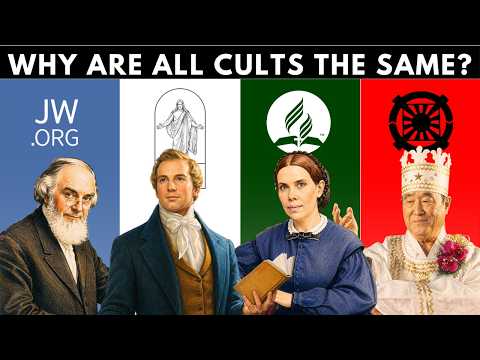
The Dangerous Patterns Cults Use To Deceive
Illustrated Theology
11m 4s1,877 words~10 min read
YouTube auto captions
Transcript source
YouTube auto captions
This transcript was extracted from YouTube's auto-generated caption track. The transcript below is server-rendered so it can be read, searched, cited, and shared without opening the original YouTube player.
Pull quotes
[0:00]Cults may look very different on the outside, but on the inside, they are frighteningly similar.
[0:00]The names change, the leaders change, the messages change, the promises change, but the mechanism is almost always the same.
[0:00]Because every cult, in the end, must fulfill the same function, to pull you away from the truth of the gospel.
[0:00]And that is exactly what I want to show you in this video, the pattern, the logic, the structure they repeat over and over again.
Use this transcript
Related transcript hubs
Watch on YouTube
Share
MORE TRANSCRIPTS


