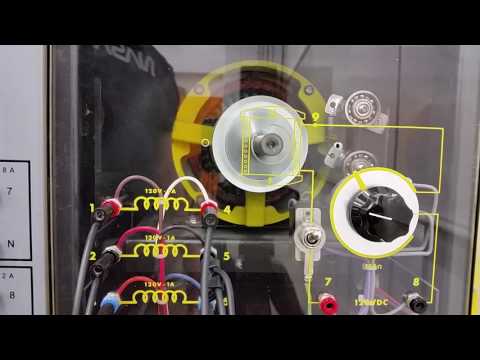
[0:01]All right guys, we're going to take a look at the synchronous motor now. Uh first thing we're going to do is we're going to pull this bad boy out and take a look at uh the guts of it. So there are two screws here that you can back off. And that takes this plexi glass off. Now I've already loosen it because I gave myself a hernia trying to get it out here. But you should be able to grab the bottom, grab the top and just bump it. There's a piece of sheet metal on the back that's holding it in place. Uh once you've bumped that sheet metal off, then you can just slide this guy out. Once it's out, then bring these guys back in. And then watch yourself because they're quite heavy. Uh so we're going to pull it out and then we're going to drop it over on to uh the desk and we'll take a look at the guts of the machine. All right, so at the beginning there it says uh viewing the motor from the rear of the module. Note that the two rotor windings are brought out to two slip rings via a slot in the rotor shaft. And identify the two slip rings and the brushes. Okay, so you can clearly see here, let me just focus in, that we have two slip rings. So it doesn't matter where I have the rotation here. It it's a concentric ring of copper here. And on each of the rings, there are two brushes, one on for this slip ring and one for this slip ring with an insulator between these two bad boys. Now the next thing says, uh can the brushes be moved? Well, no, they're set, right? And it doesn't matter where in the rotation you have. There's a spring in here that pushes that brush up against, you can see that the clearance between the brush. There we go. You can see the clearance between the brush and the actual slip ring. So the brush is providing current into the rotor shaft. Okay, next thing I'm asking you to do is just take a look at the stator windings. You can see there that the stator windings all seem to be the same gauge. You can't really discern one pole from another, so this is a three-phase motor. And really an induction motor, a synchronous motor, and a wound rotor motor. They all have the same stators. It's the rotor that's that's different. Okay, so the stator windings are basically identical to a three-phase squirrel cage motor or a wound rotor motor. They all have the same stator windings. Uh does the synchronous motor contain an induction winding? Why is the squirrel cage component necessary? So, on the inside here, you can see that there are two coils of copper wire on the inside. This is not your standard rotor. I just focus in. So, right here and right here, there are two windings. They're essentially the same winding. We're going to put DC to this winding. There's a piece of wire that gets wound around over here, comes over, winds around on this side. And when we put current to it, DC current, it essentially creates a north and a south pole on the rotor. Now we'll see that when we stir it up and we if we just applied the DC, then the motor is going to make all kinds of funky noise. So you can't apply the DC until the motor's up and running. In order to get the motor up and running, we need this squirrel cage. So there's your standard squirrel cage induction motor, right on the outside here, where we have the bars that go across and this ring, there's another ring on the other side that's shorted out. And there's a fan component that's cast into that as well. These guys right here, the standard squirrel cage, is there for startup. Because the only other way we would get this motor to get up and running would be to have another motor coupled to the shaft of the machine. So these guys for the squirrel cage get the motor up and running. Once it's up and running and very close to synchronous speed, then there'll be less induced voltage and less current flowing on here. Then we're going to put DC to those two to that winding there and it's going to lock it in and this rotor is going to spin at the exact same speed as the stator. So it's called the synchronous motor in that once it's up and running, we lock it in with DC current. It locks into the synchronous magnetic field and the rotor spins at the same speed as the stator. Okay, on the front face of this unit, all those conductors for the stator are brought out to these terminals right here. So number four says, uh viewing the front face of the module, the three separate stator windings are connected to two terminals, well, obviously one and four, two and five, three and six. Okay, so those are all our different windings. You can see that they're rated at 120 volts and we can only push an amp of current through there before they start to smoke. Uh so that's our rated voltage and current. The rotor winding is connected through the 150 ohm re stat and a toggle switch to terminals. So over here, the rotor, so just to make sure everybody's cool. These guys are the stator windings. That's our three-phase stator windings. Over here, there are two terminals. And remember we said we're going to put DC. So we're going to put 120 volts DC to the rotor. That's going to lock it in. This re stat here will allow us to vary the voltage to the rotor and obviously vary the current to the rotor. The other thing to notice is that the stator windings have not been connected in neither a Y or a delta. Well, the voltage in the shop is 208 volts. These guys are rated for 120. So we're going to have to put a jumper between four, five and six to create a Y connection. So that the 208 line voltage going into one, two and three, gives us a phase voltage of 120 from line to any neutral connection. So we're going to put a jumper between four, five and six in a little bit in order to create that Y connection on the stator. All right, guys, next thing we're going to do is we're going to wire up like this. You can pause the video here. So we're going to have terminal four going to the ammeter. You can see that I'm using the positive and negative as my common. Then I'm coming off the 2 and 1/2 amp uh terminal. Remember that these windings can pull basically an amp. We're going to connect them up as a Y. So whatever the phase current is, the line current will be identical. So the 2 and 1/2 amp setting should be fine. You can see the four, five and six are jumper together to create that Y connection. Then I have line two going to terminal two and line three going to T3. So remember that the synchronous motor just has a standard three-phase stator. Okay, so now I've got it wired up. I've come off of four, five and six as which is my variable voltage output, three-phase. Phase A, I have that going through my AC ammeter. So, these guys are just basically you can just pull them out and replace them. So there is a DC ammeter and there is an AC ammeter. Make sure you're using the AC ammeter. I came into the positive and negative and I'm coming off out of the two and a half amps. So just to zoom in there. There is the AC ammeter there. I'm coming into the positive and negative, coming out of the two and a half amps and I'm coming over to the terminals for the synchronous motor. And from that ammeter, I'm going into terminal one or T1 for the motor. Then I have line two going to T2 and line three going to T3. You can see that on the the back end of the the connections here, four, five and six have all been jumper together to create that Y connection there. So these guys are all jumper together to create the Y connection. We have 208 volts being applied to the windings, leaving us with 120 volts on each of the phases. Okay, so now what I'm going to do is I'm going to ramp this potentiometer all the way down. Remember this is a variable voltage output. So I'm all the way down to zero. I'm now going to crank on the voltage. Okay, you can see that I've got three phase being applied to this power supply. That three-phase is now being applied to the stator of the motor, but nothing's happening because I got zero voltage and zero current. As I slowly increase the voltage, you can see that this motor is slowly ramping up up to full speed now. Okay, so you can see that the synchronous motor, because it has that squirrel cage component is able to start on its own. I don't have DC applied to the rotor yet, but you can see that by varying the voltage, I can then get current to flow on the stator. Okay, what I want you to also see is that this is an induction motor at the moment. So we're we haven't locked it in yet. As I increase the voltage, watch what happens to the current. It bumps and then subsides. And bumps up and then subsides. Look at that. In rush and then subsides. And then finally, see, every time I increase the voltage, I get that in rush of current and then it decreases. So right now we've got just over an amp of current going to the machine, which is good. Right, that's why we're on the 2 and 1/2 amp setting so that we can see that scale. Our scale is right now from zero to two and a half. You can see that we're just, sorry, just above one amp of current. Every time, if I decrease that current down again, sorry for the camera work, if I increase the current again, Wow. Every time I increase the current, you can see that the ammeter goes up and then subsides, right? Because as soon as the motor goes faster, then you get more counter EMF and reduces the in rush current to the motor. Okay, so if we turn this guy back on, give it full voltage and then turn it off, we can see that the motor is turning in a in a clockwise direction. So this is a three-phase machine. So all I have to do is just interchange two of the windings here, any two of them, and the motor should go counterclockwise now. Just let it slow down and you can just see that it is going counterclockwise. So you can reverse this motor the same way as you can any three-phase machine. So we're going counterclockwise right now. We will put our phases back to the way they were before. Bump the motor. And now we're going in a clockwise direction. It has the exact same stator as an induction motor or a wound rotor. So reversing this motor is simply just changing any two phases.
[11:44]All right, so now we're getting crazy. You can pause the video here and you can jot down any values that I have on this diagram here. So now what I'm going to do is I'm going to come off of uh terminals one, two and three for my three-phase supply. And this lab volt trainer comes with a watt varmeter. So I'm going to go through the watt varmeter from the vars connection. I'm going to go, excuse me, over to the stator. You can see that the stator is still connected up as a Y. I'm still looking at the current, the AC current on the stator. But in addition to that, I have my 120 volt DC. So it's a 0 to 120 volt DC, it's a variable DC supply. I'm going to go through my DC ammeter. I'm going to take a look at the DC voltage that's applied there. Um, and we're going to go into terminal seven and eight with the DC supply.
[13:41]All right guys, now at a glance, this looks crazy now because we've got conductors going everywhere. So let's just slowly walk through this. Looking at your diagram, we have current going from uh the standard 120 208 volts output. So we're going from terminals one, two and three. So we're coming from here, here and here. On the previous portion of the lab, we were using the variable output. But I want to vary my DC now. So the potentiometer will now vary the DC. So I'm going to put my straight three-phase to the stator. We've already seen how an increase in voltage provides us with that bump in current. So we've already done that. So let's move the conductors that we had here over to these terminals. That's going to go to our stator. Those conductors are going up from there to my watt varmeter. So this is from my source. And then from this watt varmeter, these three terminals are coming down and they are feeding my stator. You can see that the stator is again connected up line one, line two, line three, T1, T2, T3 and we've connected these guys up as a Y. So nothing different. That first phase, so this one coming off of terminal number four, you can see that that wire comes over here to the AC ammeter. And we're still going to register the current from zero to an amp going to the stator. Coming off the positive and negative and the two and a half amps. Okay, the DC, the DC is coming from my variable output, zero to 120 volts. I have my positive coming up and it's going through my DC ammeter. So I'm coming into the common, out of the two and a half amps and that two and a half amp conductor, you can see is going down here and is feeding my rotor. The other side is the negative and that guy just goes right back to my DC supply. Now, in order to look at the voltage on these two terminals, seven and neutral, you can simply just change this so that we can read seven and neutral and we'll be able to see the voltage here. If you wanted to see the voltage simultaneously here on your volt ammeter, then you can take two terminals and bring them down to the two terminals that we brought to the rotor. Okay, so what we've got now is we've got a three-phase supply going to the motor. That three-phase supply is going through a watt varmeter. Then we have a separate variable DC voltage that's going towards the rotor. And both of those guys are going through an ammeter so we can keep track of the current on each one. Okay, the rest of the settings are that we want to have minimal resistance. So we're going to turn this potentiometer totally clockwise. We're going to switch this up to allow current to go to the rotor. You can see that once current goes to the DC current goes to the rotor, it's going to create a north and south pole in the rotor. And then at this point, I want the this potentiometer completely clockwise, meaning that we're not applying voltage to the rotor yet. No DC voltage to the rotor yet. Okay, so let's turn this bad boy on and see if it works. Right on. So it sounds great. I do not have any DC voltage applied. You can see that the voltage here to the rotor is zero. You can see here on the watt varmeter that this is an inductive load. You can see that the vars are over on the right hand side. Right now, it's pulling an excess of 300 vars. And remember, the vars is the potential energy held in the magnetic field. And we can see that there's a little bit of wattage. So a little bit of heat lost on the motor as well. So this is a strict is strictly an induction motor at this point. Okay, so now at this point, what I'm going to do is I'm going to slowly increase the DC uh voltage. So I'm going to slowly increase the voltage to the rotor, and you can see that as I increase the voltage to the rotor, that the vars is actually going down. Let's go back to the point where we have no DC excitation current. So, again, If we turn this guy on with no DC applied, we're going to see over here, we're going to see over here, an inrush of current here. So it's going to bump and then go back to an amp of current. Boom. Okay, so there was that in inrush current, just like any standard induction motor. And then we saw that this guy was pulling an amp of current. Now that it's an induction motor, we see 300 vars. But now what I'm going to do is I'm going to slowly increase the DC amperage to the rotor. So what you're doing simultaneously is you're looking at um, let me just pan over here. You're looking at the current that you're applying to the the DC rotor. So we're going to start with uh 0.1 amps, right? So we're going to slowly increase that current. Let me stop here because it looks like my meter's deflecting in the opposite direction. So let me pause for a second. Okay, so what I'm going to do is I'm going to slowly increase the excitation current to the rotor. And I'm going to just start with 0.1 of an amp. You can see that this ammeter is slowly creeping up. Then I'm going to take a reading at 0.2, then 0.3, then 0.4 and on and on. Okay, so you can see that and again, like a donkey, I have the other one backwards. Look at this voltage is going in the opposite direction. Hang on for two seconds. Let's swap these guys out. Okay, turn this bad boy on. And now you can see that I'm 50, 60. I'm up to 70 volts DC that I'm applying to the the rotor there. Okay, so I'm slowly increasing the current to the rotor, which is also increasing the voltage that's applied to the rotor as well. So I'm creating a stronger DC magnetic field on the rotor.
[21:07]Okay, so watch this because this blew my mind the first time I saw it. So what I'm going to do is I'm going to slowly increase that current to the to the rotor, right? So the motor's already up close to synchronous speed, but now I'm going to lock it in with the DC current to the rotor. So I'm going to slowly increase the current to the rotor and watch what happens to the vars value on that rotor. It's getting less and less like an induction motor. Down, down, down. I keep increasing the current and at this point, this is crazy. This motor is running as a resistive load. There is no vars whatsoever. You can see that the the watts have decreased a little bit. This is purely a resistive load now. But the motor is still spinning. You can hear it running. There's been no reduction in speed on the motor. It's actually locking in. So it's actually increasing speed. It went from a little bit of a little bit of slip to now locking into the synchronous speed. Okay, watch what happens now if I increase the current to that rotor. Okay, so now I'm increasing the current to the to the rotor. It was a resistive load. Over here, it means it's an inductive load. Now it's a capacitive load. It's pushing current in the opposite direction. It's acting as a capacitor. The motor has not changed speed whatsoever. It's still what's gone up a little bit, actually. So, it's now locked in. We're putting a DC current to the rotor. And now that we've overexcited the rotor, then the magnetic field of the rotor is now cutting across the stator windings before they even get current. So the motor is actually acting as a power factor correction. So it's acting as a condenser, acting as a capacitor by overexciting the rotor. Okay, so just to pan out here, you can see that there's no change in the motor. The motor is still basically running the same speed. So what I'm going to do is I'm going to go back to it being an induction motor. Right, you can see very minimal change at the speed. Now this is a resistive load because we're increasing the current and the voltage to the rotor. So we're putting more DC current there, creating a more stable magnetic field that locks into the synchronous magnetic field. And then if we over excite the rotor, That means that we're pushing more current into the rotor. That magnetic field is cutting across the stator and it's actually inducing a voltage same as you would have with power factor correction capacitors. The next thing I want to show you, uh because now that we're done the lab, I want to show you what happens uh if you try to apply the DC voltage before the motor is actually spinning. Okay, so last thing I want to show you is, uh, the motor's at a complete stand still now. We only want to bring the DC voltage and current into the rotor once it's very, very close to the synchronous speed. So remember that the outside um squirrel cage components is going to get up and running. But if we try to jam DC current to this right away, when we start it, watch what happens to the motor. So I'm going to put three phase to the stator, but I'm also putting DC to the rotor when it starts up. Okay. That didn't work. Supposed to sound funky. Hang on for a minute. Well, it's not reacting the way it uh I had another trainer that I used. And if I applied the three phase and the DC at the same time, uh the whole board shook. Uh and that's because the DC wouldn't be able to lock in quickly uh with the synchronous magnetic field. You usually get the motor up and running and then you apply the DC. So it's not as uh it's kind of anti-climactic. Uh but I'm going to put DC, so full DC voltage and three phase at the same time. Uh just take a look at all the meters right across and you'll see uh the motor when it starts up, it doesn't make the the funky noise that I thought it would make. Uh but it does pull an excessive amount of uh current. And you can see that the motor just kind of wobbles and then gets up to speed. Right, so that initial uh in rush there. Everything's cool now. But uh initially there's that kind of bump in current. Uh because I'm applying that DC voltage. If I get rid of the DC voltage and then reapply the current, then everything's cool. Very minimal in rush current and everything. Uh but you don't want to have the DC and the three phase applied at the same time. Try it. Uh you may find that uh that once you do that, that the whole motor board just goes and starts shaking because the magnetic fields have not locked in yet. So again, we need to be up and close to speed and then we're going to apply the DC and lock it in to keep it at that synchronous speed. The last thing I want to to add is was with this synchronous motor, it doesn't matter what physical load that we put on to this motor. It's a synchronous machine. Once it is locked into the synchronous magnetic field up to rated load, it will still stay at the same speed. So from zero load all the way up to full load, it's locked in. So the beauty of the synchronous machine is that it maintains its speed, 3600 RPM, 1800 RPM, And keeps it locked in because of the DC that's applied to the rotor. All right guys, hopefully that clears up synchronous motors. Thanks for watching.