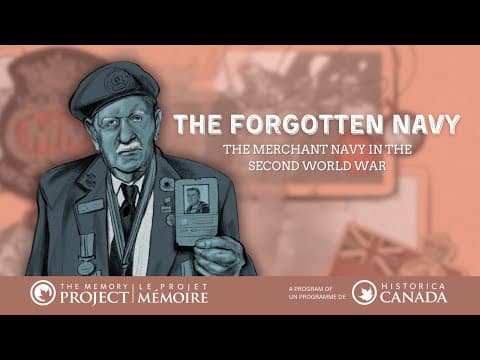
[0:01]When the captain gives the command 'abandon ship,' then everybody was on his own. When you jump from a deck, you would normally jump 60 feet into the water. in the Atlantic, which was one of the coldest oceans in the world, and then you didn't know what was in the water. If it was an oil tanker, it'll be covered with oil, mostly on fire.
[0:33]From the very beginning of the Second World War, the men and women of Canada's Merchant Navy played a vital role in ensuring Allied victory. Unlike the Royal Canadian Navy, the Canadian Merchant Navy consisted of former civilian ships and government-run vessels, crewed by merchant sailors who were not members of the armed forces. Earle Wagner joined the Merchant Navy at only 17 years old, after being turned down as a boy soldier for the Royal Canadian Navy. Percival Smith also joined at 17 years old from the British colony of Salon. Unofficially known as the Fourth Arm of the services, these civilians endured serious threats from mines, aircraft, surface raiders, and in particular, a vicious German U-boat blockade. All while having a limited means of self-defense. They were commissioned to carry supplies up and down the Atlantic seaboard of North America and over to Europe. For Britain, these supplies were critical. The civilian population was often on the verge of starvation, and the military needed a continuous supply of ammunition, weapons, vehicles, fuel, and other equipment. You have to understand, Britain was just about in starvation, and they had to rely on countries like Australia, New Zealand, Canada. If you starve people to death, they can't fight, can they? But with the ever-present threat of lurking U-boats, dive bombers, dangerous storms, and the practice of sailing in tightly bound convoys, these were no simple voyages. Warfare at sea, it's very dangerous. You've got a cargo that was worth probably at least a million dollars or more. A ship worth a couple million too, actually. So we're valuable. We were the primary target. When Hitler came to understand that it was the ships, merchant ships that were bringing in all the goods. The Air Force provided some cover for the ships, but they at that time these planes could only go to a certain length. And in the middle, there was a spot where the planes couldn't reach. So this is where the U-boats got in. And so that was called the Black Pit. And so the dangerous part of your voyage was getting through that Black Pit because we were sitting ducks. Fortunately, I was never torpedoed, but I saw with my own eyes, people struggling to stay alive in this massive fire-ridden ocean. And the only way that you could see these men struggling in the water is because of the light from the burning ship. You see the guys struggling in the water and you can't stop your ship to pick them up, because if you do, you'll be the next sitting duck. In 1942, at the height of the Battle of the Atlantic, the Allies lost on average one 10,000-ton ship every 10 hours for 31 straight days. A 10,000-ton vessel could carry enough food to feed 225,000 people for a week. Of the more than 12,000 Canadian merchant men and women who served during the Second World War, 1,629 died, one in eight. A casualty rate higher than any branch of Canada's military. When you see someone dead for the first time, it just, it has an effect on you. But after a little while, when you see death, it's just a matter of fact that, that's what might happen to you. I think the hardest part of what made it is the fact that you leave family and friends behind. You didn't know whether you were gonna be submarine torpedoed, and, uh, there were times that you were a bit concerned, and so on, that you'd probably take your life jacket to bed with you. You put it at the foot of the bed. It's a very hard life. I went in as a boy, came out as a man, and I couldn't believe when the war was over that I had survived. After the war, Rear Admiral Leonard Murray, Commander-in-Chief of the Canadian Northwest Atlantic Command, stated, "The Battle of the Atlantic was not won by any Navy or Air Force. It was won by the courage, fortitude and determination of the British and Allied Merchant Navy." However, despite the dangers they faced and the critical operational support they provided, the Government of Canada did not consider merchant navy seamen as veterans of the war when they returned home. We were classified in 1945 as civilians. And we didn't get the benefits of the Army, Navy, and Air Force, but you weren't a civilian. I volunteered because I felt that I'd take my risk and do this. You went home and nobody cared about you. I made an application to Veterans Canada, and the first letter that I got, or the first sentence was, "We do not recognize you as a veteran." I felt slighted, I felt insulted. I was a veteran, because I was right in the thick, in the middle of it. I was fighting at sea. And I thought to myself, well, something has to be done about that. I'm gonna fight this guy tooth and nail. The media got behind us, and Canadians got behind us too, huh. Beginning in the 1980s, Canada's Second World War merchant sailors banded together to advocate for veteran status and their right to the benefits they'd been denied since 1945. In 1992, this group marked an initial victory as they were finally recognized as veterans. Merchant sailors were finally eligible to receive disability pensions, allowances, and healthcare benefits, though difficulties accessing these benefits remained. Regrettably, by that time, thousands of these men and women had already died, and nothing was done to compensate their families. In 1998, four Merchant Navy veterans began a hunger strike on Parliament Hill until the government approved a new compensation package. In 2000, the Canadian government began awarding cash payments owed, 55 years after the end of the war. And in 2003, in a final act of recognition, Parliament declared September 3rd Merchant Navy Veterans' Day. When I got that letter from Veterans Canada that I had been awarded veterans benefits, it was one of the happiest days of my life. Pretty proud to serve in the service. I mean, if I had to do it all over again, I would still find a crew and do the same thing. Without that element of transportation for the Army, Navy, and Air Force, and so on, these people wouldn't able to carry on. I'm so proud to be, to have served my country, and if you asked me, "Would I do it again?" I would emphatically say, "Yes, I'll do it again." You'll never see a generation like us again.