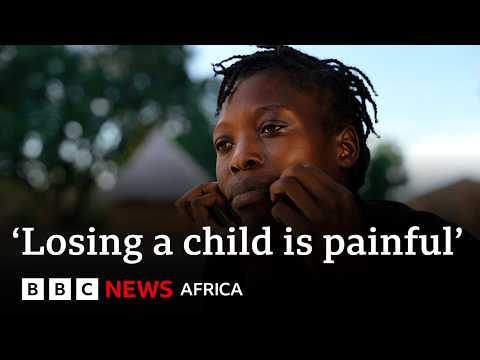
[0:02]On the outskirts of Mazabuka town in Southern Zambia, 23-year-old Isabel is grieving the loss of her first baby. I have not gotten over it.
[0:14]Losing a child is painful. The doctors say her baby's death was caused by exposure to the local clinic, where the baby was born that lacked basic sanitation facilities. After cleaning the child, we were seated and the child was breastfeeding well, at about 15 hours. I just saw the condition of the child changed. He developed a high temperature. I wanted to breastfeed him, but he stopped and became dyspnoeic. The symptoms Isabel's newborn developed resembled what medics call sepsis, a life threatening response the human body sometimes has to an infection, which causes it to attack its own organs. In their report, the charity WaterAid said sub Saharan Africa is the most impacted region, with one in nine women experiencing maternal sepsis. In 10 Sub Saharan African countries studied more than 76% of births occur in healthcare facilities without basic water, sanitation and hygiene. Just to give you an idea, here in Zambia, according to WaterAid, 98.8% of local healthcare facilities lack basic sanitation facilities to be used on patients before and after childbirth. Here in Mazabuka, a local clinic I'm in, the showers and the toilets don't work, in fact, the shower is being used as a storage. So how vital is water for childbirth? Rachel Modenda has been a midwife for the last 13 years. The mother has to wash hands, the mother has to bath after delivery, if that is not done properly, it means that infection will set in. According to government policy, we are supposed to observe mothers for 48 hours after delivery before we discharge them. Now because we have inadequate running water, actually our patients shower, there's no running water. And so we observe them for six hours and then we discharge them. What does that make you feel when you have to discharge them prematurely? It makes me feel uncomfortable, first of all, as a midwife because at the back of my head I know the proper thing that I'm supposed to do. WaterAid says that ensuring safe water, basic sanitation and good hygiene in health care facilities is affordable and could help save lives. Our recent report actually confirms that investing in water sanitation and hygiene is a cost-efficient way of tackling the issue of sepsis. And that in itself can translate into as much as 50% reduction in illness and death that's related to maternal sepsis. With that said, we can see from our study that as little as $1 per capita can translate into the change that we want to see. And that $1 is three times much more cheaper than actually treating the sepsis. I'm in the southern part of Zambia, specifically a town called Monze, where I've spent the day speaking to women about their experiences on giving birth to children and lack of clean water access. Just to give you an example, this dam right here is where some women told me they've had to resort to using when they don't have access to clean water, but they share it with other things like animals.
[3:30]32-year-old Precious Jemimah shared her experience with me. After I gave birth, I was still bleeding. I needed a bath, but was forced to collect water which was dirty. I use it to bath and drank it. It wasn't good for my body. The BBC reached out to Zambia's Ministry of Health to speak about this issue, but they have yet to respond. It did recently say on social media that it was launching a nationwide initiative to expand access to water, sanitation and hygiene in health care facilities aiming to tackle associated infections. But it comes too late for Isabel. Each time I think about my child, I cry. I am not okay because my heart is paining. Me, I am just seated here.
[4:36]For this grieving mother, dealing with the reality of how her baby passed away is still something she is wrestling with. But with the support of her family she tries to remain positive.