[0:04]So what are the possible outcomes of the inflammatory response? Well, a short inflammatory response with fairly quick resolution, complete resolution can occur after a relatively minor trauma. So very often, there's complete and rapid return to normal physiology and normal anatomy. But if there's a greater inflammatory insult, then there can be a degree of scarring. Because wounds heal by fibrosis and or regeneration. Now, if the wound heals by regeneration, that means adjacent healthy cells replace the damaged cells and there's complete healing, that's good. Other times there's going to be the formation of fibrous scar tissue because of the deposition of collagen. So you can get fibrous scar tissue as an outcome of the inflammatory response as well. And of course, in many wounds you can get a combination of regeneration and scarring, so you get some of each, maybe with minor scarring left over at the end of the process. But if the inflammatory insult is not removed, inflammation can go on to become chronic. It can be a longer-term condition. And one of the things you can get in chronic inflammation is abscess formation with the accumulation of pus. And pus often collect in hollowed-out areas and fills a hollowed-out area. And I'm sure you've all seen pus relieved, you can cut into a pussy abscess and all the pus comes out. And as a general principle, once pus is consolidated, if we can reasonably let it out, it's a good idea to do so because if there's pus about, best to let it out. But what actually is the pus? Well, it's dead granulocytes, the polymorphonuclear sites and macrophages, possibly with some still living leukocytes in there as well. There's going to be phagocytosis going on especially around the edges, but in the middle mostly it's going to be dead white cells and phagocytosis products, dead tissue cells that have probably been phagocytosed and bacterial cells. Some dead bacterial cells and some living bacterial cells. That's why pus can be infectious, it can be a focus of infection, that's why it's best to let it out if it's there. Also pus really counts as necrotic tissue, so you can't get healthy cells migrating into the wound very readily to heal it up, best to get rid of the pus. So it's an infectious liquid. And you get something called liquefaction necrosis. So when the cells necros, they liquefy and you get liquefaction, you get this sort of semi-liquid, thick, gooey solution of pus. And there's also probably going to be some tissue fluids in there as well. Now if something is producing pus, we call it suppurative. So suppurative means to produce pus. And purulent means something contains a lot of pus. So if something's purulent, it means it contains pus. And there's another term you might come across, empyema. Empyema means a pus-filled cavity. For example, in severe cholecystitis, you can get empyema of the gallbladder. So inflammation can become chronic if the insulting stimulus persists, for example, if the bacterial infection persists. But if pus is not evacuated, in time usually it will autolyze and gradually be reabsorbed into the surrounding tissues, but that can take a lot of time. And there is the risk of pus spreading to cause infection in other parts of the body. So if there's a large area of inflammation, as we've seen, this can result in the systemic absorption of cytokines and we can get the systemic inflammatory response syndrome. So there can be spread of the inflammatory response from being local to being systemic. And of course, if the insult causing the inflammation persists, one complication of systemic inflammation can be death. So death is one possible outcome of a major inflammatory response. But most times we're going to get resolution, it's just a case of how long it takes, usually with regeneration of tissues with or without additional fibrotic tissue deposition, the process that we refer to as scarring.
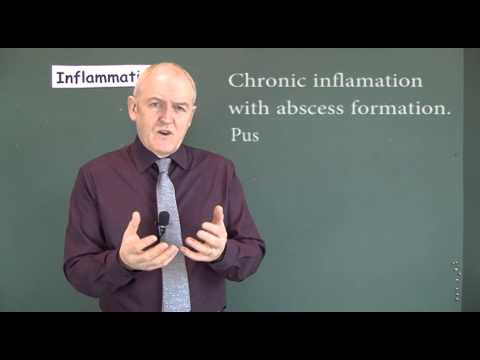
Inflammation 8, Outcomes of Inflammation
Dr. John Campbell
5m 4s665 words~4 min read
YouTube auto captions
Transcript source
YouTube auto captions
This transcript was extracted from YouTube's auto-generated caption track. The transcript below is server-rendered so it can be read, searched, cited, and shared without opening the original YouTube player.
Pull quotes
[0:04]Well, a short inflammatory response with fairly quick resolution, complete resolution can occur after a relatively minor trauma.
[0:04]So very often, there's complete and rapid return to normal physiology and normal anatomy.
[0:04]But if there's a greater inflammatory insult, then there can be a degree of scarring.
[0:04]Now, if the wound heals by regeneration, that means adjacent healthy cells replace the damaged cells and there's complete healing, that's good.
Use this transcript
Related transcript hubs
Watch on YouTube
Share
MORE TRANSCRIPTS


