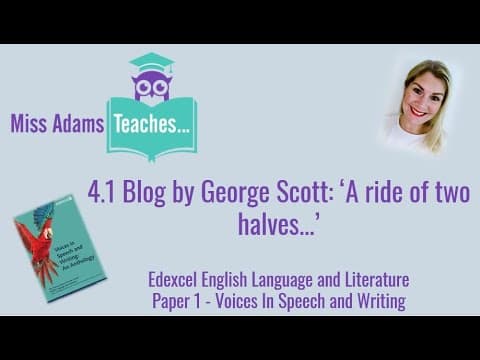
[0:00]Hi everyone, welcome to Miss Adams teaches English language and literature A level. In today's video, we're going to be having a look at George Scott's blog, A Ride of Two Halves, which is taken from the Edexcel Voices in speech and writing anthology. I'll take you through the major content, context, features of gap, before we look at some different ways to describe George Scott's voice and focus on some literary and linguistic concepts to support that. So let's get started.
[0:31]Okay, so this blog by George Scott details a particular trip that he was on with one of the cycling group on a training camp, a cycling training camp in Spain, in Mahaker. And he basically tells the story of the conditions that they were cycling in, and then his decision to go off with the guide on a more difficult cycling route, which he found really, really rewarding and exciting and adventurous. Um, and then by the end of the blog extract, he rejoins the rest of the group and has a lovely beer, you know, in the beautiful weather in sunny Spain. Now, in terms of the context of this, uh, particular blog, it was written in 2014. And at the time, he was the assistant editor of Road Cycling UK. Very, very popular website, a lot, a lot, a lot of, um, monthly viewers. Um, actually now he is no longer assistant editor, he is now editor, but he also used to work for Euro Sports, Sports Beat. So he's very, very much known for his experience within the field and in particular cycling. Um, he is certainly a, uh, very, very passionate cyclist that comes through in this, um, blog extract. There is a reference to, um, the actual training camp that is being used here, Wheels on Wheels, which is where James works. Um, which is obviously the group that is organizing this particular cycling camp. Okay, so in terms of gap, obviously what we're dealing with is a, um, blog, shortened web log. Um, for the degree, you could argue that as he's writing, there's a sense of writing this for himself, um, reflecting and recording his ideas, but actually, it, you know, it is for public audience, it's for public consumption. Um, and that audience is very specific. It's obviously enthusiasts, cycling, outdoor sports. Um, you're also going to get travel enthusiasts, because this being set in Mahaker, there is a lot of content that is to do with Spain, to do with this particular area and how beautiful it is. So there is a little bit of a crossover between travel writing and sports writing here. He will have his own following as well, and there will be audience members that are checking in with this blog on a regular basis. Um, and so they'll be aware of what cycling they did the day before, what cycling they did afterwards. Um, so obviously this is about being informative and entertaining them because obviously he wants them to keep coming back, he wants to the website viewership. Um, but there's a degree here that you might be thinking to yourself, is he trying to kind of persuade people not just to cycle, but to take part in these kinds of training camps. So in terms of the voice, again, as always, I'm just going to take you through a, uh, take you through a few little sections of the text, rather than looking at every bit. But what you're going to expect from his voice is there's going to be a really interesting blend between that sort of passion and enthusiasm and excitement for the adventure of cycling. But there's also going to be quite a lot of like factual information as well, where we get more of the sort of travel vibe. Because it's a blog, you're going to expect it to be informal, colloquial, very conversational, which is where we will begin. So let's just start off with the way that it looks. So he's given this part of the blog a title, and he's called this part of the blog a ride of two halves. Now, that will probably sound quite familiar to you, uh, because of the idiom a game of two halves. So what he's done is he's played on the idiom and exchanged the noun game for ride, which is of course, cycling specific. So sense of familiarity, but you know, there's a slight lighthearted chuckle in there, everyone loves the cycle pun. Um, but what's, I suppose important about this title is it does actually set out, um, the experience, yeah, being a sort of paradox, being both challenging and rewarding, being both grueling and exciting. Okay, starting with the first section, which is in bolden. Sorry, I realized that I haven't put that on the screen. There are a lot of graphological features here that are fitting to the conventions of the blog. I'm not entirely certain whether it's worth talking about, so I've not focused on it. Uh, but we do start with a temporal discourse, uh, temporal discourse marker, and you're going to see a lot of them running through this text. Day two's mountain ride left most of the group with sore legs ahead of the third day of training camp, so we set out for a four-hour loop on the flat coastal roads north of Mahakar. So we immediately get a sense of the informality of the piece, the reminder of the sore legs, which of course is actually about drawing attention to the challenge. Uh, we've got this shared knowledge or this presumed shared knowledge. The expectation is, is that the people reading this have read the day before and will read the next one. We call this exophoric reference because it's referencing things that have come from, uh, previous, well, in this case, a previous blog. But we are reminded that this is only day two, the legs are already sore, and that is why they are going for the flat coastal roads north of Mahaka. That is the majority of the group, obviously, they, um, George and James do a little detour. Okay, so we've got further kind of discourse markers, but I want you to think about the way that this opens. Trouble is. Trouble is, we now had a headwind worthy of the Northern Classics. So certainly it's conversational, but what the reason it's conversational is because of the sense of uh, ellipsis, elliptical phrasing here. It's not the trouble is, it's trouble is. So that informality creates a very direct, conversational, friendly tone, but it also sets up the notion of challenge. He is very clear to tell his readers that this isn't easy, you know, that it's not just, like, he wants the people who are experienced cyclists to know that there will be challenge whilst not scaring off the, the less experienced. Okay, so we've got quite a lot of subject specific lexis here, Northern Classics, uh, is a reference to a very, uh, famous race, but that is also the area of it is known to create a lot of wind. Um, so we've got the phrase trouble is here, we also have the reference to strong winds, again, setting up, um, setting up the sort of adversity in the challenge. Um, but then we also get this juxtaposition with relaxation, and you can see, um, we've got a sort of secondary semantic field of like holidays and relaxation. Primary semantic field, obviously, being that of cycling. Um, but we've got early, early cafe stop, beach front, tan lines, okay? So this is what we mean by being of two halves. Yes, there's challenge, but there's also enjoyment. You can see why I questioned whether or not there's an element of persuade, persuade persuasion here, come on these training camps, uh, because he is showing how both side, like, or both types of people experienced and inexperienced can get something out of this. Um, moving on, uh, to slightly further down in the text. This is where we start to see that factual element in his voice, that sort of credibility and authority shining through, because again, like I said, this is a bit of a blend between, uh, yes, cycling blog, but also travel writing. So we start with a declarative, Andalusia is both beautiful and barren in equal measure. So you've got this lovely juxtaposition between these adjectives, beautiful and barren, tied together with that plosive alliteration. Um, and again, notice, once more, two halves. Okay, so yes, beautiful, but there's a sort of sense of isolation. Then we move into an area here, where we've got parenthesis, created by hyphens rather than brackets, but it's still parenthesis, it still counts. And within this parenthesis, we receive additional statistics. So this is again that sense of authority, um, making sure people know what they would be getting in for if they went on a trip like this. Uh, so 200 millimeters of rain per year, so not very much. Um, and yesterday's mountain peaks had by now been replaced by arid coastal plains, with little to take the mind off the strengthening wind. So notice, we're back to the conditions again. Um, we've got again this sense of, um, Mahaka being very, very vast and expansive. We've already been told that it's going to be a four-hour loop around the flat coastal paths, um, but we're being reminded again through this adjective, the strengthening wind, um, of the growing adversity. They get a slight little shift in the voice here. So we've gone from this sort of quite factual information, and now we're moving into direct address. We've got the imperative, give me hills and a view to work for over a death march into a block headwind. So know our metaphor here, incredibly hyperbolic, uh, again, he's pointing out about what is wonderful about cycling. So he doesn't mind focusing on a hill and like and and facing challenge that way, especially if it means you're building up to a hill, but just cycling into a wind, not so great. I think in this section, when he starts talking about his decision to go off with James for a slightly harder route, he refers to it as a lumpier loose loop, sorry, back to base. You get a sense of his own pride, certainly his own passion and enthusiasm for cycling. Um, we have another discourse marker at the beginning here, after a short descent. You'll notice that all of these paragraphs start with types of discourse markers, a lot of them are temporal, um, and this is about the fact that it is very clearly a linear structure, which suits with the topic of the cycling blog. And then we've got this repetition. After a short descent, we took a detour off our detour. So, our repetition here of this noun detour, yes, it creates a sense of freedom, but that's where you kind of get his sense of pride, that, you know, that he's an adventurer, that he's not scared to take a detour, and then, hey, let's get crazy, let's do another detour off that detour. Um, so you've got that sense of confidence in his own ability and James's ability. And I think in order to demonstrate to his readers that he's not just being a Maverick, he does point out that James knows the area. So this other bit of parenthesis when he says, oh, hang on, you know, James has visited, it's been on another training camp is saying, you know, we're excited to go off piece and go off track and be a bit bold, but we're not being foolhearty. I.e. you're safe if you come on one of these trips, and that's why again, we've got that reminder of the company, a ride guide for wheels in wheels. So, yes, this is a professional company, you're not in any danger, even if you do go for a detour off a detour. It's all about creating this sense of adventure. You get that again here keen to explore a back road over the ridge. Um, towards the end, you actually, it starts getting a little bit more literary, a little bit more descriptive and emotive. Another discourse marker, another temporal one, so by now. We were in the middle of nowhere, not entirely sure of the route, and with only a farmer and his herd of goats for company. So, a little bit of hyperbole, perhaps, but what he is demonstrating to us is that it is remote, it is isolated, making it seem more beautiful and attractive. That sense of freedom is again reiterated here by the kind of play on uncertainty. Not entirely sure of the route with only a farmer and a herd of goats. So it's a little bit tongue in cheek, he's, you know, especially the kind of specific detail here about the goats for company. Um, but we're back to this declarative, which is all about demonstrating what cycling gives you. This is what cycling is about. Exploring uncharted territory with the wind and sun on your back and the traffic free road rising before you. This here, this is why I said it gets a little bit more literary, a little bit more descriptive, because this is actually an allusion to the Irish blessing or to part of the Irish blessing, which I've just popped in here for you. May the road rise to meet you, May the wind be always at your back, May the sun shine warm upon your face. And that's what we've got here with the wind and sun on your back, and we are just playing around here, aren't we, with the traffic-free road rising to meet you, rising before you. So he's just altering little parts of that prayer, which makes it feel like almost a spiritual experience. This, this incredible, like, this incredible gift that cycling, uh, gives you. Um, and again, you've got this sort of sense of remoteness, you're the only ones there, it's uncharted territory, it's traffic-free road. And then right towards the end, this is the last little bit, which is slightly more summative. James was now back on familiar territory, and we climbed up the hillside on a series of steep ramps with a beautifully smooth, freshly laid road surface. So here we have in the declarative, uh, repetition of the noun territory, but notice the jux position, we've gone from unchartered to familiar. So again, a reminder that just because they went off piste, it doesn't mean that they weren't safe and that it wasn't organized and they didn't know what they were doing. So it's, he is credible, it is safe to go on these training camps. Uh, we climbed up the hillside on a series of steep ramps with a beautifully smooth, freshly laid road surface. Okay, so this is interesting because our descriptive detail has now moved to actually like man-made, um, features. It's not just about the beauty of nature here, uh, so it's a reminder that actually sometimes you want to just cycle on tarmac, and that's lovely. Again, catering to both sides of the kind of readership or potential audience. With Badar in sight, we skipped past the turning for our villa and joined the rest of the group in the village for a cold drink. So check out this verb here, dynamic verb, we skipped past the turning. So it's saying, we weren't even tired. We were so happy, we were so relaxed, we just skipped on past, um, and joined the rest of the group in the village for a cold drink. After 90 minutes of some of the best riding of the camp so far. So the blog ends on high positives, using that superlative adjective, best, to modify the riding. So when it comes down to it, what is the best thing of everything? That's why it's cycling, ladies and gents. Um, come on a trip like this, tune in with, you know, him the next blog to see what they got up to. So there is that element of persuade as well as to inform and entertain. That's it from me. I hope that was helpful. Thank you so much for joining me. Um, and thank you also for subscribing if you have, if you haven't, do click the button, um, and then you will get more details of the other A level texts that are coming up to help you with your English language and literature A level. Give me a shout if you've got any questions on anything that I've covered or anything that I haven't covered, and I'll get back to you. Thanks again, happy revising.