[0:00]All right, we're going to do the stop Pilates five basic principles here, okay, which are breathing, pelvic placement, rib cage placement, scapular movement and stabilization, and cervical and head placement, okay? So, the first principle is breathing. We have three goals with this breathing practice. One is to utilize the full capacity of the lungs, okay? So, often we have underutilized areas of the lungs that we're not breathing into, so we're going to emphasize breath into the under often underutilized areas of the lungs. Two, we want to relax breathing pattern. Breath breathing patterns can sometimes create tension in the body, especially neck and shoulder tension. We want to have a breathing pattern that actually promotes relaxation and releases tension from those areas. And three, uh, we want to get a deep abdominal engagement, that is transversus abdominis and pelvic floor, and we use the breath, this breath technique to really get that, okay? And so, those are our three goals to the breath pattern, and there's really four parts to it. I like to break it into kind of four parts. First part is we breathe in through the nose and exhale through a purse lip, just making a real slight sound there. Inhaling through the nose and then exhaling, and just just a gentle resistance at the lips there is great. Inhaling through the nose there, and exhale again, pressing the air. Fantastic. Now, moving down the body here, I want to breathe into the sides and back of the rib cage. And then the rib cage will gently glide back down. On the inhalation, think about the back and sides of the ribs expanding, and then down. This is our three D breath pattern. We want to get the breath moving in all directions, into the back and sides of the ribs here, often underutilized areas, and then pressing the air through the lips and then naturally the rib cage funnels back down. And just keep that going there. I'm going to start talking now about the pelvic floor, okay? It's a kind of a hammock of muscle that's at the base of the pelvis, okay? And on the exhalation, we're going to add in a gentle lift of that. About a 20% engagement. We're not looking for a really strong engagement there, just a gentle contraction there inside the body, okay? So, inhale, back and sides of the ribs, exhale and lift the pelvic floor. Great. Great, Sandra. Inhale. And exhale and a little lift of the pelvic floor. Fantastic. And then while you keep that going, I'm going to talk about the final part of it, and that is the transversus abdominis, which is muscle fibers that run around the waistline horizontally, around the waistline, and they compress the abdominal, uh, wall. And actually act as a stabilizer of the lumbar spine, okay? So, now let's add that in. We'll inhale through the nose and into the back and sides of the ribs. Exhale, and lift the pelvic floor and wrap up. Great. Inhale, back and sides of the through the nose. Exhale, and just a gentle pressure through the lips there, and pulling in and lifting the pelvic floor. Inhale, and exhale, and pelvic floor along with that gentle transversus abdominis engagement. It's a very stable feeling when you get it right, right? Just a gentle contraction of those pelvic floor and transverse abdominis muscles. Great. And then one thing I want to add about the breath there is we were just breathing here with just keeping the spine still and just moving air in and out. I want to just add the note that we can use the breath there. The exhalation does promote flexion of the spine, and inhalations in general promote extension of the spine, okay? And so we can kind of use that in the exercises at times, okay? Next principle I want to move on to is the pelvic placement. When I when we talk about pelvic placement, it's really pelvic and lumbar spine, okay? And so I like people to get in touch with how the pelvis and lumbar spine move together. So, imagine you had an axis right through the sides here, right through the hip joints, okay? And just roll on that, like you roll the pelvis this way, and then roll the pelvis that way. And don't even worry about the breath yet. Just go ahead and roll the pelvis. And roll it, roll it a little more this way, and then a little bit that way. Good. Yeah. And so, you once you to notice how the pel when you think the pelvis right, its axis here, that the pelvis and lumbar spine move together. So, as you think about that, you can really adjust just the lumbar spine position by thinking at the pelvis. Do you get that? Yeah, yeah, very good. So, now I want to go and talk about two positions that we like to talk about in the in this work, neutral and imprint. Go ahead and place the hands. The heel, the outer part of the heel of the hand over the ASAS bones. Fingertips under the pubic symphysis there. Great. And when we have that, if you just rock that back and forth a little bit there, okay, when you find that place in the middle there where the that triangle that's formed there is level to the floor, parallel to the floor, that's our neutral pelvic position. In that position, the natural curve of the lumbar spine is present, okay? We like to use that position as much as possible, because it's optimal when standing for shock absorption. It's also optimal for getting that transversus abdominis engagement, so the it's a very efficient movement patterns that kind of come out of that kind of position, okay? So, we use that often also in closed leg chain, which really simply means the feet are down on the reformer, they might be on the foot bar, on the mat, they might be down on the floor, okay? So, the other position that we like to use is an imprinted position, okay? And that is, go ahead and inhale, and exhale, now roll the pelvis towards you, coming from an oblique engagement. Yeah, and then inhale, back to neutral. And then exhale. So a small posterior tilt to the pelvis, roll this way. Good. And then back to neutral. And then exhale, and pull in and roll it into imprint there. Great. Inhale, back to neutral, and exhale, and pull it in. And then we like to use this position whenever a client is not strong enough to stabilize in neutral in open kinetic chain, that is with the legs in the air, we like to use this position. So, let's go ahead and find that imprinted position and keep that. And then bring one leg into tabletop position. And then the other leg into tabletop position. Good. And an important point, this imprinted position, the spine's not jammed into the mat, but it is gently coming down towards the mat, okay? And then let's go ahead and test it out here. And inhale, and exhale, and straighten one leg out there, and back in. And then exhale, the other leg goes out there. Great. And so, you see as the leg goes out away from you, as we lengthen that lever, we have to dig in a little extra in the abdominals there to keep the imprinted position, right? So, that's our stability there that we talk about. We have to use recruit a little more abdominals to keep that imprinted position as we start to move the legs about, right? Then you can come on back in, imprint one leg down on the floor, and then the other return back to neutral, okay? So, just like the legs, now the legs challenge, uh, the pelvic placement, right? So, it gets harder to hold a pelvic and look pelvic and then therefore lumbar spine position, uh, when the legs come into the air, right? When we move the legs about, right? Similarly, arm movements will challenge the rib cage placement, okay? So, now we use two things to get the sta stability into the uh rib cage and and thoracic spine. One is breath into the back of the ribs. So, we always talk about that breath into the posterior side of the rib cage on a breathing principle. Other one is there's an abdominal the abdominal wall connects at the base of the rib cage here, okay? So, let's test that out. Let's use those two things together. Let's inhale into the back of the ribs as the arm comes to the ceiling, and then exhale, reach back there, and there's just a gentle engagement of the abdominal wall right there at the base of the ribs, keeping this stabilized against the mat. Inhaling back up, and exhale back down to your sides. There you go. Inhale into the back of the ribs here, and then exhale and arms go overhead and pull in right there. Great. And then inhale, and exhale and back down. Just one more of those. Inhaling up there, and exhaling and overhead here, really getting that nice engagement of that. Uh, rib below the rib cage there. Inhale, and exhale and back down to your sides. So, you see, we use those two things to keep the thoracic spine and rib cage stabilized during exercises, right? We use these two techniques, okay? Next thing is the scapular, uh, place, the scapular movement and and stabilization principle. And, um, the scapula are is, uh, triangular bones lying flat on the back of the rib cage, and they've got a lot of mobility, right? There's only a small bony attachment to the rest of the body, and that is through the clavicle. Okay? So there's lots of mobility in the scapula, right? We look to balance out that mobility with stability, okay? And so we want to get an engagement of that network of muscles that are around the scapula. Uh, to work all in in uh, in conjunction to keep the scapula stabilized, right? A dynamic stability, okay? Let's explore scapular movements, okay? So that you know what I'm talking about. Okay? Let's reach the fingertips to the ceiling here. And I want to explore protraction and retraction. Let's go ahead and inhale and reach the fingertips up to the ceiling, and then exhale and back down, to neutral position. And then inhale, reach up, and exhale and back down. Good. And you'll notice that's what you're doing there is widening the scapula on the back of the rib cage. And then they come towards each other, just back to their neutral position. One more time. Up there. They widen, they spread away from each other. And then they come back down. And now let's retract the scapula. Inhale, and retract. Small movement here, and exhale and back up there. Inhale, retract. Exhale, back to neutral. Both of those, uh, we exhale back to the neutral position. Inhale, and retract. And exhale, and back to neutral. Let's take our arms down by our sides. So, what you've done now is protraction and retraction. The scapula moving this way. Now, they can also move up and down the back. So, let's go ahead and inhale and elevate the scapula up to the ears here, and then slide the scapula down there. Great. And up to the ears, and then exhale, and down. Fantastic, Sandra. And then up to the ears there, and then down. Great. And so, we've explored movements going horizontally, you could say, protractions, retractions and up and down also elevation and and depression. One other movement of the scapula we'll talk about is rotations of the scapula. They can as they're sitting on the back of the rib cage, rotate upward and downward, and it's really best to just do that with our arm movement, okay? So, I'm going to have you do an arm circle. Let's just inhale and take the arms up overhead, behind you, and then exhale and come around. And then when you do that, the scapula will naturally upwardly rotate here, and then as you come back down, they'll downwardly rotate back to their neutral position. Maybe just one more of those. And then down. Great. We'll take a break there. Fantastic. So, we always start exercises with the scapula stabilized, okay? So, we want to just be aware of where the scapula are in any time and exercises, and also we want to start with them stabilized in the neutral position as much as possible, okay? Moving up now to the head and neck placement principle, head and cervical spine placement principle. And, um, we could say that the neck has a large range of motion, right? The flexion and extension, lateral flexion, rotation. All of the spine movements are there's a lot of movement available there. Our goal is to stabilize the cervical spine, okay? And is our goal, you could say is that the the cervical spine follows the line of the thoracic spine, that is to say if we are in flexion with the thoracic spine, the cervical spine is in flexion also, and to a similar degree. And if we're in extension in the thoracic spine, the cervical spine is in extension and also to a similar degree. We don't want to overdo the extension, that's a strong tendency to do that, right? So, um, uh, and then also I want to say if if someone were looking tense in the neck here, in in this supine position, so if we see a lot of neck tension in that supine position, we might place pads under the head there to just release that. They should be in a very, um, um, relaxed position of the head and neck there, okay? Now, before we come up into a flexion position here, we want to start by, since that's going to be a flex thoracic spine, we want to start with just a small flexion in the in the cervical spine, okay? So, we call that a head nod. Let's go ahead and inhale and lengthen the back of the neck there, and then exhale and back to looking straight up. So, you could say your gaze goes here. Inhale, and exhale and back to looking straight up. Inhale. Down a little bit. And then exhale, and back up. Small movement there. And we're recruiting these deep, uh, uh, stabilizers in the neck there that to flex the spine. Inhale, and exhale, and it shouldn't be a tense position. It shouldn't be a forceful kind of a thing. Real gentle, small movement of the neck just to prepare bringing the head up off the mat. And maybe we can even do a couple of those. Let's do a couple of ab presses. Let's inhale and lengthen the back of the neck. Exhale, and we slide the ribs towards the pelvis to come up. Inhale, and stay there, and exhale, and back down. Good. And inhale, and lengthen the back of the neck. Exhale, and curl on up into it. Inhale here, and exhale and back down. Inhale, and lengthen, and exhale, and curl up there. And just look right down at the thighs. Inhale, and exhale, and back down. Fantastic. And that is your Stop Pilates five basic principles.
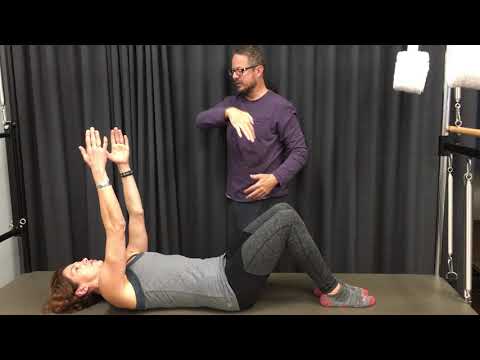
Basic Principles Sandra B
David Freker
12m 54s2,597 words~13 min read
YouTube auto captions
Transcript source
YouTube auto captions
This transcript was extracted from YouTube's auto-generated caption track. The transcript below is server-rendered so it can be read, searched, cited, and shared without opening the original YouTube player.
Pull quotes
[0:00]All right, we're going to do the stop Pilates five basic principles here, okay, which are breathing, pelvic placement, rib cage placement, scapular movement and stabilization, and cervical and head placement, okay?
[0:00]So, often we have underutilized areas of the lungs that we're not breathing into, so we're going to emphasize breath into the under often underutilized areas of the lungs.
[0:00]Breath breathing patterns can sometimes create tension in the body, especially neck and shoulder tension.
[0:00]We want to have a breathing pattern that actually promotes relaxation and releases tension from those areas.
Use this transcript
Related transcript hubs
Watch on YouTube
Share
MORE TRANSCRIPTS


