[0:00]you turned a $90 investment into $50,000 in a year. On the side. Yeah. Yep. Geez, you could start this for free if you really wanted to. I probably closed 95% of my deals over Messenger or text. Wow. Without having to hop on the call? Nope. I didn't have an LLC for the first two cards that I sent out. That's fine. I always just would get caught up, you know, worrying about making sure the website looks good and the the logo and all this. I was like, no, this time, I'm not doing it. I'm just going to make sure I can actually make money before I I go and spend money on doing all this stuff. And so it's like, I started this business for less than 100 bucks. This just kind of snowball into something that I wasn't really expecting a year ago. I just wanted some extra money and now it's turning into this full-time. We built a multi-million dollar business with five or six pieces of direct mail to a few thousand hair shops. It works. So, yeah. All that to say, like, you should dog food it, right? You should eat your own dog food and use your product to find more services for your product.
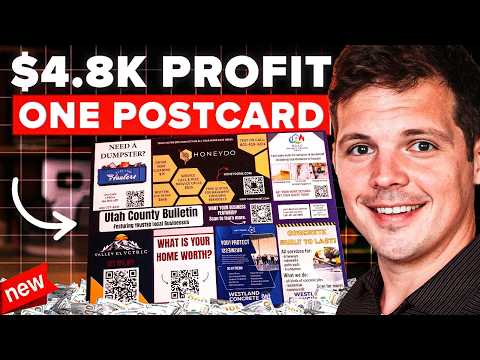
[1:06]So I just came across a 25-year-old on Instagram doing something wild. He turned 90 bucks into 50 grand in one year from his phone. He's never cold called, he's never ran an ad. He's never even hopped on a Zoom. He closes 95% of his deals in Facebook Messenger of all places. And one plumber even paid him $1,100 after five texts. No skills, no experience, no employees. He pockets about half of everything he collects as profit. And at the end of this, he's going to show me how to acquire as many customers as you'd ever want. And even more interestingly, he's going to show me this weird Facebook trick that he uses to make plumbers and other local business owners DM him first. This isn't an AI business or a sweaty startup. But whether you want to do this on the side or full-time, you're going to love it. Please enjoy. So, what I do is I sell advertising space to local businesses in my area on shared postcards like this. So, here's one that I did, and you know, filled front and back. You know, here's another one that I did. And so, I filled the ad space with local businesses. I only allow one business per category on the card, so I'm not going to put two landscapers against each other. So, um, they get full exposure for whatever services that they want to offer, and then I will send it out to the local area. So, this this card right here went out to 10,000 homeowners in, you know, the city right next to me. So, I got businesses that service that area or were in that area. And then, the way that I send it out is by using the USPS Every Door Direct Mail tool, so I don't need a a mailing list or names to send these cards out. Man, I'm just thinking, I'm trying to compare it to like something different, like a newsletter. And a newsletter is like a two-sided marketplace. You need the supply of the email addresses, which you got to go out and find. Paid ads, organic, you know, one by one by one. And then, you need the demand from the advertisers, which is usually in the newsletter business the harder part. Yeah. But you're over here saying, like, I've got a marketplace, but I only need to fill half of it, because I can legally, thanks to the US Postal Service, EDDM, every door direct, yeah. I can mail anyone in the world that I want to mail for for 40 cents or whatever, right? Yeah. I just need to find the advertisers for the postcard, is that accurate? Yeah, so I pick the area. I'll go out to the USPS every door direct mail tool and I'll type in the zip code that I want to target. And usually I'll I'll sort by higher income, just because they're mostly single family homes. Because you don't want to you don't want to get a bunch of home service businesses like a landscaper, a roof, and then send your card out to condos and apartments, you're just going to be wasting those people's money. And so pick the area and then I match the advertisers to that area. And so I'll sort my income, and then I have a break even point, right? So, it's like I got to fill the front half of my card to cover printing and postage. 25 cents per home to send out a card. That's to like buy the the data or for the stamp to that home. So, this right here is the Indicia. Every card looks exactly the same. Yep. And so, the cards will come printed with the Indicia. And so it's 25 cents per mail piece. And so if you buy, you know, if you buy 10,000 mail pieces, it's $2,500 in postage, and then printing 10,000 of these cards right here, which this is like a a 14-point, so it's a thicker like card stock type paper, it's a little bit nicer quality, stands out in the mail. And that's going to run you about $2,300 for 10,000 of those cards shipped. Okay. So, your cost is like about $4,800, and to fill the front of the cards, because I'll sell this is a 3x4 inch space here, and then a double space. So I sold $600, $600, $600, $600, and then $9.99. Um, and then I have some half ones on here that I sold for $3.50. And so, basically, you need to fill the front of your card. To break even. Yeah, to break even. And everything after that is profit. So, I'll just post on Facebook, in Facebook groups, you know, your local business networking groups or contracting groups. And I'll just say, like, hey, you know, I'm putting together a shared postcard. It's going out to thousands of homes in, you know, whatever area I'm sending it to. I only feature one business per category, so it's first come, first serve. And then the business owners will comment below and and then they'll purchase or ask questions, and so we'll go from there. So, that's one of my favorite prospecting methods is just posting in groups. Okay, let me let me summarize, because I'm like, I'm about to get manic here in a minute. I'm about to get manic. So, you don't need to like, you know, lick a bunch of envelopes and ship them out and have these days where you do You don't do any of that. You find a printing company, and there's tons of them. And then you find the US Postal Service, and you say, after you get your advertisers, your sponsors, you throw them all together, right? You design them, you put them in Canva, whatever, you drag them around, you make them all fit, you send them to the printing company, you say, I need 10,000 of these, and then here's the address. And you probably give them like the US Postal Service address, I imagine. Yeah. Are you getting like a sample from them first just to make sure it doesn't look bad? I have a printer that I've been printing through. He does a great job. So I do know that that printing, he does a great job printing, but if, you know, but there's plenty of other places, but I do recommend people go and try to get a sample from them first. Because, right, you don't want to have 10,000 cards show up to your house or 5,000 cards and they look like garbage. Yeah. And so, you know, 14-point UV gloss card with color on both sides is typically, you know, a good quality card with plenty of color on there. And so I would just make sure that you know the kind of paper quality that you want, but that is just a good, like, standard quality right there. So, these printing companies, you can either get them printed and sent to your house. So I had these this run of 10,000 cards sent to my house. Uh, this run of 10,000 cards sent to my house. And they will come pre-bundled, you'll need to get them pre-bundled into hundreds for the USPS to actually accept them. So, you can get a sample, or you can just, uh, you can have them shipped directly to you. Because from what I understand, USPS has like, um, they have like different distribution hubs. You've got like a post office, but then you have like a distribution hub. DFW might have one or two. Salt Lake might have one, et cetera. So, you can take it yourself, but you have to label it correctly. I used to have a direct mail business. So, like, and it was a pain. It was it was like a pain to get it all set up. But once you get it set up, it's great, right? Anyway, so, once you're set up and you're confident with the quality you're getting from a vendor, theoretically, you could just say, he could they can send you the PDF, you're like, yep, looks good. Ship it to the post office. They ship it to the post office, it goes out, and then you're done. And the unit economics are, you spend about $5,000 and some time in aggregating these sponsors, mostly from Facebook groups. And then, if you fill it out front and back, then you make about $9,000 to $10,000 revenue. So, for every $10,000 mailing, you're hoping to profit between $4,000 and $5,000. Is that accurate? Yes, that's correct. And you don't really have any costs. You don't really need employees, at least until you're at scale, because you're not doing the printing, you're not doing the shipping. You're just connecting pieces, sending emails, sending stripe links, pay your invoice, $400 for this landscaping service, $3.50 for the orthodontist onward and so forth, right? Yep, that's correct. How recurring is your business? How often do people want to do another and another and another mailing? So, yeah, that's a great question. So, typically, there are two different card types, I guess, in this industry that you can put together. So, this is something called a 9x12 card. It's 9x12 inches. It typically goes out to five, ten thousand or five or 10,000 local homeowners. The ads are going to be, you know, a little bit more premium, a little more customized, whereas it's like this is a 6x11 inch card. We call this a community card. And it will go out to 2,500 homeowners. And this it's a better card for, you know, a local bakery, a restaurant, these these lower ticket businesses that just want to offer a coupon to their local community because they're a brick and mortar store. So, I ran this one for three months. So, I had them sign up for a three-month run. Whereas these ones, they they just ran one time, but I do have some repeats that carry over into the next cards. So, I will always reach out to the the previous advertisers. I'll say, like, hey, you know, I'm putting together another card. It's going out to, you know, 5,000 homes in, you know, a city that's right next to the one I just sent my card out. Mhm. You know, would you like to take a the landscaping spot before I reach out to other landscapers? And really depends on how you set up. You can set it up to run monthly, or you can set it up to run once and just get these businesses the exposure to direct mail marketing and to a local community. So, you said the small ones are 6x11? Yeah, 6x11 inches. Hey, YouTube's fine, but what about when you're driving around? What about when you're mowing the lawn? You need my audio podcast, The Kerner Office. Just look up TKOPod in Apple, Spotify, or wherever you get your podcasts. And when you say a three-month run, are you sending the same thing three times, once a month for three months? Yes, I'll send the the same card. This one that I sent out three months, I sent it to three different routes, each month. to kind of test different offers. But I'm going to put together another one that's going to go to the same routes, the same offers to get the same exposure. So, I'm just it's fun to test and try different things and see how different parts of the local community respond to the advertisers. So, Yeah. Yeah, because if I'm a restaurant, I want repeated exposure, right? Like, I want to be on top of mind once a month for X number of months. Why is that different for a landscaping business? Why would they not want a monthly run as well? That's a great question, and it it just comes down to the particular landscaper. I think, you know, a landscaper should, a plumber should. Um, I think the, you know, direct mail, especially utilizing the EDDM tool is very. They used to be, you know, direct mail used to be a big thing, and then once digital came along, direct mail kind of died down. It's back, baby. Yeah, direct mail doesn't work. Well, it's like your competitors are probably all thinking the same thing right now. Why don't you go and and own the mailbox? Like, you can still run digital. It's not here to replace digital. It's not better. It's not worse. It's just another tool in your toolbox to to utilize. And something like a shared postcard is just a great introduction into that world of direct mail. Yeah. Here's what I think is wild, like, there's so much regulation around emailing, like the CAN-SPAM Act of 2004 or whatever. You cannot just like send emails to someone soliciting something unless they opt in. Cool, got it. Text message marketing is like super regulated, which I get. Who doesn't hate getting a spam text out of nowhere, right? I get it. I hate it. There's a $5,000 fine per text sent, right? Which is crazy. But when it comes to forcing someone to I have a 200-foot like gap between my front door and my mailbox, 200 feet. Yeah. When it comes to forcing a human to walk up to 200 feet to their mailbox, risk getting hit by a car, in my case, to check the mail, there's that's totally fair game. Anyone can mail anything they want to anyone on the planet, right? Yeah. It's wild. And it's funny that you you mentioned something like that, because I do like I say, I post a lot of social media videos about this, and I will get people that would just like, stop filling up my my trash bins, like, you're sending crap to my house. Or you're terrible like people just hate on me for no reason. Like, is it really, is it really that hard to just like toss it in the recycling bin? Like, genuinely. And then I always say, like, but did you see something like this with local businesses? Like, how many times is this getting sent to your house? Because I guarantee you, it's not getting sent to your house very often or at all. So, you're just confusing go go complain to like Discover or Wells Fargo. You know, I get those things all the time in the mail. So, yeah, I just think it's funny. I think I just realized why it's legal. It reminds me of the bot problem that Twitter's had since day one. They have so many bots. And for a while, they threw around the idea of like, any new Twitter user had to have their card on file. Which is crazy, right? Could you imagine Facebook or Instagram needing your credit card, even if they didn't charge it? Like, they would have no users. That's so much friction. But it was so frictionless and easy for bots to create and multiply and multiply on Twitter, that like, Twitter just could not stop it. They had no idea how many users were real and how many were bots, because it was free and frictionless. Sending an email, sending a text is free and frictionless. So, I feel like, just the fact that it costs money to send mail is the reason why it's unregulated, right?
[14:06]It's anyone can send anything they want because you got to have money to do it, you know? That's kind of besides the point, but I'm sure that, like, you hear a lot from your sponsors, like, let's say I'm a landscaping business. I just need one sale to make this work, right? I just need one sale out of 10,000. And then you're like, absolutely. Yep, that's it. Sign here. Tell me about some of the ROI that your sponsors have seen from this. Because I would imagine it's all across the board. You probably have people that are like, didn't hear a thing, not even a phone call, and then they maybe did, maybe didn't, but they're not attributing it, they're not using it a different phone number, whatever. And then you have other people are like, dude, I got a $13,000 concrete repair job from this, you know, this is amazing. Yeah, so that's a great question. That is actually one of the most common questions or objections that I get. When I do this, what is going to be my ROI? And so I'll tell you what I tell them, which is, I, I can't guarantee ROI. I don't promise it. Like, I I'm selling you exposure. Like, you're getting exposure for for into your local community. The cheapest way possible, except unless you go and hang up door hangers yourself to 10,000 homes, but then you're paying with your time, which is the most expensive. And so I can't guarantee exposure because, one, you know, the business type might not be something that homeowners might want, so I can't control that. Two, the offer on the ad. So, I help these businesses try to come up with a good offer, but some just don't want to put an offer, they put weak offers. So, I let them know, the stronger the offer, typically the better results you're going to see. And then, three, just probably the most important, which is the system set up to actually keep track of leads. So, I provide free dynamic QR code with every single ad. So, I design all of the ads for free for the businesses. It's part of the purchase price. And I'll throw a dynamic QR code on there for them to keep track of scans. So, I can see what kind of ads do better in the ads with the better offers and the more simple ads typically have seen more scans. But like, even then, I can't control somebody calls your number instead of scans the QR code, because, you know, an elderly person just might call you for their landsca landscaping services. Well, if you don't have a unique offer tied into that ad, well, you're going to have no idea how or where that person came from. And so, that being said, some businesses have seen, like you said, more results, well, others have not seen, you know, anything. So, I had a bakery on my cards, dropped the cards off. The offer right here, I have it, is free sweet pocket pie and or cookie, no purchase necessary. Are we talking about Lehi Bakery here? This one is grapefruit and thyme. Oh, okay. I love Lehi Bakery. Shout out Lehi Bakery. So, that's a great offer. Who doesn't want a free cookie? And it's going to 2,500 homes near her bakery. Well, dropped it off at the post office, the post office then distributed the cards the very next day. Well, she had four people walk in, redeemed the offer, and then bought additional. All four? All four of them. The day that they'd landed? Exactly. And so, she I'm super, like, I'm so happy that you got on my my I got on your card, because, you know, I had four people walk in and they bought additional. Dude, a free cookie to a Utahn is like crack to a crackhead, dude. Exactly. That is like the best offer in the world. So, I'm like, now, if what you bake and what you make is good, and these people are satisfied, well, now they're going to tell their neighbors. They're going to tell their friends. It's like, your ROI, you know, like, you're your you're still making money from this campaign. You just don't really know it. And then I had a carpet cleaning guy. He, we sent him out in May. He got a call in September for to come clean carpets. So, that was a little bit probably more delayed than he would have liked. And then I had a junk removal business that started getting a bunch of calls. Now, I I asked him if like, where you convert any. He never filled me in on that. Dude, if I were you, I would make like a very sophisticated process about maniacally getting follow-up from your sponsors on how it's gone. Every week, every day, because that's going to be your best sales tool ever.
[18:22]Yeah. Those case studies in the Facebook groups will sell more than you ever can. Yeah. I need to I need to be, because I'm I'm very tedious when it comes to following up when they're interested.
[18:45]Thorough, yeah. But then after I send it out, I was just like, oh, hey, how'd it go? Like, what kind of results, like, did it bring in what you thought it was going to bring in? Like, some of them just like never fill me in on it. And, you're right. I do need to do that. I need to be more be just as, you know, tedious with my follow-ups, yeah. In the case of the bakery, like for the first day, do you know how it looked like over the next two, three weeks? So, I know, because I I had a couple extras that I gave to, like, one of my my wife's friends. And so she went in, and she redeemed it, and I think over the course of the three-month run. So I think she paid a total of $350 for that entire three-month run. I think she said she had 15 to 18 people total come in and redeem that coupon. And I don't I don't know if they bought additional items. And so, but I do know that at least four or five people came in, they used the coupon. They bought stuff, you know, now they now they know if, you know, if what you make is good or not, so now they can, they'll probably share it with their friends, their neighbors, it'll be kind of that that go-to spot. Like I kind of said earlier, a lot of these a lot of these businesses don't really understand kind of like the the exposure aspect of something like that. Like, yeah, you maybe month two wasn't as good or month three wasn't as good as month one, but, you know, you did have people come in from it, and you don't know how much they're going to spend over the course of the next year or two or however long your bakery is there. Um, because like, one time, I got some chickens a coupon in the mail for some chickens, and I never heard of them. But they had a good offer. I went and redeemed it, and I've probably paid for that entire mailing campaign myself for the last course of three years. Because I got the exposure to their business, and I redeemed their coupon. And so, that's why I try to tell businesses, like, at the end of the day, like, you are getting exposure. I sell exposure. It's like, it's a mini billboard that's going into people's mailboxes. Well, they say that, you know, 50% of marketing works, but you don't know what 50%. Yeah. And I mean, transparently, there's probably some clients, some industries, whether the offer is good or not, it's just not a great fit, you know? Not every marketing channel is a great fit for every business. Mhm. Have you seen any industries that this works particularly well for? Home service industries work really well, because, you know, like home cleaners, right? Everybody, even whether you live in an apartment or a $10 million house, you know, sometimes you want your home cleaned. And then, if you send it to the right area, landscapers do well, or just a lawn care guy. So if he only specializes in lawn care, and then I have a like a dog yard scooping services, you know, junk callers, carpet cleaning, window cleaning, plumbers, permanent holiday lighting. That's a huge thing in Utah. Real estate. So, we ran I ran an ad, like what is your home worth? Scan to find out instantly. That got a lot of scans, you know, to get people into an email list or or whatever you wanted to do with that. Did you know you can build a six-figure business with only a 10,000-person email list? I just talked to the founder of Beehive, and he told me that there are people with 10 to 15,000 subscribers making more than newsletters that are ten times that size. Here's how. Well, this one design newsletter with around 15K subs doesn't just sell ads. They run two-week online cohorts four times a year that generate six figures, and on top of that, they're charging companies $20,000 to $30,000 to get in front of their audience. And that's on one small focused list. This is not about going viral anymore. It's about owning a niche and monetizing it correctly. And Beehive gives you exactly the tools to do just that. Like surveys to understand exactly who your readers are, or a built-in recommendation network to grow automatically. Paid subscriptions, digital products, sponsorship tools, and you keep 100% of the revenue. You don't need a massive audience to run a successful business. You need the right system. So, move your email list over today and try out Beehive with 30% off for 30 days with code Chris30, because this might be the simplest, highest-leverage business that you can build right now. Just go to beehive.com/chris to learn more. That's BEEHIIV.com/chris. How did you land on pricing for this? There's a group of people that do this. Just kind of all across the nation. And I was able to connect with a guy in Ogden. So, about an hour and a half away from me. And so, he was kind of able to show me the ropes, like, okay, like, how to how to take it to the post office, like, how to bundle everything and get everything ready to go. And we walked through pricing. And so, I kind of just took his pricing and and changed it. Uh, but typically for a larger card, like 10,000 homes, you don't really want to be charging more than 10 cents per home for a typical like average space. And an average space is going to be 16 average spaces on a card, typically. So, you don't want to make sure that one of those 16 spaces like this is more than going to be more than 10 cents. So, you know, six cents per home for this space, and then this one's going to be 10 cents per home, because it's a double space. You're getting you're getting double the exposure. And so, yeah, you just kind of play around with pricing. Some areas you can charge more, right? If you're in like Southern California, people are just typically used to paying more, so you can you could charge $800 for one of those spaces. Uh, whereas like, if you're in a smaller town in the Midwest, $600 might be too expensive. You might want to charge, you know, $4.50 or $500 for one of those, you know, average spaces. You just kind of you play around with pricing, and you know, like, if you fill your card up in in two days, then, yeah. Price is too low. Yeah, it takes you forever to fill up your card. You know, maybe you're not doing the outreach. Enough outreach. Maybe you're not really helping them see the value, or maybe you're charging too much. And so obviously, like, I want to make $20,000 on one of these cards, and send it out to 5,000 people. Well, that's just going to be unrealistic because. Yeah. You just the value doesn't justify the price that you're charging. So, you want to make sure, like, okay, like $600, they get a 3x4 inch space. I'm designing the ad for them for free. I give them free revisions. So, if they hate the ad, I'm going to redesign the entire ad. I'll help them create a good offer, if they don't really know where to start. And I provide a dynamic QR code for them, so they don't have to go pay 20 bucks a month for software or anything like that. So, I keep track of the scans for them. And so, I try to, you know, give them lots of value on the back end. So, it's like, you're not going to have to worry about thing. Yeah, pricing just kind of have to play around with it, right? You might, you know, somebody listening wants to try this, like, maybe you want to charge $700. You know, and and then you can always go lower. So, you're looking at like five to ten cents per home, depending on the size of the ad. Yeah. Give or take. Whereas like the the smaller cards like this, like you could charge $250 for a 2.7 by 2.5 inch space. Send it out to 2,500 homes, that's 10 cents a home. Um, you can even charge $300, and that comes out to like what, 12 cents a home. But the the barrier of entry to get on that card is much lower. And so, what I have found is that most of the businesses really just, as long as their reach is 2,500 homes or more, like in the thousands, they only are concerned with the price, right? And so, like, yeah, the you could have a way better deal and pay six cents to be on my 10,000 card, or you could pay 12 cents and be on my 2,500 run card. And for them, they'll probably go on the 2,500 card run because it's a, you know, they're not spending as much to get on that card. Whereas some people, like this space right here, I message this plumber. I found him posting in a bunch of groups, and I, this is my first card that I ever did. And I was in the back of my truck, my dad's truck, coming back from California, from a wedding, and I just shot him a message. He said, yeah, I'm interested in the details, sent over the details, send him the mock up of the mock up of my card, where it's going, how it all works. And I was charging $1,100 for that space. He said, I'll do the $1,100 space, sent him the invoice, and it was paid. It took like five messages to sell that. So like, some people, when they get it, they like, they get it. They just get it. And it's like, it does most of the heavy lifting for you. Well, especially if they're already, like, hustling for for customers in Facebook groups, like, they're hungry. They're they're actively marketing. Like, those are the people you want to close. You don't want to try to convince someone to start marketing their business. It's just not going to work. Yeah. Right? How many of these sales do you close like via DM or text? And then how many do you have to get on a call with? I probably closed 95% of my deals over Messenger or text. So, without having to hop on the call. Nope. I sold I sold this space to a guy over the phone, but because this real estate guy referred him to me. So he's already, like, a warm lead, and, you know, 10 minutes, and he bought the $1,000 space for me. But yeah, most of the most of these people, they come from my Facebook posts. In fact, this card, every single business on this card, except for two of them, came from posting in Facebook groups. So, I actually, I did do outreach for it, like, via email, but most of the people that took the spot, they came, they saw my post, and then, you know, 30 or 40 businesses would comment, and I would just kind of sit there and kind of whittle them down a little bit and then get spaces sold. So, are you able to share your screen and show a post? What what one of your post looks like. Let's see. Let me let me get pulled up here. And for those listening, we'll describe what what we're seeing here. So, here's one I posted April 1st. Can you can you zoom in a little bit? Okay, perfect. So, I'm putting together a little co-op of local businesses as a way to work together to reduce crazy marketing costs. The postcard will be sent to thousands of high income homes in Draper, featuring respected local businesses who serve that area. I don't allow competition, one from each industry. So it's first come, first serve. Ooh, first come, first serve. That's a solid way to end the post. Yeah. And then people go in and, you know, PM sent. They sent, like, this person right here, uh, I just actually sold a $497 space to them yesterday over Messenger. And, so, yeah, I just reach out to every single one of these businesses. Some of them some of them just won't be a great fit like you were saying. They have, you know, an e-commerce business. And I I'll feature I've featured a few e-commerce businesses before. But typically, I'm like your kind of business, like, yeah, sure, you can send it and you're getting exposure, but like, you need to probably spend more time doing organic and Facebook, running Facebook ads. So, I will turn away businesses or, like, I get some B2B type businesses, and I'm just like, look, this is going to homeowners. I can still share the details with you if you want, but, like, I don't think this would probably be the best fit or the best use of your money. So, some of these businesses, like, more B2B businesses, and I just kind of I've just turned them away. But that's just one of my posts. Here's another one from March 18th. Same post. So, I kind of post the same thing. I don't I will say that I don't spam it. I post once a week in these groups. Okay. How many different groups are you posting in? I've posted in 10 at a time, just because Facebook allows 10 total. But there are two that just like do really well. Okay. And so, I sometimes I I will post just in those two groups and spend time, um, in those two groups. Where, sometimes I'll post in the other ones, and, like, maybe one of those groups will get will get a comment. Because there's a very there's a very particular method that I like to do that I kind of discovered. That's what this podcast is here for. We need sauce. Perfect. So, when I post, I will like my own post, and then I will comment, comment or send me a DM if you're interested. So, my Facebook post gets a like and then a comment right away. And then I will take my business account, my business page, so Purple Mountain Advertising. Excited for this one. And I will comment with that. I will like my post. And then I will go back into my personal account and I will, you know, reply to myself. So, now I have proof it's social proof. You're engineering your own social proof. Yeah, so I have I have three comments and two likes. And so, everybody else who's posted it at that same time, well, my post is now going to get pushed above theirs and get put on to more feeds. Because it's Facebook's going to start recommending it as something that is worth viewing, I guess. And there's a very particular time you need to post at. Which I have found is Tuesday, Wednesday or Thursday between 6:45 p.m. and about 7:15 p.m. People will post at 10:00 a.m. or 12:00 a.m. Like, I do custom websites. Well, the people that you're trying to serve are at work. They're not looking at Facebook. By the time they get back from work, they check Facebook. Well, guess what? Your post is clear down in the feed. They're never going to see it. But I post at 6:45. Saturday, dinner's over. They're kind of sitting down. They're scrolling Facebook. Boom. My post is there. It's short and sweet. So, I believe this part right here that says first come, first serve, or maybe just the first serve part will be cut off. But you don't want to have a super long post. Yeah. That requires people to click see more, because people are lazy. They're not going to click see more. You're just adding another point of friction. Exactly. And so, this post is short enough where they can get the idea. And they'll comment. I mean, they do have to click see more. I think Facebook, I swear, Facebook shortened it a couple characters, because I I swear, you know, before it it showed the entire post, but it still works great. And so, yeah, I'll post in these groups, you know, once a week. I've posted twice before, but I don't want to come across as just spamming. But these groups are a great way to actually find businesses as well. And that's how I was able to sell that plumber on that $1,100 spot, because he was posting in these groups. I was like, well, he's already open to getting his business name out there, and he's spending his time posting. So, I'm just going to, you know, pitch it to him. And so, I've made, you know, a fair amount of money just by being in Facebook groups, my local business Facebook groups. What types of groups do you have the most success in? Is it like the business networking groups that we're seeing here, or is it the like the local city groups, like, you know, residents of American Fork, you know, Salt Lake City neighbors, etcetera? Business ones. I, because the the neighborhood ones, they a lot of people are very, they don't like the advertisements as much. And so, it's harder to to kind of get through those. Or they'll it takes forever to get approved. And so, I like these business networking groups, because they get approved almost instantly. Or they don't have any they don't have to get admin approval. But I'll typically stay out of the groups that just like that are free, you don't have to, like, really answer where you're from, and then go into the group, and it's just like a bunch of just, like, crazy stuff in there. And there, you're like, what is this group? Like, who's moderating this? So, I won't post in those, but, like, this Utah Business Networking one, they rarely get, like, these spammy posts. Like, it's a bunch of people that are actually trying to network with each other. And so, I like Utah Business Networking, and there's another, like, Utah Business Networking page that those two I've seen the most the most results from. I mean, Josh, you know you got to do, right? You need to start your own Facebook group. This is much easier, unless you already have. I I actually have a Utah County Business Networking. Okay. I really put I haven't put much work into actually growing it, but I do have one. People would be shocked at how organically you can get people to join your group. By literally just creating it, filling out the info, and waiting. No paid ads, no marketing. Just waiting. And, you know, you'll go a week and you won't have anyone. Then you'll get two people. Then you'll get seven the next week, then you'll get 20, then in like, like, they'll just start coming. And you post, like, welcome new members. Like, we've all seen how it works in Facebook groups. You could do this with 10 different groups at the same time, like, Utah HVAC owners, Utah home service businesses, blah, blah, blah, blah, blah. And you could have like this network of Facebook groups that you own the audience. Like, you can approve every post. We did this for our our Texas Snacks, our Bucky's business. I heard about that.
[34:40]We owned Bucky's fans, Bucky's lovers, Bucky's, we we bought them from other owners. We started them, they have hundreds of thousands of members. So when we have a new sale or a new coupon code or a holiday, we just post, and it gets shown to everyone. So, it's a beautiful thing. Yeah, it's awesome. Listen, I need more people like this to interview on my podcast. So, if you know of someone with a side hustle or a business that's unique and cool and super profitable, email Molly, molly@cofounders.com. That's one word, cofounders.com. molly@cofounders.com, tell her your story, and we'll give you 100 bucks if we end up interviewing them.


