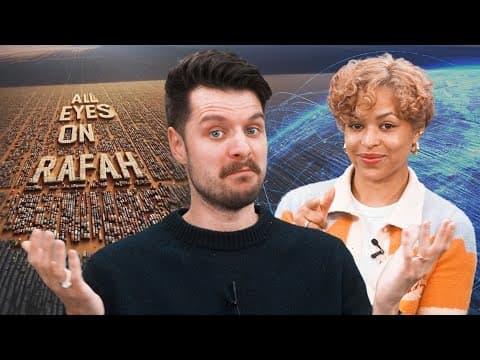
[0:00]In the wake of the viral all eyes on Rafa AI generated image, there's been a renewed conversation about online activism and how effective it really is. Is it just virtue signaling? There's so much arguing and infighting online and it can get quite overwhelming. So I really want to create a little space here where we can just hash things out in a way that feels helpful. So today, I'm delighted to say I'm joined by Moya Lothian McLean, a journalist and contributing editor to Novara Media who has written extensively about activism. And who's going to help us unravel some of the debates around online activism, especially in relation to Gaza. So Maya, thank you for being here. You smashed that name pronunciation. Thank you very much. I was a little bit stressed about it. I know you practice. No McLean here. You have the dubious honor of being our first ever guest on Scroll Deep. Oh my God. Okay, well, I really have to pull out the big guns out there. Yeah. Depending on how it goes, possibly our last guest. All right. So let's start with the the all eyes on Rafa image. We'll put it behind us. This was this AI image that was shared tens of millions of times. Celebrity shared it, um, activists shared it. Immediately in classic internet fashion, it was a big thing, and then there was a backlash to it, and then a backlash to that backlash. Some people have said that it's just basically completely useless. Is that your gut response to it? 47 million people shared that, which isn't something to be sniffed at. My gut reaction to it first was, this is really annoying. And then I thought again, I thought, hang on, this has got some of the most traction that we've seen for something related to what I call and a lot of other people call the genocide in Gaza. And sometimes you have to have watered down elements sadly in order to be effective. It's not the only thing that's coming out there. It doesn't mean it doesn't stop there. Some people might stop at that image. But other people go on and they will read about what's happening in Rafa, and then they will read about what's been happening in Gaza and Palestine as a whole. And then they will go back and read more. There is always a place where people have to start. And I think by trying to shut down that as a potential starting point, it says more about the fact that that image is something that people feel they can control. When they have very little control over what's actually happening in Rafa and to Palestinians in Gaza as a whole. It's much easier to direct anger that has no other outlet against the people in power who are committing these acts, against people that you feel you can actually make a difference with. If even if that's like your cousin who hasn't shared anything about Palestine thus far, and you can instead direct all this anger that you feel on them from not doing enough. I think you've touched on a few things that we're going to like come on. Okay, great. Sounds a wonderful start. Um, first of all, why was your gut response that it was annoying? Because I've been on the internet a long time. And I think when you're on the internet a long time and you're on these spaces a long time, you see everything, you become desensitized. And you forget that for a lot of people, this is the first time that they might be engaged in this online activism or the first round. And I'm also aware of, you know, I've seen lots of rounds of online activism in this in this sense. And I'm aware of that it doesn't tend to translate into like long-term political tangible change. But that doesn't mean it doesn't have a really important impact. Yeah, you mentioned, you know, like your cousin random cousin. It wasn't my cousin. I just said my cousins were good. Oh, no. Sure, sure. A generic cousin, right? Because I feel like in in my opinion, in order to make any kind of meaningful change, right, you need to get like a critical mass of people. And most people are not as internet poisoned as you or I, or perhaps not, you know, super politically aware or keep up with the news or whatever. So if your cousin who posts to Instagram two times a year comes out and posts that, it's at least a bit of a bell weather right that something is moving in the right direction. Something is shifting and I think something I've noticed over let's let's talk about like BLM really quickly. I know we'll do it later. Literally the next paragraph. Oh my God. But like, the thing is, it it does shift language when these things happen. The way people think and the ways they talk about a subject does change. And even if that's not affecting maybe the politicians who are making decisions per se, this is new generations of people who have become aware of an issue and will talk about an issue. And you know, Palestine and what's happening in Palestine is cutting through to people that in my life and my friends' lives that had never discussed this before. And they're now really upset and aware and reading up about this, and that is because of the stuff they're seeing on social media. There you go. I mean, to come back to, you know, you said it was a sort of, um, I don't know if you used these words, but it was a sort of a sanitized image, right? It's an AI image. That was one of the criticisms of it is that it's not even a real image. But, you know, there's there's arguments to me made there that people have made of like, for example, you know, most of the images coming out of particularly Gaza are incredibly distressing. Are not things that a person might want to share for a variety of reasons, because they are so heavy, right? Similarly, you know, it went most viral this image on Instagram, a place that will absolutely nuke anything vaguely heavy. You know, Twitter, of course, absolute wild west, you can do what you want. So, you know, the fact that it is such a sanitized image, does that speak more to the limitations of these platforms? Well, absolutely. This is another thing that you could talk about this for hours. But when you're doing online activism, you're organizing according to the rules set by a social media platforms. And the sensitization, yeah, that is something about why it was shared so much. I mean, look at the most popular pop star in the world, Taylor Swift. One of the most sanitized pop stars in the world, and I'm a Swiftie. So I don't feel like I'm cursing out saying this. The broader the appeal, the more likely it is to get that buy-in, and that's really annoying because, you know, I you see these horrific pictures or videos. Like, I've seen some things on my feeds in in the last seven, eight months that I will never forget. I will never get those image out of my head, but as you say, your cousin is your your cousin who doesn't really engage with politics might see that be horrified, but they will not share that. And the sharing is like the first step, it's the start, it's the opening. I do think it's important. Sure. And let's talk about what the now sort of infamous Blackout Tuesday. Oh. When everyone posted the black square to Instagram, is now spoken about kind of derisively. People talk about it as sort of like the ultimate example of like performative activism. I mean, was that a completely useless thing? I wrote about the Blackout Tuesday at the time, and it was interesting to me because it wasn't started like it was specifically meant to be for the music industry. I think it was two black women who created it. And it was, um, created specifically for the music industry to try and show solidarity or people in the music industry to show solidarity after the murder of George Floyd. But it spread beyond that, so it lost all context and meaning. And a lot of these images do lose context and meaning when they go that viral. But so long as I think they carry that cool message of, you know, what is what do this all eyes on Rafa. What is this? This is meant to signal, you know, the awareness of Black Lives Matter. And yeah, a lot of the time it won't be accompanied by action. I think what happens here is there's the split between the expectations some people have of like an image to still have the power to change the world and the direction of events in the world. Versus what actually an image might have the power to do, which is on an individual level make some people read up a bit more and maybe donate and maybe get involved. And it's the disappointment and frustration when you see people posting something that seems incongruous with the rest of their behavior. But guess what, a lot of people are hypocrites, a lot of people don't think, a lot of people like are not going to go out and suddenly get involved because these issues are very big and scary to them. And I would argue that they're right to feel scared by them, they're not getting bombed to crap in, you know, Gaza. But that doesn't mean they're not going to feel like that. And we have to, if you really want to campaign in an effective way, you have to understand people's psychology. And you have to understand it work, and you have to understand that image sharing is just one thing. I often compare this to like pamphlets in the past. Instagram is it not, people like, it's so useless, like it's useless sharing and stuff. And it's like, yeah, it is, if you think that's the only mode of activism that's going on. And that suggests to me that you perhaps aren't doing much more or more involved in some of the cases than being on Instagram. Because when you're involved in all the other things, that's when you feel a little bit more like you have tangible action out in the world, is when you are only online, you're only seeing online. That some cases you can feel really despondent. And I know like a lot of Palestinians, that only mode of getting out information, like that's how we've seen it. They have been reporting, they have been posting, they've been on social media, so don't stop posting. We know it's not the BLM, but don't stop posting. And yeah, it's the pamphlets of now, in back in the day, you know, behind us, back in the day. Um, but like all the way through history until we had this like social media as the mode of disseminating information, information would be disseminated by pamphlet. You know, when the Chartists were organizing, it would be pamphlets, when, I don't know, Cromwell or whatever you're trying to appeal then, pamphlets, out on the streets, always pamphlets, always leaflets. What does the printing press was invented, that's when people really started kicking off, because they had the way of like getting information together. Yeah. They were like, I want to do Protestantism now. On the door. Yeah. It's worth mentioning actually as you say that that the phrase online activism is a pretty broad church, right? Palestinians sharing stuff from the ground is a form of online activism, right? It's not necessarily all just Instagram posts. You know, there's that kind of phrase don't let great be the enemy of good. And it's like, okay, yes, if someone's doing the bare minimum, I'm not saying give them a medal, but it's still not nothing. And I think there is a certain kind of very online person that I'm sure we've encountered that treats activism or or you know, virtue as a kind of competition. And it becomes very infighting, and it becomes a little bit less around what good can I do and more about can I win the game of activism. Do you know what I mean? Yeah, of course I know what you mean. Of course I know what you mean. Yes. And and that in itself is a weird sort of kind of virtue signaling because it's like, what are you helping or are you just um like chiding people? And I feel like again, if you want to get normies on board, not the not the phrase, I hate the phrase normies. Well, I don't I've got a bug bear against the phrase normies. Because normies, normal people are the people we are trying to get on board. When we say normies, it it instantly puts this gap between us, it's like, there's me, and then there's you, the normy, and it's like, I'm the I'm the like, yeah, I'm the outlier perhaps because I'm more plugged in. But it's like, if you want people to be involved in a broad-based coalition of politics, and you want to be like, by the way, this kind of politics might change your life for the better, and I want to actually talk to you on a level. You can't be like, they're a normy. Well, also because it the balance is wrong because we're the psychos who spend a lot of time online. I'm not going to use a normy, but they they spend all their time online too, it's just even spaces. This is what we don't see. Different spaces. Everyone's online, though, well, in the West at least. Yeah, there's this kind of broad idea that people with with large followings have like a juicy and a responsibility to speak out about these things. Broadly, do you think that's true? On my like personal level, I'm like, yes, if every person with a large following was spoke out and said, there is a genocide going on. Look at it. Would maybe more things happen? Yes. I mean, you look at say when Ariana Grande and Katy Perry got shamed into posting by Kehlani, the singer. Who was like, yeah, I'm so disappointed in all of you all. And then suddenly 40 minutes later, oh, stories go up, you know? So, but that to me is less is like about peers, because it's your peers that influence you most. And this is a funny thing about the influencer economy as well, in that a lot of research shows, it's less like the Kim K who's going to influence in posting. And more like the peer like your peer pressure, the people you really see every day and like respect or in the same industry or whatever. It's them posting that's going to push you also to post. And it's funny when that critical mass happens, and you notice like I see on my stories a lot. I see one person re-post one thing from someone, and then I see like every single other person I know follows them in the same sphere, in the same industry. And it depends what rules we're using for society, because like under my principles, and I'm like, yeah, we have a responsibility to one another to like be aware and share information for the greater good of the world. But like, we live in a society. We live in a society. We live in a very individualistic society, where responsibility differs from person to person, and everyone can just like, well, it's subjective. I don't owe anyone anything. And I would say that is true, under the limitations of the system we live in. But if you don't owe anyone anything, how are we ever going to move forward and create a better world? That's a non-answer to your question. Sure, sure. Well, I'm going to throw some of the kind of common held arguments at you. The first is that if you, for example, Lizzo, for whatever reason, was like a real flashpoint around this online. Everyone's like, why isn't Lizzo talking about Gaza? I don't know where Lizzo of all people was picked, but because she's a minority woman who is both fat and black. And therefore people from minorities are expected to always be the spokesperson, especially if they've spoken out on other topics that affect minority communities before. There you go. That's for that question. Thank you very much. The argument is if Lizzo is speaking out about Gaza, why isn't she then also speaking out about other issue other issue? And because we live in a world of constant hell, does it become that Lizzo is 24-hour rolling news? Lizzo is actually Sky News. Yeah. Is that the purpose of a Lizzo? This is also another thing. It's the the classic question when you say, I'm going to speak out about this issue. Why are you speaking about this? It's a perfectly reasonable question. And it depends who's asking it and whether I take that as a good faith question. Because, you know, there are answers to why I'm more invested in Gaza than perhaps elsewhere. And some of those answers are, yeah, I should be more invested in places where there are similar things going on. You know, there's actually nothing of the level of Gaza happening right now, or Palestine because it's like, the currently it's the most densely populated area in the world being bombed at a rate that's like worse than World War II. But there are other places where similar things are happening, like Sudan, you know, the last operating hospital in Darfur is just being attacked right now by the RSR. And it's like, why do we have more of a stake in some of these places, and some of it is we don't value some lives as much as others. I don't think that applies as much to Palestine, because the whole point is that, you know, Western leaders do not explicitly, there was an article in New Yorker where someone was interviewing a state official. And they were like, do I think Joe Biden values the lives of Palestinians as much as Israelis? No, just straight out said it. So I don't think it applies as much, but it is also, we do find it easier in some places to look focus attention on one place, we can't spread our attention everywhere. That is the problem with the attention economy, you're expected to spread yourself so thin and that will wipe you out and you won't get anything done. I would say you should focus on three things. I borrowed this from a colleague, find three things to focus on and really laser on that. The other thing is that I think countries like the US and Britain in particular, have a specific stake in Israel and Gaza. We helped create that problem. We helped create, uh, Israel as it is today. We helped create the fact that Palestine is a ghettoed, you know, occupied territory. We're continuing to help. We we don't just help now, we have made it hell, and the US is the biggest funder of, um, you know, it holds up Israel. Everything Israel is doing and doing is only because of the US that it can continue to do that. And every time we have had the opportunity to block what is happening, we have failed. We are literally supporting a genocide, whether that's through shipping weapons out, whether that is through political support, whether that is through financial, like, our part of security budgets go on, like our aid budgets. Our aid budgets are going on killing Palestinians, that is crazy. So if you live in the US and the UK, and if you are a member perhaps of a either the cultural, like elite or the political elite or anywhere where you have a platform, I do think if you live in those countries, you have a particular reason to speak about this issue. And a lot of people in the US have, but they've spoken up for Israel, because of the ties the US has to Israel. You know, like Amy Schumer, the US in particular has a specific imagined Israel that doesn't represent what Israel actually is and what it actually does. And when it is so difficult for Americans to speak out against Israel, like the academic Noami Klein was speaking recently, and she was in London and she was talking, and I was interviewing her, she was talking about Israel, and she was like, you know, just fully saying, like, this is a genocide, this is terrible, all of this. Um, and she's an American Jewish woman. No, she's Canadian Jewish actually. She's but she's from North America, and she was really nervous. And I was like, oh, I remember she was nervous. I remember, we have a lot more freedom here. I mean, it's not amazing, you still can get like lose jobs and stuff, but in America, the backlash against speaking about Israel in North America is so great. It is a real risk to your career. Let's pull this back to Lizzo for me. Um, no, no, no, this is fascinating stuff. There's this idea of a digital guillotine, right? Yes. You know, choppie, choppie, the idea of like, let's block celebrities who don't speak out. And to be fair, it seems to have sort of worked in some way. But it does seem that some of these people who were targeted by these quote unquote digital guillotines, then did a quick turnaround and started speaking out. So, is that a form of activism? But does that also have any real material benefit? Well, we'd need a longitudinal study to see that. When I saw the digital guillotine, I'm like, oh, I I privately was discussing it with people. Because they were like, it's effective. This is the thing, it's effective, but in the short term. In the long term, is it going to be effective bringing people along with us, because again, is guilt a good place to operate from? I don't know. I really don't know, and I'm not convinced, but then it's a genocide, so do we need to be urgent? You just need to like, get get stuff done. What I will say with the digital guillotine is the scattergun nature of some online activism isn't it's not organized. What are your end goals? Okay, is it just to get them speaking then like, what next? How are we going to bring them along? But sadly, the only thing you can do to stop radicalization or stop people going to another community is trying to just like understand and listen and answer questions. Um, and that doesn't always work, but it's it's the only way to like stop someone going out. So you watch people double down. Like if they're criticized about something, then they'll just double down even further because they feel attacked. And that's what I worry about with stuff like the digital guillotine, whether it's just like in public, yeah, they're saying this stuff, but in private is it actually going to change their views? And in some cases, is it going to make it worse? And also, when it comes to stuff like BDS, a lot of people don't know what BDS actually is. So they're just like, well, we'll just everyone organically boycott, I don't know, uh, sports direct. It's like, no, BDS, this is an orga BDS, it's not just some random thing you can claim a boycott on anytime you want. It is an organized, specific, targeted movement that has carefully chosen who it's going to boycott, who it wants divestment from, who it wants sanctions on. By saying that everything that, you know, there was a thing about the Puregen founder who's made comments about Israel. But is he funding the Israeli war machine? Is he investing in like the apparatus that allows this genocide to happen? No, in which case, he's just an annoying man who says something, like really disturbing, but is it worth organizing a boycott around? People do not understand how boycotts work, and that is a lack of like top down political education. Yeah, fair enough. Um, I think there's another extremely online thing you see a lot around, uh, I don't know what it is, policing, but like policing of language in particular. Where it's like, I feel like you can very easily lose someone if, you know, I think you see it a lot again with people who are less online, who are perhaps not up with the very latest terms. And they may be expressing ultimately, the correct not the correct, but an opinion you agree with. You know, they may be talking from a place of love, they may be doing it with out of date language. And so often you'll see people going down on them, not going down, sorry. Another new online imagine that's in the metaverse.
[18:36]Yes, yeah. We see people coming, coming down on them, being hard on them. We see people attacking them for their language. And it's again, like you say, they will then double down. And I think something that the, you know, we talk about the the YouTube alt-right pipeline, for example, something that the right and particularly the sort of far right are very good at, is welcoming people in, comforting them, saying don't worry, you know, we're not going to have a good. You can be part of our team, and then you've got a 14-year-old who loves fascism. Do you know what I mean? For a movement on the left that is generally supposed to be inclusive. Don't get me wrong, you should be using the right language. But I feel like sometimes online there needs to be more of a sense of like, how do we get more people on board rather than being the one who is the best of it. Of course, but again, it speaks on the very first thing I said, which is that we feel we we try and exercise control over the things we feel we can. Yes. And the left as a whole or people who have progressive leanings, uh, which is a very broad coalition, to be fair, but like some of the ones who have more radical political leanings, um, who we now have like real domination in culture and spaces like that, but in the political sphere, we've had our ground completely eroded. You know, like, we've never had such great representation for say transgender issues as in, you know, TV and film and music. But at the same time in the UK, hate crime is the highest it's been in, I think five years. Literally they're trying to rewrite the Equality Act. The material conditions for people have been rolled back. And when those kind of things happen, you try and exercise control where you can. And online is not representative of the whole country. It tends to be like small spheres of people, but it's it feels like the whole world when you're in it. And so, you have someone who wanders in who does not have the rhetoric or the lexicon that you have built up as part of your shared communion that exemplifies the values you built together. Then immediately it's like, what is this? This is so jarring, like, ah, and people freak out. But again, it's it's I just feel that the online sphere is is worrying because so much of our organizing or whatever is done online. It's like, we need to go to the community center now, like, get offline now, because it's doing, I think it's doing real damage. The ways we relate to other people, especially through organizing, but it's really difficult because we've seceded so much ground, and we're fragmented, and we're fighting all the time. And it affects real life. Like, I've had people call me a wanker just for where I work, who are literally, and the same side as me. And I was like, you don't know me, you don't know anything about me, like, I agree with you on all these things. I agree with you, like, and also in the past, who cares if I was a wanker? If we had the same beliefs, we'd be trying to organize together. You're going to organize with some people that you think are wankers. You're going to organize with people that you don't like. To not like someone is not a reason to politically not organize with them. There's going to be people where you even politically disagree with them on some points, but the main thing is if you can get around one issue and get together, you get stuff done. And that is what the right is really good at. They're really good at building a coalition based on like a few based issues, even when there are some people within that who agree disagree so much. Like, Naomi Wolf, for example, and Steve Bannon, they usually poles apart. Now they hang out all the time. Why is that? Because they managed to find things they could they built a coalition, it brings you closer together, but the left is get further apart from each other all the time. Palestine is the one thing where we've actually been pretty good on. I'd like to read a quote. This is from Palestinian author, Roger Shehadeh. I hope I pronounced that right. It says, quote, with all this solidarity, and with all this vociferous support, nothing has changed. The Israelis are continuing to bomb everything, and the settlers are continuing with their action, only now with the support of the army. And I think this speaks to that powerlessness you were talking about, right? There's a difference between someone not engaging because they don't care or they're against it, and there's a difference between that and a person saying, nothing I do is going to stop the actions of the IDF. Nothing is going to make a big geopolitical difference. First of all, is that true? Second of all, how do we counter that feeling of powerlessness? In the first instance, no, it's not going to make a big political difference, but that doesn't mean it's not going to make a difference somewhere. It changes the way we speak about things, and we've seen this from the right, like, the way and I think this is something we forget all the time. When we talk about organizing, we're all we're always talking about it as if it's just the left organizing. But you look at the way our political sphere has changed, our like, the way we discuss issues, what issues are on the table. I was, for example, doing some video journalism recently in a landlocked constituency, um, in the East Midlands. And every person there blamed what was happening in like the decline of the High Street on immigration. There were no migrants. It's one of the it's literally next to one of the whitest constituency. They weren't just talking about like, they were talking about brown migrants. If they'd been talking about migrants from Eastern Europe, who, you know, been read as white, I'd have understood it more. But they were all citing specifically Islamophobic concerns about migration. And it's like, how has that message got to them? How has that message got out there? Because there's been such, you know, campaigning has changed the dial, and the way that we talk about stuff has changed the dial. It might not make a geopolitical difference right now what we're doing, but it does change how people start thinking about things and the the normative attitude to something. There's there's a snowball effect. And this is the most that I think I've ever seen, and people who have been moving a lot longer than me have said, have seen people talking about Palestine, understanding Palestine as it is, rather than as this thing, which is, you know, it's really complex, and we can't discuss it, like both sides, both sides, both sides. And instead of saying, no, this is a nation that is literally up against the settler colonial state that's trying to wipe it out of existence. And that is that's huge. That's going to change the dial for years to come. And yes, it is too late for the tens of thousands of people who've been killed, and the people who've been displaced, and it might Palestine might never be the same again, but we have to try. Because if you don't try, nothing changes. Like if the, you know, the anti-apartheid campaigns in South Africa haven't tried, what would have happened? There was a my friend has was in the ANC and spent her formative years growing up like hanging out leaflets and she said, we didn't think anything would change until it did. And I think about that so much. When you're in the middle of it, you never see the change, and some horrible things will happen before there might be any change. And yes, it might never change, but if you don't try, it never possibly will, is what I would say. And that's also how we'd counter the powerlessness. That's lovely. And also, in the meantime, you do get little grassroots. If it's just getting a little bit of money to a family or little, you know what I mean? Plus also, you know, the landlock constituency, it wasn't because of immigrants, it was because of woke, it was because of pronouns. You're so right. Yeah. There were too many pronouns in that. That it's broken the bank. Um, is online activism, is it important in its own right, or is it at best supplementary to real world activism? What is the real world anymore? What is the real world? Uh, everything is supplementary, isn't it? There's that quote, you have to push it and I'm paraphrasing it terribly. It's like, we won't win this thing by doing it one way, you have to push it it from all directions, in many ways. So everything is supplementary now. It's not one big thing that happens that changes everything. Well, it is, if you subscribe to the great man theory of history, um, but it's all these little changes, as you said. All these little actions, all these, what I would say is if you are doing online activism, try and pair it with something tangible elsewhere. Just for your own sake of feeling community. If you can get out and about, whether that's going to a protest or whether that's going to a meeting, being with other people physically. And I know not everyone has the capacity for that, but it if you do, it really changes how hopeless you feel, and how bored you feel by other people. Because we live in a world that tries to teach us you are on your own, you're born alone, you die alone. And yeah, technically you're you're born alone, you die alone, but you're also not, you're surrounded by people a lot of the time. It tries to teach us that all you have is yourself. When actually, if you look at every single system we exist in, whether it's, you know, our roads, or whether it's like the tube, or whatever, all our infrastructure, even, it only it relies on other people. Something I read really recently, we just great book, which was talking about how road rage is really comes from the fact that people in cars are promised this idea of autonomy. A promised us you have complete control over what you're doing, where you're going, and then they get stuck in traffic and it's like, I've been reminded I actually have no ability to change the circumstance. And now in my tiny tin car frothing at my own lack of autonomy. And that's very draining, right? That's why people get so mad at protesters on the road, like kicking them, because they have been held up by a reminder of their own connectedness to the world around them. And that connectedness is also what is going to keep you going when you feel like crap. When you feel like there is nothing left, and there's nowhere else you can go on, because you're taking all in yourself, and you are not Atlas. This is not Greek mythology. You need to get out there and like actually be with other people who, you know, it's just sitting in a room for five minutes. And with protests as well, it's like, I don't think the protests are going to change anything in the minds of say Rishi Sunak or Kier Starmer. But do I think the protests are going to change the way we feel? That's what's important. That's a great place to end it. Thank you, Moya. Where can people find more things from you? Oh, at the moment, mostly Instagram, so I'm on at moya_lm. Uh, or you can check me out on Novara Media. Fantastic. And we want to know what you think in the comments down below, as always, we have a wonderful community here on Scroll Deep that never argues. So, yeah, please let us know your thoughts about activism and beyond, and as I always say, goodbye. Yeah.


