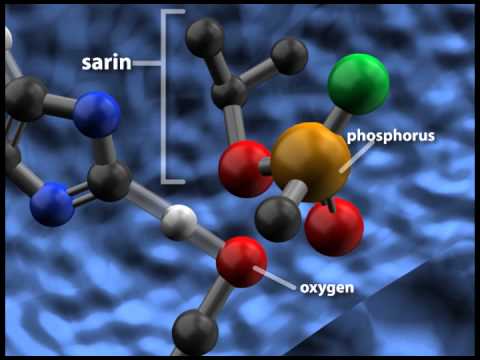
[0:01]Here we see a molecule of the nerve agent Sarin. This is one of the many organo phosphorus compounds that has the ability to inhibit the enzyme acetylcholinesterase. Hydrogen atoms are associated with the carbon atoms but are not shown here for simplicity.
[0:29]The Sarin molecule is pulled into the active site gorge of acetylcholinesterase. It is believed that the hydrophobic aromatic residues lining the gorge help to steer the molecule into the active site in a reactive orientation.
[0:48]The phosphorus atom seen in orange is subjected to nucleophilic attack by the oxygen atom in the serine of the catalytic triad. As a partial bond forms between the oxygen in serine and the phosphorus in sarin, the bond between the phosphorus and the fluorine becomes weaker. This molecular configuration is called a pentacoordinate intermediate and is believed to transiently adopt a trigonal bipyramidal configuration. The bond between the Sarin and the serine becomes a full bond and fluorine leaves the phosphorus on the Sarin. This Sarin adduct is very stable and results in complete inhibition of the ability of acetylcholinesterase to hydrolyze acetylcholine.

![Thumbnail for ✅ Best Smart Door Lock 2026 [Find Which Smart Lock is Right for YOU?] by Foremost Picks](/_next/image?url=https%3A%2F%2Fimg.youtube.com%2Fvi%2FoRozIS6IsnY%2Fhqdefault.jpg&w=3840&q=75)