[0:11]Hello friends, welcome to another video of Zeta Axis and today we will discuss about Tropospheric ozone which also causes photochemical smog. So we have seen in our previous videos that the ozone is mainly concentrated in stratosphere and here it acts as a blanket against the UV rays. It absorbs the UV rays. While in the troposphere it acts as a pollutant. So we have discussed the role of ozone in stratosphere in our previous video. And in this video we will discuss the role of ozone in causing pollution in the troposphere. So this is what we have seen that in the stratosphere it protects us from the UV rays. It absorbs the UV-C rays which is the most energetic ultraviolet rays. While it partially absorbs ultraviolet B rays and then it allows UV A rays to reach our earth. These are the least energetic and least harmful UV rays. So the harmful UV rays are absorbed by our ozone layer. In the troposphere ozone causes photochemical smog which looks something like this. It occurs in the presence of sunlight. We will see how this photochemical smog is created and what type of chemicals are present in this photochemical smog in this video. Tropospheric ozone is a secondary pollutant which means that tropospheric ozone is not directly emitted in atmosphere by vehicles or industries or any other process. But it is produced by a chemical reaction between two primary pollutants nitrogen oxides (NOx) and Volatile Organic Compound (VOC). These two compounds, volatile organic compounds and nitrogen oxides are emitted by vehicles as well as industries. And it is the reaction in between these two chemicals we get our tropospheric ozone. Tropospheric ozone is therefore not directly emitted in atmosphere. And it is also a greenhouse gas, that is it absorbs heat which is released by our earth. Ozone also has severe health hazards. It can cause breathing problems as well as it can cause burning in our eyes. Now let's see this nitrogen oxides. Now this is a data for European Union only. But we can see here that the maximum emission of nitrogen oxides comes from road transport. And this is an an important factor. Secondly there is volatile organic compounds. Now by volatile we mean that anything which has a very low boiling point. That is they are easily converted to gases at the room temperature. Organic means they are carbonic compounds and these are the examples of VOCs. In fact isoprene is the most common VOC. Again VOC are also emitted by road transport as well as certain chemical processes. The VOC emitted by road transport is important for us. Now let's see the process of formation of photochemical smog. We know in the morning there is a lot of vehicular traffic. These vehicles they emit primary pollutants like nitrogen oxide and volatile organic compounds. So we see that in the morning, concentration of these two pollutants increases. As the day progresses till afternoon, we see that photodissociation starts and we see formation of NO2 and ozone. There are certain hydrogen carbons also emitted by the vehicles as well as created by reactions going on in this gases. Further, when the day progresses by afternoon by 2 o'clock, we see that there is a full fledged photochemical smog formed. In which we see secondary pollutants like PAN, aldehydes, acrolein and there is a haze. We also see that the concentration of ozone increases. In the later part of the video we will understand how this process occurs. Now let's see the major reactions involved in formation of photochemical smog. The most important reaction is breakdown of NO2 in presence of sunlight. NO2 breaks down into nitrogen oxide and oxygen atom in presence of sunlight. This oxygen atom then reacts with an oxygen molecule to give ozone. So we can see that the oxygen atom produced over here reacts with an oxygen molecule to give an ozone. Now these ozone and NO nitrogen oxide, they react with each other and they give us nitrogen dioxide and oxygen molecule. That is these two molecules are returned back to atmosphere. So we can see that whatever was used up in reactions over here is again given back. So this is basically a cyclic process where we can see that these set of reactions they produce ozone. And then the outputs of these reaction, they again react with each other and they destroy ozone. So this is kind of a natural balance. These reactions create ozone, these reactions destroy ozone. So the level of ozone is maintained in the atmosphere. But when we see that there is VOC available, this reaction will stop. And we will see that this nitrogen oxide will react with VOC instead of reacting with ozone. Now these two reactions will give us NO2 as well as certain other pollutants. So in the presence of VOC, the process which was destroying ozone is stopped. And therefore there is a slow increase in the amount of ozone in the atmosphere. And that is why the presence of VOC causes ozone formation. Here are general reactions. These are hydrocarbon radicals and we see this is general reactions which occur over here. You don't need to remember them, but we see that these radicals when react with NO, we get NO2, which is over here, and then we get certain organic compounds. So to understand this whole thing step by step, we will use this graph. The process of formation of photochemical smog involves long chain of reactions, which is difficult to present over here. Therefore, we have simplified the process and included the important steps so that you can understand it. Starting with the vehicles emitting nitrogen oxide and volatile organic compounds. Now these nitrogen oxides, they react with oxygen radical in the atmosphere and they form NO2. This NO2 in the presence of sunlight we have seen that it gets dissociated into nitrogen oxide and again oxygen radical. Now this oxygen radical reacts with oxygen molecule to give us ozone. This ozone and this nitrogen oxide will react to give us NO2. So we have seen this in our previous slides. But let's see what happens when there is VOC present. When there is a VOC present over here, these oxygen radicals as well as this nitrogen oxide and this ozone, they all will react with this VOC. And they will create radicals. Hydrocarbon free radicals which are very reactive. These reactions will also create some pollutants. But mainly the hydrocarbon free radicals they react with NO2 and they give us the secondary pollutants, which are PAN, aldehydes and others. So this is the basic process of formation of photochemical smog where nitrogen oxide emitted by the vehicles, it reacts to form nitrogen dioxide, which again gets photodissociated and we get ozone. The ozone and the nitrogen oxide react to give NO2. Now these compounds which are created by these reactions, they react with VOC, because VOC is also there and it is also emitted by the vehicles. So some of them react with VOC and they give us free radicals. These radicals react with NO2 to give us the secondary pollutants. And as the amount of this pollutant increases, photochemical smog also increases. So let's see how the photochemical smog is formed with respect to time from morning to evening. In the morning we see that the level of ozone and nitrogen oxide is less. VOC is also almost constant. But in the morning due to vehicles, we see that the concentration of NO increases. Now this NO reacts to form NO2. Therefore we can see that there is a slight increase in NO2, but you will see that the level of ozone is almost constant, in fact it decreases. The VOC is increasing because the vehicles are emitting VOC. Now as the day progresses, we see that the reaction between NO and ozone increases. And therefore we see slight dip in the amount of ozone and NO2 is formed. So we see that the level of NO2 increases. Meanwhile the level of VOC is continuously increasing because of traffic. We also see that some secondary pollutants are created over here, but the amount is still less. Now when the sun is higher up in the sky, we see that the photodissociation of NO2 starts. And therefore the concentration of NO2 starts to decrease. The oxygen radical, which is released, it creates ozone. Therefore we see that the level of ozone starts to increase. We can also see that these reactions starts to create PAN and other organic compounds. Therefore the concentration of these compounds starts to increase drastically now. And because VOC is consumed in this reactions, we see that their concentration also starts to decrease. So by 2 p.m. we see that these secondary pollutants has reached their maximum level. The ozone is also higher. While NO2 has decreased because of photodissociation and we see that NO is also consumed in the reaction forming secondary pollutants. Now by the evening what happens that because of the sun directly heating the earth, the air above the earth is heated. And we know that the layer above this air is cooler. Therefore this warm air rises up by evening. And therefore it takes away a lot of secondary pollutants with it. And therefore we see that by evening there is a sudden drop in all these pollutants. Moreover, the sunlight decreases and therefore the process of photodissociation stops. Therefore there is a decrease in all these pollutants. You can see that the formation of ozone also starts to decrease by evening. So what are main secondary pollutants? We see aldehydes. It is produced by reaction of oxygen and free radicals. Then there is nitric acid in this photochemical smog, which is created by reaction of NO2 with hydroxyl radicals. These hydroxyl radicals come from water vapor in the atmosphere. So you can see that NO2 reacts with water vapor to give us nitric acid. The most important secondary pollutant is PAN which is also called Peroxyacylnitrate and it causes severe respiratory problems. PAN is produced by reaction of peroxide radicals, these are the peroxy radicals, which react with nitrogen dioxide. So we can see that it is the reaction of these two which creates this PAN compound. Formaldehyde is also created in photochemical smog and it is created by reaction of ozone and methane. So remember this formaldehyde is created by these two compounds. Now let's see the factors which affect photochemical smog. So the first is topography and the second is atmospheric stability. If we see topography, we can see here that there is a city which is surrounded by mountains. Now when there is photochemical smog in this city. This photochemical smog has very less space to move away. There are mountains. So this air is trapped in this city. And therefore this kind of situation will create persistent photochemical smog. Here you can see example of a city surrounded by mountains having photochemical smog. So this kind of topography actually enhances the effect of photochemical smog where the effects can be prolonged. The second important factor which enhances photochemical smog is atmospheric stability. Now normally in the atmosphere we find atmospheric instability. Which means that the air in the lower region of our atmosphere, it gets heated from below by the land and therefore it is warm. While the layer of air in the upper region is cool. Now we know that the warm air is lighter. Therefore this air will try to rise up. And when it rises up, it takes the photochemical smog with it. So the city is freed from the photochemical smog. And this is called atmospheric instability where the air from the lower region starts to rise up. But when there is temperature inversion or there is atmospheric stability, that is, the air in the upper region is hot, while the air in the lower region is cold. Therefore, this air will not rise up. And in this situation the photochemical smog will remain over the city for a prolonged period. Therefore we can see that because of atmospheric stability or temperature inversion, the effect of photochemical smog increases. But what causes this temperature inversion or atmospheric stability? The first is that there is upper atmosphere advection, that is warm currents from some other place have arrived and stayed over the city. So we can see that because of this warm breeze in the upper atmosphere, there is a temperature inversion. The air will not rise up and therefore there is atmospheric stability. The second could be that there is advection in the lower atmosphere. We see cold current has come over the city in the lower atmosphere. And therefore this air is colder than the air above, creating atmospheric stability. There's one more factor, which is called heat island over cities. Now in mega cities, because of lot of heat produced by them, there is generally a hot air over these cities, which is confined only to the cities. Now let's see what are the health hazards of photochemical smog. So we know that ozone, it causes coughing and sore or scratchy throat. So basically it affects our respiratory organs. There is difficulty in breathing. There can be inflammation and damage to the airways. They make the lungs more susceptible to infection. Aggravate lung diseases as well as asthma and increases the frequency of asthma attacks. So we can see that ozone mainly affects our respiratory organs. If there is any prior disease, then the chances of aggravation are increased. Ozone also causes negative effects on plants. It reduces their plant growth and it also causes some damage to their cells as well as tissues. And it reduces photosynthesis. Rubber is known to have surface cracking in the presence of ozone and it decreases its tensile strength. We see PAN, which is the very important secondary pollutant. It has effects on respiratory functions of humans. It can also cause eye irritations. In plants it cause wilting as well as reduces soil moisture content. So you can see that it affects both plants and humans in a negative way. Now let's see what are the solutions for this photochemical smog. So the most important solution is catalytic converters. We see that the engine generates carbon monoxide and nitrogen oxides. Now these elements are pollutants in the atmosphere. But if we use a catalytic converter which includes platinum and rhodium elements. So now this carbon monoxide and nitrogen oxide, they are converted into very stable gases. They are converted into nitrogen and carbon dioxide which do not create photochemical smog and have less pollution effects. Other solutions which can be used is fuel substitution, that is using fuels which create less pollution like CNG. Or we can increase the quality of the fuel like using Bharat Stage 6 quality fuels which creates lesser pollution. Another solution could be better engine design. So we can create engine designs which emit less pollution. There should be strict laws for maintenance of the engines. We can see that the pollution checks are inefficient currently. So this pollution checks of the vehicles should be increased. Public transport should be promoted and plants also help in reducing the photochemical smog. If you have liked this video, then don't forget to subscribe and press the bell icon. Please follow us on our social media handles.
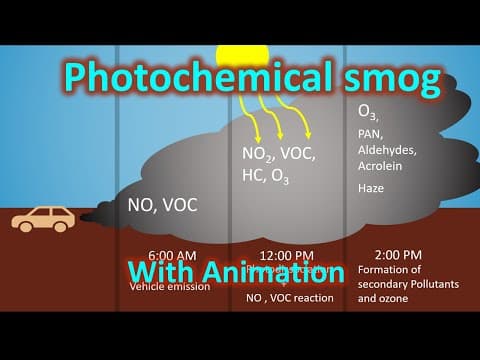
Photochemical smog (Tropospheric ozone ) | Environment | UPSC | Animation
Zeta Axis (UPSC-SSC)
17m 16s2,591 words~13 min read
YouTube auto captions
Transcript source
YouTube auto captions
This transcript was extracted from YouTube's auto-generated caption track. The transcript below is server-rendered so it can be read, searched, cited, and shared without opening the original YouTube player.
Pull quotes
[0:11]Hello friends, welcome to another video of Zeta Axis and today we will discuss about Tropospheric ozone which also causes photochemical smog.
[0:11]So we have seen in our previous videos that the ozone is mainly concentrated in stratosphere and here it acts as a blanket against the UV rays.
[0:11]And in this video we will discuss the role of ozone in causing pollution in the troposphere.
[0:11]So this is what we have seen that in the stratosphere it protects us from the UV rays.
Use this transcript
Related transcript hubs
Watch on YouTube
Share
MORE TRANSCRIPTS


