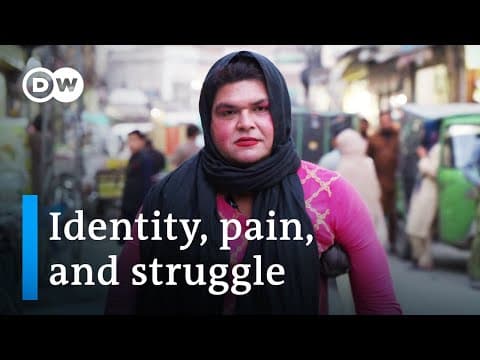
[0:04]Welcome to Pakistan. To the transgender community in a conservative Muslim country. The problem is that if you kill a dog on this side and on the other side you kill a transgender person, the transgender person has no value, but the dog does.
[0:24]Sometimes I feel depressed. Sometimes I feel empowered that, yes, I am somebody. Sometimes I feel, I have to fight back.
[0:51]When I was born to my parents, they named me Muhammad Asim Sharif, but I never associated with this name. I always imagined myself in the clothes of a woman, but my parents gave me the clothes of a young boy. Those were not my clothes. This is my real expression. This is real of me. And I'm very proud on it. But I will not forgive any of the human being who mistreated me. I will not. I will not forget my brothers. They say that our society will point us if will be sitting with you. I'm not a criminal. I'm a human being.
[1:56]Reem Sharif works for the Human Rights Commission of Pakistan in Islamabad as an expert on transgender issues. In 2018, the Transgender Person Protection of Rights Act was implemented. It is a law that provides equal rights to transgender people in Pakistan.
[2:15]So I'm a bridge between government of Pakistan and this community. Reem helped Lubna file a government application for housing support. There were many needy people like me. Look at her and her, they don't own houses. First, the government should provide us with accommodation because a transgender person's biggest worry is a place to live.
[2:46]Few transgender people have access to government support. Many live off the money that they are given on the street. Here, day by day, they are exposed to people's reactions, like Kushbu. There are good and bad people. Most of them are bad. There are few good people. We get a lot of questions. Someone will say, why are you doing this? We say to them, we're humans like you. If we were valued as much as you, we wouldn't be begging. Transgender women also work as dancers and sex workers. For many, it's the only way to earn money. Labor for which they are condemned. Sometimes a human mind comes under satanic influence, so transgender women fall victim to lust. They get murdered. They get invited to different parties and then get murdered in cold blood. I know this from the newspapers.
[3:58]If I were not disabled then people's behavior could be even worse than this. There are still good people in this market who don't utter bad words. Otherwise in crowds people grope us or do nasty things. The problem is that if you kill a dog on this side and on the other side you kill a transgender person, the transgender person has no value but the dog does.
[4:28]We think that a transgender person isn't like us. Why? She's also a human with two eyes, hands and feet, a nose and a mouth. She talks like us. Why are we segregating them? I think they are like us.
[4:49]They are underprivileged in our society. And I don't see them being helped or given jobs. I feel like they should be helped. I wanted to be a superstar because there is an actress inside of me.
[5:19]But I am neither a woman nor a boy. If I was a boy, I would become a hero. If I was a proper girl, I would become a heroine. What can I do? That's why I've become nothing.
[5:36]Most transgender people in Pakistan are rejected by their families when they become aware of their identity. The same thing happened to Reem 12 years ago. She was lucky. A friend gave her a new home. She lives with him and his family in Islamabad. She's my fifth sister. I have four and now I have five.
[6:01]From the victim to the protector. The journey was beautiful. The journey of tolerance of depression, the journey of being raped many times. The journey of thinking that I am somebody who is useless. My life changed when I was bedridden for around one year. In that time period, I was continuously asking myself, Reem, why are you wrong? Why is this society always target you? Okay, there is no space for me in society. Okay, there is no space of me in religion. And I don't care anymore. I am like this. In 2020, Pakistan's first transgender protection center was established in Rawalpindi with the cooperation of the Pakistani police.
[7:15]Mostly transgender people come to us with complaints about harassment, mental pressure and threatening phone calls.
[7:28]They also come here with money problems and transgender people have a lot of complaints about public behavior. They complain that people don't treat them the way they treat their own brothers and sisters.
[7:57]Now we have sister Lehar. She gives us time. She listens to us and then she speaks to the other party and then our problem gets solved. There has not been a single time when we were not taken care of since we started coming here. Thank God, we're safe.
[8:21]Mano is what is known as a Guru. Gurus are transgender people who take on responsibility for younger transgender people, known as Chelas or students. The Guru-Chela system provides the transgender people with what they've lost, a care structure, a replacement for their families. Okay, keep this money for cooking. I'm dying of hunger. Dying of hunger. Go and get the stuff. I'll cook. Is the bread ready or should I prepare it?
[9:01]Mano and four of her students live in this two-room apartment. I am a transgender person. I am a she-male. Not from today, but since I was 10.
[9:17]And I will be one until I die. And it's not just me. No transgender person will leave this world. Why? Because they are happy in their world. We are living very well in our own world. We have brothers and sisters, fathers and sons, Gurus, students. We live in harmony.
[9:54]In Karachi, a city in Southern Pakistan, the Women of the World Festival is taking place. It includes a panel discussion where Reem and other representatives of the transgender community discuss the current situation. Conservative parties are trying to overturn the law on transgender rights. Some of the senators think that this transgender person's protection of rights Act is not under jurisdiction of Islam. According to them, only intersex persons are the transgender persons, and then they think that these transgender persons are the source of sin. They're badly misinformed. This legislation is all about basic human rights. What is this X giving to us? No privilege.
[10:57]We cannot get married. And that is something which is very close to my heart. I am alone because just because of my reality. I am happy to be here. Although I feel these men are cowards. So, they will not accept us. You know, but forcefully, they will. So we have, you know, that kind of stick in our hand to, to, to make our visibility strong, to make, to, to make our acceptance accepted. We transgender women expect from the society social affirmation to respect us as women. Transgender is our adjective. It's just like a woman is beautiful. It's just like a woman is intelligent. In the same manner, a woman is a transgender. For me, I am a woman.


