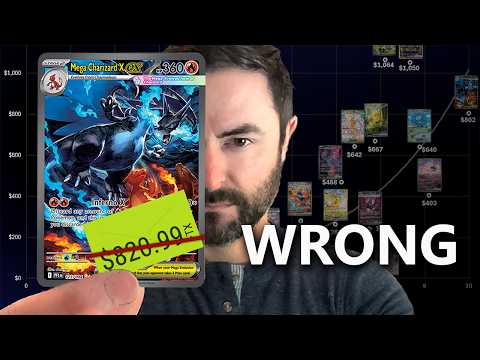
[0:00]I just built a pricing model, that within 90% accuracy, can predict top chase cards from modern Pokémon sets.
[0:10]How do we do it? Well, I was spending some time trying to understand how the odds of pulling a specific card can contribute to the price.
[0:20]And it turns out to be pretty important, but it's only part of the story. What about the demand part?
[0:25]And so I've tried to quantify these forces and what's been really interesting is not only how accurate it has ended up being, even with a very small amount of data that I'm using to model from.
[0:36]But it really helps highlight some of the outliers. Some of these are really overvalued. Some of these are undervalued, potentially, you know, it's not going to be able to predict everything, but for the most part,
[0:46]there are some patterns here and there's definitely some cards out there that are way above and below, we should be seeing for market price for some of these top chase cards.
[0:55]So, let's jump into it. The first way we're quantifying supply, I'm using what's what I'm saying is called pull cost.
[1:06]So how much does it cost to pull a card, a specific chase card from a set? Well,
[1:11]if you know anything about the hobby, then you know that every set has different rarity tiers.
[1:18]And within that rarity tier, you have a certain number of packs where that card could show up in what you pull. So this is what we call the pull rate.
[1:28]Now, if you multiply that pull rate by the number of cards that exist in that rarity tier, then you get on average, the number of packs that you would have to pull to eventually find that card.
[1:39]And what you see here is that there are some sets where it's really, really hard to pull a specific card.
[1:45]In particular prismatic evolutions, like that was one of the hardest sets to pull a specific card.
[1:54]You have a select number of cards that everyone wanted. And even though it looked like, yeah, it's one in 45 packs, that's pretty generous compared to all the other sets.
[2:00]But because there are so many cards in that rarity slot that everyone was chasing, that you still had to rip a ton of packs to finally get the card that you're looking for.
[2:08]So that's really what matters in the supply side. So if you think about it, if the card is easier to pull, then, of course, there's going to be more supply.
[2:16]People are going to be ripping packs and finding it all the time. It's not as valuable. Next is the desirability.
[2:22]So this is the demand side and I'm calling this a desirability index. And I'm using three things to try and weigh into the score.
[2:30]The first is character premium, uh, the second would be artwork and the hype around specific cards,
[2:37]and then the last would be universal appeal. So, let's talk about all three real quick.
[2:43]Character Premium, again, like I said, it's intrinsic to the TCG. So the way we're quantifying this is if you were to take every card that's been printed with that character on it,
[2:55]across every rarity tier and across every set that's been released. How does that character rank across all that on average?
[3:02]Charizard, on average is a 1.1 rank. So almost 1.0, Umbreon, it's 1.3.
[3:10]And then etc, Mew is 1.4, Dragonite is 2.3. And then if you just normalize that down to a 1 to 10 score, that's how we get this part of the desirability index.
[3:20]Now, next would be the artwork in the slash hype. This contextual kind of subjective measure of the cards and their desirability.
[3:30]The only way I can kind of describe it is just to look at some examples you can judge for yourself. It's not going to be perfect, but here's some examples of tens.
[3:37]The Bubble Mew. universally loved card.
[3:41]The artwork is amazing. The Pokémon is a high character premium, uh, the lore behind Mew,
[3:49]it's the artist that designed this card, like there's all things that come together that make this what would be a 10.
[3:54]Uh, the Mega Charizard, it's already obviously a highly desired Pokémon.
[4:00]And then this everyone is saying, generally the consensus is, this is the best Charizard that's ever been printed in terms of artwork, so therefore, it gets a 10.
[4:08]So a nine would be something like the Mewtwo from Destined Rivals. Even though it's the top chase card from Destined Rivals, one of the best sets that was released in Scarlet and Violet era, if not the best.
[4:18]There's some like lack of universal consen- consensus around the artwork.
[4:24]And then what would a one be? A one would be like Dotsbun, which I didn't even know this Pokémon existed until I did this analysis.
[4:32]And this blew my mind. This is a Dotsun dog but it's made out of bread. Okie dokie.
[4:39]I actually don't hate the artwork to be honest with you. It's just like, what are we looking at?
[4:42]And it kind of reflects in the price that's a one, okay? It's subjective, but still.
[4:47]All right, lastly, for the desirability index would be just another external force. So we're using Google Trends just to understand universal appeal.
[4:55]The cards that most people go to who are new to the hobby are going to be the ones that Pokémon that they've heard of.
[5:03]So the Charizards and the Pikachus, this is where you see it in Google Trends. They're the most searched by far. And then finally, here's our desirability scores and how we weight them.
[5:11]45% weight for character premium, 45% weight for card features artwork and hype, and I'm using just a small remaining 10% for the external factor.
[5:21]Just because there's a lot of big swings for those higher popular Pokémon. So, now, let's put this into the model and start seeing how this, how this impacts our prediction.
[5:30]Look at how tightly correlated desirability is, even though these are all within the same rarity tier.
[5:37]You know, across sets, they have different mixes of how hard they are to pull, but generally speaking, just desirability alone can explain a large portion of the price.
[5:48]Next would be the pull cost. So you can see there is some clustering that's happening.
[5:54]And especially when you get out here to the highest pull cost, you see these do have the highest prices as well.
[6:02]Now there are some very clear outliers here and I'm just going to be like, um, hello, Mega Charizard.
[6:09]What are you doing out here? You were playing with the big boys at this $800 price and your pull cost is super, super low.
[6:15]All right, let's pull this all together now. Here we go. You ready? Let's break it down. Here we go.
[6:20]When you put these two variables together, how good is it at predicting the market price? Well, uh, even with just a small amount of data that we're using for this,
[6:29]this R squared value, basically is saying that about 88% of the price variation can be explained by pull cost and desirability.
[6:39]So we have a very, very healthy model. Now you don't have to know what coefficients are, but basically for every one point of pull cost score increase, you're going to see a price point increase by about 19%.
[6:51]Uh, for desirability score, it's almost twice that.
[6:56]So for every desirability score point you go up, you're seeing a 41% increase in price.
[7:02]So desirability is about twice as impactful as pull cost in determining the overall market price, but they both do play a role in a pretty significant one.
[7:13]But now let's see, if you put it through our magic little formula here, this is the price that we are seeing for our top chase cards.
[7:23]Now, let's just start at the very top. Gardevoir from Scarlet and Violet base.
[7:27]Now, its pull cost that looks like a lot, but relatively speaking, that's only a 1.4 to pull this card across, you know, how, how hard it is to pull and how much it costs to pull some of our top chase cards from other sets.
[7:38]Now desirability score is about mid. We're expecting a a price of around $71.
[7:44]The market price for this card happens to be around $65.
[7:49]So it's right within that range, right? Now, let's move on to a different card, something like the Charizard 223 from Obsidian Flames.
[7:56]Now, this one is again, the lowest pull cost out of every set.
[8:00]And that was kind of the thing that backfired I think for a lot of people realizing like, oh, hey, this Charizard is pretty cool from Obsidian Flames. Oh wait, you have it too. Oh, wait, you have it too. Oh, everyone has this card.
[8:11]Oh, shoot, this one was really easy to pull. Well, it turns out that has impacted the price pretty significantly.
[8:19]Even though it's a Charizard, gets a 7.8, downgraded a little bit for the artwork, like you that's kind of the subjective piece of this, right?
[8:26]But because the pull cost is so low, then there you go. You can kind of expect a pretty low price.
[8:33]So, you know, it's not perfect, but we're saying, there's probably some wiggle room at least compared to how Charizard typically performs,
[8:40]that maybe this card should be valued more than it is. So, maybe a little bit undervalued.
[8:45]Um, same thing with our 151 Charizard. Even though this pretty much doubled in the past past month, we've seen this card shoot up in price.
[8:54]We're saying, hey, you know, the the pull cost score is mid low tier, so it's pretty easy to pull still.
[9:03]Uh, but this is a highly desirable card. And with it being Charizard, we should still see this card around the $500 range.
[9:10]And we've only just seen it bump up to 400. So it's almost like the market's finally catching up for how valuable this card might probably should be, right?
[9:20]Um, so I found I found that to be interesting. So even though I was fretting over this card increasing in value so quickly, it kind of feels like maybe it was destined to be that price to begin with.
[9:31]That's just my interpretation. Um, something like the Umbreon from Prismatic Evolutions. Well, we're modeling that price. We're saying that, uh, we're also undervalued a little bit with the market price because this is a super hard card to pull, super costly card.
[9:46]And then the desirability score is still really high. So modeling this out, we're still a little bit undervalued for what the market is saying right now.
[9:54]Now, here's where it gets really interesting. And this is the big, remember I was saying, look at that Mega Charizard ex out there in the middle of nowhere.
[10:02]No Man's Land. How is it fetching an $800 price?
[10:06]This is where I think there's somewhat of a limitation in the model that can't factor in everything, but also it's telling something.
[10:14]That is, the pull cost for this card is so low. It's a two. It's easier to pull than others, right?
[10:24]And then it's a highly desired card, but does that really make up this near double in price that we're saying that we're seeing in the market versus what the model, this model is saying?
[10:33]This model is saying this should be around a $500 card, and we're around 800 plus. Like and it's continuing to climb, which is kind of wild.
[10:43]So the way I look at this is either it's it's overvalued, or because this card is so highly desired,
[10:51]that and there's so many new people in the hobby trying to procure the coolest Charizard artwork that's ever existed, that it's going to take some time for this to normalize.
[10:59]Because it feels like this is a must-have card that every collector should have, and that is definitely influencing the price and making it an outlier.
[11:10]Even though it's easier to pull, I think there are a lot of people who are just opting to buy the card versus trying to buy a bunch of Phantasmal Flames sets and open them because it's such a Charizard or bust set.
[11:22]That's my interpretation. People would rather take the risk of just buying the card at a high price, then take a risk of opening the packs and just getting a lot of trash.
[11:34]I mean, at least cards that aren't that valuable, right? Comparatively. So that's why I think this is in such a weird place and it's hard to interpret this cleanly, but that's my best interpretation of what I think is happening.
[11:45]Um, I won't go into the too much detail, but the other ones basically like, I wanted to just talk about this Pikachu.
[11:49]This Pikachu from Ascended Heroes, it's finally usurping the Dragonite that was second place for this.
[11:57]It's a beautiful artwork and a universally acclaimed Pokémon. It's no duh that this one should be one of the top ones.
[12:04]And I think the only reason that Dragonite was fetching a price over the Pikachu before is because Dragonite hasn't had a really good printing or a high rarity tier printing or a special illustration or an alternate art printing in a long time since Evolving Skies, right?
[12:20]So it's been a long time coming for Dragonite to have a really good, awesome looking. I mean, the Dragonite artwork looks so cool.
[12:28]So I think people were were ready for a Dragonite and maybe there's a little bit of a Pikachu overload, um, over the past, you know, couple years.
[12:35]But, uh, that's my interpretation of that, but still Pikachu is starting to kind of price out Dragonite now and it kind of makes sense why, because again, the model is saying it should be a much more highly valued card because of its pull cost score is very high and then the desirability score is higher than Dragonite. So,
[12:54]all right, my voice is going out because I've recorded this multiple times and I haven't liked any of the of the takes.
[13:00]But that's it for me. I I hope you like this video. If you like the details, you like the data, then man, this channel's for you.
[13:09]If you don't like the data, this is boring to you, then I don't know what to tell you. How I don't even know how you got to this point in the video if that wasn't in part of your, uh, what you were interested in.
[13:20]So, but anyways, all right, I will see you in the next video. Please let me know what you think. Do you think this model is
[13:26]which which one of these cards do you think are overvalued, undervalued? Do you think the model is accurate? Do you think that we still have a lot of adjustment and normalization in the market to kind of get towards some of what this model is saying?
[13:36]Just curious to your thoughts and feedback. Let me know. Um, and other than that, we'll see you in the next video. Thank you.