[0:00]As you guys know, I'm a huge fan of generating cash flow by selling options. But I also prefer and almost exclusively sell daily options.
[0:09]In this video, I'm going to share with you why I choose daily options as opposed to weekly or monthly options. And I will confront head-on the two largest objections I receive about selling daily options.
[0:25]Now, to be clear, we're talking about daily options, which mean we're only really talking about three different main investments that allow for daily option expirations.
[0:32]And that would be IWM, the Russell 2000 ETF, QQQ, the Nasdaq 100 ETF, and SPY, the S&P 500 ETF. Aside from these three indexes, the majority of other investments out there are going to be either weekly or monthly.
[0:46]So focusing on these three indexes, the first big reason why I like to sell daily options is they are by far the most capital efficient way of generating premium.
[0:54]As an example, let's take a look at the IWM option chain. We'll look at one day, we'll look at weekly, and we'll also look at monthly. So, first off, let's go ahead and exclude this. Let's look at right here, June 21st, 2024 right here. Okay.
[1:09]Current market price is 208.18 and let's say you wanted to generate $250 in premium. If we're looking at the June 21st expiration, in order to generate, we'll say 240 here is a good number.
[1:21]240 in premium, we'd have to use the 212 strike right here, okay? And that would be a 37 delta. Okay? So $240 every single month is the goal and that would require a 37 delta as you can see right here.
[1:36]Let's look at the same thing with a weekly option frequency. And really quickly, we'll take 240 per month times 12 and then divide by 52 to get the weekly amount, which would be $55.38. So we would need to go right here at the 210 strike on a weekly basis, okay?
[1:54]That would get you $67 to $69 as opposed to $41 to $43 right here. That would be the 31 delta. So you can be less aggressive with the weekly option frequency.
[2:02]And then let's look at daily. Go to the May 21st expiration right here. Let's pull up that calculator again. We'll take that same 240, which is monthly and divide that by 22 because there's on average about 22 trading days every single month. So, 240 divided by 22 is essentially $11 per day we need. Okay?
[2:22]So, going back to the option chain, we can go right here. 210, expiring tomorrow, you can collect between $10 and $11 and you only need a 13 delta to do so. Okay?
[2:32]So, obviously here, when we look at the daily options, it's the least aggressive, meaning the most conservative play, and it's the most capital efficient.
[2:40]And this is not just exclusive to IWM, it's the same across all investments. The shorter dated expirations generate the most premium when you extrapolate it over the week or over the month or over the year.
[2:52]Second reason here is, these are crazy times we're living in right now. Tensions in the Middle East, politics here at home are insane. And if you're an average Joe investor like me, trying to generate income from our portfolio,
[3:05]it can be difficult at times to ride the wave of volatility. The good news though is there are alternatives to investing in the stock market that can still generate really good cash flow. So I want to tell you a little bit more about buying US Treasury bills.
[3:15]And if you're going to do it, by the way, you should do it with Finvest. Finvest is an easy way to buy US Treasury Bills in a few clicks through your phone. You can earn up to 5.3% interest through Treasury Bills because interest rates are at an all-time high since 2007.
[3:30]You might be thinking to yourself, well, I can earn 5.3% or maybe 5% with a high yield savings account. Well, sure you can right now, but what if interest rates go down? Treasury Bills are one of the safest assets in the world because they are backed by the US government. You don't pay any state taxes on interest earned, unlike your savings account.
[3:49]This makes a huge difference to your returns. And by the way, Finvest already has millions of deposits on their platform. If you want to learn more about getting started with Finvest and buying US Treasury Bills from your phone, check out the link down in the description below.
[3:59]Second reason here is, you just get more premium this way and I can prove this to you here.
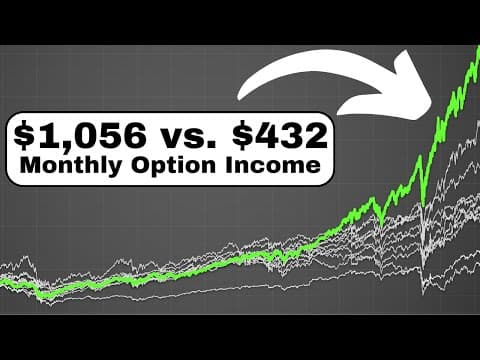
[4:03]Let's assume you have enough of IWM to sell covered calls. One contract, so you have 100 shares but less than 200 shares. So you only sell one contract, okay? If we do it on a monthly basis and let's stick with the 20 delta.
[4:16]Okay? 20 delta to be the same across all of the different expirations and all of the different uh frequencies. If we first look at monthly, okay? Going back here to the June 21st expiration for IWM,
[4:29]you can see the 20 delta is way out here at the 217 strike price right here. 20 delta and you can collect $108. Okay? $108 every single month with the 20 delta monthly frequency.
[4:42]But let's take a look at weekly frequency. We'll minimize that and go to the May 28th expiration. 20 delta is about right here. Okay? So we'll round this one down. So that's the 211 strike. You can collect $44, $45, really, every single week.
[4:57]And again, reminder here, option premiums are going to fluctuate throughout the month every single day depending on exterior market factors, um, what's happening with the price action of that specific investment.
[5:10]So, we're just making the assumption that that number is consistently or about the same every week or every month or every day, but it will adjust at different times.
[5:16]So we had $108 a month with the 20 delta and the monthly frequency, but let's take a look at weekly here. But again, we need to extrapolate that out on a monthly basis. We take 45 times 52 divided by 12 is $195. So we had 108 with the monthly. We had 195 with the weekly, okay?
[5:40]So, nearly double the amount of option premium and let's take a look at daily. Let's go up here to the May 22nd expiration. We'll look at approximately the 20 delta, which is going to be right here. There's no perfect answer here because, you know, on a daily basis, we got either the 14 or 15 delta or the 33.
[5:55]So, we'll stick with 15. We'll be more conservative here. So, 15 delta approximately is going to be the 210 strike. You can see, collect about $11 or $12.
[6:02]And we'll take 12 and we're going to multiply 12 by 22 to get the monthly, right? 12, on average, 22 days, so 12 times 22 is $264.
[6:14]Okay? And we're being more conservative here because we're utilizing a 15 delta instead of a 20 delta, which doesn't doesn't happen to be available based on the specific market price and the strike prices. So you clearly get much more capital, much more option premium by utilizing daily options.
[6:31]All things considered, Apple's to Apple's comparison on the delta. Third big reason why I like to utilize the daily options is it allows me to intervene much quicker on a daily basis compared to weekly or monthly or even 45 days or further out when the market jumps up higher or drops down lower.
[6:44]So, when the market shoots up way high, you and you're stuck in with a a weekly option that doesn't expire for 5 or 6 days, well, you just kind of have to just sit there and wait and hope that the market comes down.
[6:58]Because most of the time it doesn't make sense to roll your option out until expiration. Same thing with monthly. If you sell a monthly expiration and, you know, 5 days later the market price has shot up way past your strike price, I mean, you're kind of just stuck there waiting.
[7:11]And then if you're wanting to roll out to a further month, it's going to take you a long time to get access to your capital again. With the daily option, you get to mitigate the risks of large price swings to every single day.
[7:22]And if for some reason, the market shoots up way high, you can still manage that option and then get on the sidelines and wait if you prefer not to be in the markets. And the two big objections I receive when I talk about daily option selling is, well, number one, well, what do you do when the market shoots way above your strike price? How do you manage your position?
[7:40]Do you do you roll out for a credit, you know, a lot of days? Do you just allow assignment to occur? Well, the answer is, and it's very simple, you just roll your option contract no matter what, whether it's for a credit, meaning you get paid, or you roll for a debit, in which case, you have to pay money.
[7:56]But either way, you get to manage it on a daily basis. And most of the time, based on all the historical data, the market's not going to shoot up consistently by, you know, a half a percent, 1% every single day. They might do it once, twice, maybe even three or four days in a row.
[8:09]But it's not going to continue to do that every single day. The second big objection is, well, it this takes too much time, right? To sell daily options. The answer is no, maybe at first, it takes a little bit more time as you start to learn and comprehend what you're looking at and the different mechanics involved in rolling your contract.
[8:24]But once you know what you're looking at and you do it consistently day over day, it becomes a lot easier to manage. For me personally, I manage about 9 to 10 contracts every single day. Takes me about 5 to 7 minutes to do it.
[8:33]If you want to learn more about selling options in your own portfolio, or learn how to do it, how to generate cash flow in your portfolio, make sure to check out the Average Joe Investor Patreon community and the Discord chat where you get access to hundreds of different DIY cash flow investors that love to learn from each other and share their knowledge with other people.
[8:50]Alternatively, you can get more access to me exclusively and take a look at the exclusive access or VIP access tiers of the Average Joe Investor Patreon community. If you want to learn more about that, check out the link down in the description below.
[9:02]Hopefully, you found some value out of this video, guys. Make sure to leave your two cents down in the comments below. It's my goal to respond to as many comments as possible on the day I post a new video. That's all I got for you guys. Have a great rest of your day and thanks for watching.