[0:05]Would you like to be president of Nigeria? Some of us, we need to lead in terms of the trajectory of developing Africa, uh, through the business, not through the political leadership. Are there good investment opportunities for non-Africans in Africa? Well, there are good opportunities for everybody. You know, and I think there's protection also for everybody. the Arsenal team, and uh is that a team that you would like to buy someday? It is a team that, uh, yes, you know, I would like to buy, you know, someday. Would you fix your tie, please? Well, people wouldn't recognize me if my tie was fixed, but okay. Just leave it this way. All right. I don't consider myself a journalist. and nobody else would consider myself a journalist. I began to take on the life of being an interviewer, even though I have a day job running a private equity firm. How do you define leadership? What is it that makes somebody tick?
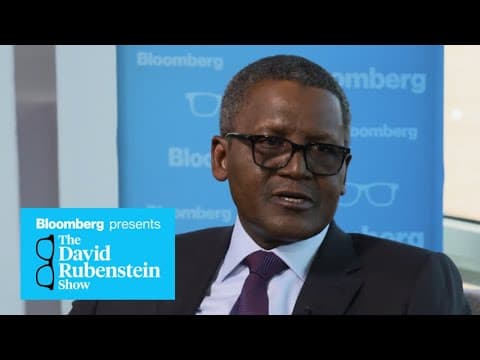
[1:16]Aliko Dangote is widely known to be the wealthiest man in Africa. So is that a title you're proud to have or is that one where you get so many people calling you for money you wish you weren't the wealthiest man in Africa? Well, first of all, thank you very much. David, it's great to be here, uh, you know, and also seeing you, uh, today. Well, you know, when they call you the well, I mean, wealthiest person in Africa, you know, it comes with a lot of baggage, of course. There are so many demands here and there. Where people now come up with so many different, uh, you know, demands, but it is good because, uh, I'd like to give back to the society. So right now you are involved in many philanthropic endeavors in Africa and elsewhere. Let's go through some of them before we go to how you actually made all of this money. So, uh, recently you had an event in New York where we are now with, um, Mo Ibrahim, also a wealthy African business person, and Bill Gates in which you, um, provided a fair amount of money for the African Center in New York, in Harlem.
[2:21]What is the African Center and why did you do that? Uh, well, we did, uh, the Africa Center idea started with, you know, uh, Chelsea Clinton, Hadeel, Mo Ibrahim, and my daughter Halima. My daughter Halima joined them, uh, later and, uh, we realized that, look, we need to set up this Africa Center, we need to make it a, you know, a reality. First of all, you know, for us to be able to project Africa in a better light, you know, bringing Africa to the rest of the world, uh, you know, especially when you look at, uh, you know, the third week of every September. We have the United Nation General Assembly where the entire world converges in New York, and what we want to do is to tell the real narrative of Africa, and, uh, tell the rest of the world what Africa is all about. So, this is now to do with policy, business, and our culture. You know, because sometimes, uh, you know, the, uh, I mean, especially, you know, Americans, they don't really understand much about Africa. You know, somebody will say, okay, well, both you Africans, you know, what kind of language do you speak? For example, in Africa, we speak about 2,000 different languages. What's a lot. That's a lot. So, right now, one of the big problems in Africa is health, and you've been very involved in trying to eradicate polio in Nigeria, along with Bill Gates and his, uh, foundation. What is the progress that you've made today? I think we've, uh, we've done, uh, quite a lot. The, you know, the progress has been very, very tremendous. In the last, uh, three years, we haven't really had any world, uh, you know, virus of, uh, polio. And hopefully, when we walk hard between now and the next six months, by April, we'll be certified to be polio-free country, which means, uh, the entire African continent will be polio-free. Now, one of the things you're doing in the philanthropic world is building a hospital in Nigeria. Why do you feel a need to build a new hospital? I think we need to build a world-class hospital, because when you look at it in Nigeria, we spend quite a lot of money where a lot of people go abroad for medical check-up, for medical operations there. And what we are trying to do is to give that hope to the population and say that, look, you don't need to travel abroad, we'll be able to treat you there. Now, for those who may not be familiar with Africa, Nigeria is the most populous country in Africa, is that right? It is. And it's growing at a very large rate in terms of its population, is that? Yeah, about 3%. Yeah, we are growing at about 3%. So in if at the current rate, at some point, more people will be in Nigeria than in the United States. Well, by 2050, we'll be at about 450 million population, and I'm sure we will be way ahead of the states. We'll be about number three after, uh, China, India, then it'll be Nigeria in terms of population. So by 2050, you could be the third biggest country in the world by population at the current population growth rate.
[5:31]Uh, it doesn't really make me nervous, because we have massive, uh, arable land. We have, uh, a lot of water, we have, uh, uh, you know, the right climate. So, when you look at it, the major contributor to our GDP in Nigeria is agriculture. So, I think we just need to tilt a bit and change from the normal oil, you know, reliant economy to agriculture and manufacturing. So Nigeria is known as well for having large oil deposits. Is that the major, um, contributor to the to the Nigerian economy, is that the major source of wealth in Nigeria? It's not the major source, but it is, it contributes 90% of the foreign exchange, uh, you know, that, you know, we have. And, uh, we also, uh, the 60% of the government's revenue is also coming from oil. But I think the government is doing quite a lot to try and diversify the economy by trying to structure their own taxes because we need to make more money from the taxes. The taxes, uh, you know, uh, generation in Nigeria is a bit low. So I think government is working very hard to make sure that, yes, they adjust all these numbers. Now, the wealthiest man in Africa and the wealthiest man in Nigeria, do you get pressure to run for political office yourself? Would you like to be president of Nigeria? I think, uh, I'm doing a great job where I'm right now, so I don't think I need to be in a political space. Uh, some of us we need to lead in terms of the trajectory of developing Africa, uh, through the business, not through the political leadership. Let's talk about how you made this amount of money, uh, which is, uh, by far the largest amount of money that any individual has in Africa. So, um, you came from a wealthy family or not a wealthy family? Uh, I came from a wealthy family, uh, my late, uh, great-grandfather, uh, in the 1940s was actually the, uh, richest, uh, you know, uh, West African. My late grandfather was one of the wealthiest Nigerian, you know, uh, the family name is Dantata. That's from my maternal side. Uh, my father, too, you know, was fairly rich, you know, but he was both, uh, you know, in business and also in politics. By now, uh, David, one thing that I'm very, very proud of is that I did not inherit any money from my father. I built everything from scratch to where I am. So your father died when you were relatively young? Yeah, he died when I was eight years old. So, uh, he didn't leave in his will a large amount of money for you? Well, he left in the will, but, uh, you know, I mean, uh, whatever that I inherited from him, which means in assets, I gave that one to charity since then. Okay. So, did you go to college in in Nigeria? No, I went in, uh, Egypt. Egypt, all right. And what did you study? Uh, business. All right. So, you graduated at what age? I graduated at about 20 years old. All right. So, you went back from Egypt to Nigeria? Yes, I went back. And then I and what did you get a job? What did you do? I started work with, uh, my, you know, uncle, but there's a few months, and then I went to Lagos, and now I started my own business, but just, you know, buying cement, selling. You know, it was just a very low-key business. Right. So, you're 20, 21 years old, you're buying cement, you're a trader. You're not you're not making cement, you're trading it.
[9:08]Oh, trading at that time. Now, cement is your main business. We'll talk about it in a moment, but why is cement such a big part of, uh, Africa's, uh, you know, wealth in this country? Well, you know, the the issue is that when you look at cement, cement is what builds infrastructure. And we need a lot of infrastructural deficits. In Nigeria alone, we have about 17,000 deficit of housing, and it is all over in, uh, you know, Africa. So, when we started cement in in Nigeria, we realized that majority of it was actually imported. And that is why we went in there, we started and it's a long story. So, you ultimately were trading cement and then was it hard to get the money to keep that business going? No, it wasn't really hard. Uh, at that time, I was buying domestically. We started importation in 1980, because I started business in '78. So by 1980, we started importing sugar, rice, you know, commodities generally, and then we stopped the cement business because the cement I was actually doing local trading, it wasn't really import business. We started import of cement in 2000. Okay. So, you had a cement, uh, trading business. Um, somebody thought Lafarge may be buying it, you decided not to sell because they wanted control. And you then decided to build your own cement manufacturing business, is that right? Yes, I decided in 2003, uh, to build my own cement. That time, Nigeria was only producing about 1.8, 1.9 million tons. But we went ahead and started with 5 million tons of, uh, cement, capacity. So what year was that? This was 2000, and we started the building end of 2003, and we finished in 2007. So now you're the largest cement manufacturer in, uh, Nigeria? Well, the largest cement manufacturer in Sub-Saharan Africa.
[11:27]So, you're building a refinery in Nigeria. Why does Nigeria need another refinery? Well, you know, David, let me give you a little bit of, uh, history. You know, what we do as Dangote Group, we use our businesses, like now, we are using our current businesses to build the future of the, uh, you know, business. Like when we are in sugar, it was the sugar profit that we use in building the cement. Now with the cement, we are building so many things, you know, refinery, fertilizer, you know, uh, uh, petroleum, uh, products, and then we are doing also petrochemicals. With the refinery, your question is, okay, why are we building a refinery? When you look at the entire Sub-Saharan Africa, you know, we have only two working refineries. One, it is in, uh, Cote d'Ivoire, uh, which has only 75,000 barrels a day. The other one is by Sasol in, uh, South Africa. But majority of all these countries, almost all the Sub-Saharan African countries, they don't have refining capacity. So, all of them, they export their oil, but they import, uh, products. So, we realized that majority of the foreign exchange spendings of Nigeria goes to petroleum products imports. So, Nigeria is exporting its oil and then it has to buy refined oil products back imported, right? Yes. And what you're doing is you're building one of the largest refineries in the world? It is the largest single line in the world, is 650,000 barrels a day, of refining capacity. So, to do that, do you have to borrow some money or where did the money come from to build that? Well, what we are doing right now, we are borrowing from the, uh, commercial banks. We are also borrowing some money from, uh, you know, financial, some financial institutions, like the, uh, you know, uh, the, uh, African Development Bank, the development banks, financial development, uh, you know, banks. We are borrowing from, uh, you know, African Exim Bank. So, many companies outside the United States, outside of Africa, uh, like to invest, would like to invest in Africa. Uh, where do you recommend that they invest in Nigeria, South Africa, Kenya? Obviously, you're probably partial to Nigeria, but are there good investment opportunities for non-Africans in Africa? Well, there are good opportunities for everybody, you know, and I think, uh, there's protection also for everybody. Uh, you know, as we speak today, you know, even foreign investors, let me give you an example. In Nigeria, if I have a partnership with you that I'm investing, I don't even, I won't have what you call minimum taxation. But if the company is owned by myself alone, as a Nigerian or Nigerian entity, we have a minimum taxation. So, there's quite a lot in terms of inviting foreigners to come and invest in Africa. But countries that I can suggest for people to invest, uh, one of them, of course, uh, you know, Nigeria. Ghana is a very good place to invest. Côte d'Ivoire, uh, you know, uh, Kenya. Kenya is also a very good place to invest. Now, I first met you a number of years ago when I was raising, um, my firm's African investment fund, and you invested in it. And, uh, today, uh, the bloom seems to be off the rose in African private equity investing. It was very attractive to many people four, five, six years ago. Today, it seems to be less attractive. Is that because the economies in Africa have gone down a bit or what would you say is the reason? Well, I think most of that reason, uh, I think it's to do of first of all, lack of understanding of where to even invest. Uh, you know, I mean, you look at the investment that were made with your I think I can say that 90% of whatever we invested in, we are doing very well. So, I think it is where you should invest. Even myself as an African, I cannot invest in every single sector. So, I have to be very choosy of where I invest. Uh, and you know, there's a lot of, you know, uh, wrong perception, you know, people read stories from newspapers and they believe what they are, you know, uh, you know, reading. But I think, uh, you know, as we go along, you know, there are quite a lot of changes in most African countries to try and, uh, change in terms of, uh, you know, focus on the economy. Now, you live principally in Lagos. Is that right? Yes, I do. And how many people are there in Lagos? In Lagos, today, we have about 25 million. 25 million people? Yes, in terms of population. I know it's a very small, you know. So, getting around in Lagos, which I've tried to do, is not that easy, um, though getting around in New York is not that easy either. Um, but for example, when you get around, you have like special police cars that take you around or how do you get around Lagos? Well, I get around in Lagos, uh, yeah, sometimes I have, uh, you know, police escort, but not all the time. Right. Over the weekend, I drive myself. You drive yourself. Oh, yes, I do. I drive myself. And people stare at you and say, there's the wealthiest man in Africa driving himself. They do, sometimes when they recognize, uh, you know, the person driving, yes. Do you go to a restaurant by yourself, do people come up for selfies or they ask you for money? Uh, they don't really ask me for money, but, uh, even here, anytime when I go to places, you know, to either eat or to, you know, I get a lot of requests for selfies, for, yes, you know, it's it's normal. Now, you have some outside interests. Uh, one of them, I think you're interested in what we call in the United States soccer, but other people call football. Um, so the Arsenal team, and, uh, is that a team that you would like to buy someday? It is a team that, uh, yes, you know, I would like to buy, you know, someday. But like what I keep saying today, we have 20, uh, billion dollars worth of projects. And I think that's really what I want to concentrate on, you know, I'm trying to finish building the company. And then after we finish, maybe sometime in 2021, uh, you know, we can, uh, So you're not buying a team right now. I'm not buying Arsenal right now. I'm buying Arsenal when I finish all these, uh, project, because I'm trying to take the company to the next level. What are the attributes that you think you have brought to the table, which make you for successful?
[18:11]I think the most important one, number one, David, if you are going into any business, you must understand the business A to Z. You must know that business. You shouldn't just go and invest because somebody now will say, okay, hey, you know, there's good money in cement, then you go and jump into cement. You have to understand the business in and out, and that's the difference with me. I know my business in and out. You can wake me up any time and ask me about, uh, fertilizer, ask me about anything that we are doing. And the other one is really to work very hard, and you have to have the tenacity of continuing to, you know, you have some hiccups here and there, but you have to have, you have to be focused in terms of what you're doing.
[19:54]Now, I've known you for a while and I never seemed to get you to yell or scream or you seem very low-key. Um, you don't use the technique of yelling and screaming at people or you're just very low-key and even-keeled? To what do you attribute that, or am I wrong? I think no, you're not wrong. That's my nature. I'm always, I'm very quiet, and I'm very, very calm. Uh, I get upset sometimes when people try to be, you know, either to outsmart me or, uh, I don't like people who will not tell me the truth. I always like people to look at me through, you know, and tell me the truth. So, are you investing any in the United States? We are going to start, uh, investing, uh, you know, in the United States, just after this, uh, project. We want to open a family office, uh, both in New York and in London. We already have an office in London, which has been operating for the last, uh, 30 years. So, we want to turn part of that, you know, as a family, uh, office, so that we can diversify the wealth. Uh, as you know, you know, I've discussed this with you before, where, you know, sometimes in Africa, you have issues of devaluation, you know, uh, uh, you know, so we want to really preserve some of the family's wealth. Right. Now, sometimes wealthy people, they collect art, they collect cars, they collect other things, or what some of your wealth that you're not using for philanthropy, what do you do with it? Do you collect, are you a collector of things or? I'm not, uh, really a collector of arts, you know, uh, the anytime when I have excess money, I like to put more in terms of charity. Okay. I don't really have very expensive lifestyle. And the great pleasure of your life is just building your company and then giving away extra money. That's my greatest pleasure in life. Okay. Yes. Well, it's a very good success story, and I know a lot of people wanted to hear how you've done it, and I guess you're saying it's hard work and persistence. Uh, a little luck maybe from time to time. Luck, definitely, luck must be there, you know, if there's no luck, you won't be able to make it, of course. Well, thank you very much for coming today, and I appreciate your giving us your insights. Thanks. Thank you so much, David.


