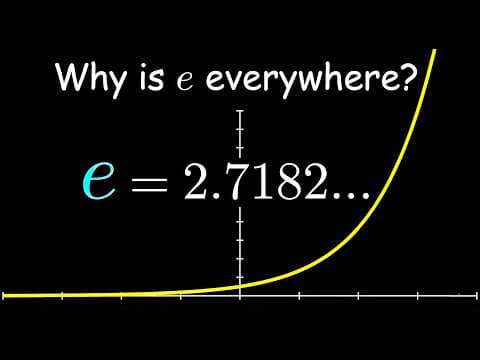
[0:00]In 1683, a mathematician named Jacob Bernoulli was focused on a very practical goal. He wanted to know exactly how much money he could make. He was studying compound interest, trying to find the mathematical limit of how much a bank account could grow, if you reinvested the interest as often as possible.
[0:26]But while he was crunching numbers for loans, he stumbled onto something much bigger. He thought he was just calculating interest, but he accidentally uncovered the universal ratio for how literally everything grows and decays. It turns out that the same math that describes your savings also dictates how fast a virus spreads, how fast your coffee cools down, and even how the universe expanded in the moments after the Big Bang. This is the number E, approximately 2.718, followed by an infinite string of decimals. It isn't just a random constant, it's the fundamental language the universe uses whenever something changes. But why this specific value? Why does nature prefer E over any other number? The answer lies in how things grow when they aren't being interrupted. To find this number, Bernoulli looked at interest. Imagine you have a bank account that pays you 100% interest per year. If you start with $1, at the end of the year, you have $2, straightforward. But what if the bank pays you 50% interest twice a year? After six months, you have $1.50, and in the second half of the year, you earn 50% on that new balance. At the end of the year, you have $2.25. You've made an extra 25 cents just by splitting the payments.
[2:18]If you compound monthly, you end up with 261. If you do it daily, 365 times a year, you get 271. Bernoulli wondered, if you compound every second, every millisecond, every tiny fraction of a moment, if interest is added continuously, could you become infinitely rich? The answer is no. As the number of times you compound gets larger and larger, the total does not explode. It settles right at 2.71828. This is E. It was Leonard Euler who really figured out why E is so special. He used calculus to show that E isn't just a number; it's a behavior. Most mathematical functions are messy. If you ask, how fast is this curve changing at this exact point? You usually get a new, different equation. But when you look at E, something incredible happens. The rate of change, the slope of the curve, is exactly equal to the value of the curve itself. This means that if you have some amount of E to the X, the rate it's growing at is also E to the X. It's the only exponential function whose rate of change is exactly proportional to itself. This equation simply says that the rate of change is proportional to the current amount. And that's the secret. Whenever the rate of change depends on the current state, E is going to be in the answer. This single differential equation is the unifying blueprint for everything that follows. Take the classic case of a rabbit population. If you have 10 of them, they don't produce babies at a fixed rate. The more rabbits you have, the more babies they can make. Visually, this isn't just a curve, it's a self-feeding loop. In the geometric world, if you plot the growth of a population where every new member immediately starts contributing, you get a curve where the height at any point is exactly proportional to its steepness. It's the physics of a system that has no waiting period where life is compounding every millisecond. It's the same pattern at the start of any pandemic. When more people are sick, it spreads faster. The E isn't a choice, it's the only base that matches a growth rate that is perfectly continuous. But if everything just kept growing, we'd run out of room. Everything that builds up eventually breaks down.
[5:32]This is where we see E working in reverse. Consider the way a radioactive element slowly vanishes.
[5:43]An atom doesn't decide to disappear on a schedule. It decays based on how much is left. For every atom that vanishes, the probability of decay drops across the whole sample. If you have half as many atoms, you have half as much decay. Geometrically, this is just a reflection of the growth curve. Instead of a slope that gets steeper, the slope gets flatter. Every second, a fixed fraction of the material disappears. This is N of T = N0 E to the minus lambda T. The negative exponent is the geometry of a breaking system, where the closer you get to zero, the slower you move. It's exactly why your coffee cools down the way it does. At first, it loses heat quickly. But as it gets closer to room temperature, that cooling slows way down. It never actually hits the cold floor. It just approaches it along an exponential curve.
[6:53]It's also how sound fades in a concert hall.
[7:00]Each bounce off the walls takes its own tiny bit of energy away. But E isn't just for things that move. It's for the very air you're breathing right now. As you go up a mountain, the air gets thinner, but it doesn't change by a fixed amount per foot. This is a stacked geometric effect. The air at the bottom is supporting the weight of everything above it. As you move up, there's less weight above you, so there's less pressure to squeeze the air together. P of h equals P not E to the negative K H. It's the same logic in chemistry. For two molecules to react, they have to hit each other hard enough. Only the tiny fraction on the far right tail of the energy distribution, an exponential tail, can actually make the reaction happen.
[8:00]Think of it as the tip of a massive mountain. Most collisions don't have the height. But for those that do, E calculates exactly how likely the flame is to catch. But what if you didn't have a specific thing to measure? What if everything was just random? If you graph something as simple as people's heights, you get the classic bell curve, E to the negative X squared. This is the geometry of pure variation. E is at the core because it's the only function that can bridge the gap between perfectly central and vanishing at the edges. It's the same math for when things arrive. Think about random phone calls hitting a server. They follow the Poisson distribution. That E term at the front is the waiting component. It's the probability that nothing happens during your interval. It's the mathematical silence between the noise. E is even the silent engine inside tools like chat GPT. Every time an AI decides on a word, it isn't thinking, it's calculating a surface of probabilities. It uses something called the softmax function. It takes a messy list of raw scores and passes them through E. Because E to the X grows so aggressively, it stretches the differences. It pushes the likely winners to the top and crushes the noise to zero. Without E to amplify those leads, AI would just be a stuttering mess of indecision. It turns a mountain of messy data into a sharp, clear choice. Listen to my voice for a second. It feels smooth, but to your computer, it's a jagged, noisy mountain range of frequencies. To clean that up, we use E in what I think is its most elegant form, Euler's formula. E to the I X equals cosine of X plus I sine of X. This is the bridge between growth and rotation. It's how we wrap a signal around a circle to find the hidden patterns inside. This little equation is the invisible DNA of every Wi-Fi signal, every MP3 file, and every MRI scan you've ever seen. But signals have to travel through the real world, and the real world imposes a geometric tax on every bit of data. This is Beer Lambert's Law, whether it's light or Wi-Fi hitting a concrete wall, the intensity I follows I equals I naught E to the negative alpha X. Geometrically, this is fascinating. Every extra inch of material absorbs a fixed percentage of the remaining signal. The wall doesn't just take away a fixed amount of power. It takes a fraction of whatever's left. It's a literal inverse of the compound interest we saw earlier. If we zoom in even further, all the way to the quantum level, E actually defines the shape of existence. Particles aren't just solid points, they're wave packets described by E raised to a complex power. It's the mathematical container that tells us where a particle is likely to be at any given moment. But E is also the reason we struggle to predict the future. In chaotic systems, like the weather, even a tiny error the size of a grain of sand won't stay small. It grows. We measure this using the Lyapunov exponent. Because that error grows exponentially, a tiny flap of a butterfly's wing really can snowball into a massive storm. E is the yardstick we use to measure how quickly the present slips out of our control. If we look all the way back to the very beginning, E was there before the stars or the planets even existed. In the first trillionth of a second after the Big Bang, the universe went through a phase called inflation. It didn't just expand, it doubled and then doubled again hundreds of times over in less than a heartbeat. Essentially, our entire observable universe is just the result of E running wild for a tiny fraction of a second. So why does this specific messy number, 2.7181, show up in our bank accounts, our forests, our atoms, and even the stars? It's because E is the only number that satisfies the most fundamental rule of the universe. The rate of change is proportional to the state. If you have more, you gain more. If pi is the constant of where we are, the geometry of space, then E is the constant of how we get there.


