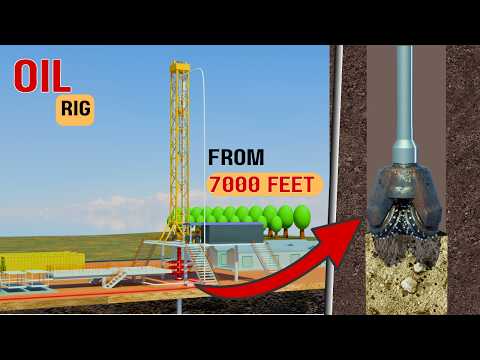
[0:00]Generally, our personal and municipal water borewells can reach depths of up to around 800 feet. However, the boreholes used for extracting oil can be as deep as 7,000 feet or even more, which is equivalent to over 2 kilometers beneath the surface. Unlike water extraction, drawing oil from the ground is a far more complex and challenging process. In fact, the biggest challenge lies in drilling the oil well itself. In this video, we'll use 3D animation to explain in detail how the wellbore is drilled and how crude oil is extracted from deep within the earth. Essentially, there are two main types of oil rigs. The first type of oil rig is land-based, where the entire setup remains on the surface. Here, a bore hole is drilled initially, and then oil extraction begins. However, oil reserves are found often beneath the ocean floor as well. In such cases, the entire system is established offshore, and this type of rig is known as an offshore rig. The biggest challenge arises right at the beginning. How do you identify oil reserves buried 2 to 3 kilometers beneath the earth? This process is extremely costly and time-consuming. It starts with geological surveys, where samples of rocks and soil are collected, and the surface structure is carefully studied. Sometimes the earth itself gives natural signals indicating the presence of oil reserves. For example, in certain locations, natural gas seeps out of the ground. Scientists then examine whether this gas contains hydrocarbon indicators such as methane or ethane. In addition, advanced satellite imagery is used to observe sudden changes in surface temperature across different regions, which can also hint at possible oil deposits below. From these initial studies, we only get an approximate idea of the geographical area where oil reserves might exist. To pinpoint the exact location of these reserves, the most widely used modern technique is the seismic survey. In a seismic survey, the primary aim is to map the earth's underground layers. Vibrosis trucks are equipped with heavy vibrating plates, and these are placed on the ground. These plates generate controlled vibration signals, which then travel deep into the earth's layers. This method is typically used in onshore or land-based seismic surveys. In contrast, for offshore or ocean-based surveys, a different technique is used. Here, specialized air guns are deployed underwater to create strong acoustic waves. These waves travel through the ocean and into the seabed layers below. In both cases, geophones on land or hydrophones underwater are used to detect the returning signals. By analyzing the time taken and the strength of the reflected signals, scientists can accurately map underground rock formations and identify potential oil and gas reservoirs. However, it's important to note that even after a seismic survey, there is no 100% guarantee of finding oil. It only indicates the higher probability of oil being present in that particular area. Once the seismic survey suggests a high probability of oil, the next step is to confirm it through actual drilling. Drilling for oil is far more complex than drilling for water, as the oil is often trapped within porous rock layers under high pressure, sometimes accompanied by gases. When the drill bit penetrates the strong cap rock and enters the oil-bearing formation, there is a high significant risk that oil and gases may surge upwards under high pressure, potentially causing a blowout. To prevent such incidents, the drilling process is conducted in a highly controlled and safe manner. Before starting deep drilling, a large diameter hole, typically around 15 to 20 feet deep, is made, called the conductor casing. This is a cement structure that provides initial stability to the bore hole and prevents the surrounding soil or water from entering. At the core of the drilling setup is a tall tower called the mast, which supports the drill pipes and the drill bit. The industrial grade drill bit is equipped with teeth made of extremely strong materials like tungsten carbide or diamond. These teeth rotate and grind through rocks efficiently. This type of drill bit is known as a roller cone bit. As the bit cuts deeper, sections of steel pipes are joined one after another to form a long assembly called the drill string. As drilling progresses, more pipes are added to extend the string further into the ground. Rotating such a long drill string, sometimes extending over 2 kilometers, poses a huge mechanical challenge. In borewell machines, the drill bit is usually operated using high-pressure air. But in oil rigs, the entire drill string is rotated using a drive system called a Kelly Drive. The main Kelly rod used in drilling has a hexagonal shape and fits into the drive rod. The drive rod is equipped with gears that can be rotated by an engine or motor. As a result, when the drive rod turns, the Kelly rod also rotates. While the Kelly drive involves direct mechanical contact, it is designed with robust cooling and lubrication systems to manage friction and heat safely.
[5:30]A Kelly bushing is fitted onto the Kelly rod. This bushing contains special gears that allow the Kelly rod to move up and down smoothly while still rotating. The bushings also have locks at the bottom, which securely fit into the drive shaft. Once locked, the Kelly rod rotates safely along with the drive shaft. First, the Kelly rod is lifted upwards, and since the entire drill string is connected to it, the string rises along with it. A pulley system is used to move the Kelly rod up and down. When the Kelly rod is completely out, sleeves are fitted near the drive rod to hold the drill string securely. These sleeves prevent the string from accidentally falling back into the bore hole when disconnected. The Kelly rod is then connected to a side rod. After that, the Kelly rod is reconnected to the string, and the sleeves are removed. Finally, the entire assembly is lowered back into the bore hole. Once the Kelly bushing locks into the drive shaft, power is applied to the drive shaft, and the entire drill string starts rotating, enabling the drill bit at the bottom to begin drilling. We will explore exactly how the drill bit cuts through rock in more detail later. However, one crucial point to remember is that the drill bit must be given the correct amount of pressure to function effectively. Firstly, the weight of the entire drill string made from heavy steel pipes naturally applies downward force on the drill bit. Additionally, the pulley system on the rig can provide extra force if needed to push the bit further into the rock. In a typical water borewell, the drill bit cuts continuously and high-pressure air is used to remove the debris. These machines can drill up to 800 feet in just 4 to 5 hours. However, drilling a bore hole for an oil rig is much more complex. To reach depths of 7,000 to 8,000 feet, it can take at least one month. The main reason for this is the requirement for wellbore strength. Usually, the top layer of the earth consists of soil or weak rock. For example, let's assume the first 50 feet is just soil. In such cases, a large diameter bore hole is created initially. This large initial hole is not made using the oil rig itself, as it cannot operate efficiently in loose soil. Instead, it is done using a standard borewell machine. Once this initial borewell is ready, a casing pipe is inserted and cement is poured around it. Once the cement hardens, it prevents soil and water from entering the wellbore. From here, the drilling rig starts its operation. Let's say the drill bit cuts through rock continuously from 50 feet down to the next 1,000 feet. One important point here: as the drill bit strikes and rotates against rock under high pressure, it starts heating up. Since an oil rig operates 24 hours a day, 7 days a week, managing this heat becomes extremely critical. To control the drill bit's temperature, drilling mud is pumped under pressure through the drill string. Multiple high-pressure mud pumps are used for this purpose. This special fluid reaches the drill bit, exits through small holes, cools it down, and also provides lubrication. After cooling the bit, this mud carries the rock cuttings back up to the surface, where they are collected in a tank.
[8:59]At the surface, the mud is cleaned to remove debris and then recirculated back into the wellbore. Suppose we have drilled down to 1,000 feet and encountered a weak layer or a water-bearing layer. Since municipal borewells also reach up to about 800 feet, it is crucial to ensure that no water or debris enters the oil rig's wellbore. At this point, the drill bit is withdrawn, and a steel casing is inserted. This casing is a cylindrical pipe, and a small gap is intentionally left between the casing and the wellbore wall. This is called the annulus. It's important to note that the entire wellbore is still filled with drilling mud, which also needs to be managed properly. The front end of the casing has a float shoe that prevents mud from entering the casing and helps direct cement into the annulus gap. First, mud is pumped through the casing, which carries debris from the bore and pushes it out through the annulus, effectively cleaning the bore hole. Next, a bottom plug is inserted into the casing, and cement slurry is pumped in behind it, pushing the bottom plug downwards. The bottom plug serves two purposes. It cleans the inside of the casing to prevent cement slurry from mixing with mud, and it forces mud out through the annulus. When the bottom plug reaches the bottom of the casing, it locks in place, allowing cement slurry to flow into the annulus. Once the cement is filled, a top plug is inserted into the casing and pushed down using drilling mud. This top plug cleans out the remaining cement inside the casing and pushes it into the annulus. Finally, the top plug sits on top of the bottom plug, locking it securely and preventing the cement from flowing back into the casing. At this point, the annulus is filled with cement, and the inside of the casing contains drilling mud. The presence of drilling mud is not a problem, as it is essential for the drilling process. The cement is then left to set and harden for about 24 hours. Once it is set, drilling resumes and the bottom and top plugs are drilled through to continue further. In this way, the wellbore of an oil rig is protected using casings and cement layers. As the depth of the wellbore increases, new casings are installed in stages, each secured with cement, providing ongoing stability and safety. Finally, when the wellbore reaches the oil reserves, there are multiple protective layers in place. First comes the conductor casing, followed by cement, then the surface casing, another cement layer, then the intermediate casing, more cement, and finally the production casing. The production casing is cemented across the oil-bearing formation to provide isolation and protection. It is the final casing through which the oil is actually extracted. However, a major challenge arises when the drill bit reaches close to the oil reserves. At this stage, the pressure from the oil and gas inside the wellbore starts to increase significantly. After installing the surface casing, a very important safety device is mounted at the surface called the blowout preventer or BOP. Oil often tries to surge upwards under high pressure. This sudden upward movement is known as a kick. If not controlled, a kick can lead to a dangerous blowout inside the oil rig. The blowout preventer is equipped with annulars, which are shaped like large donuts. When tightened, these annular seal off the well and block the upward flow of oil and gas. In addition to these, pipe rams are also used. They function similarly by clamping shut the pipeline when the pressure becomes too high, effectively preventing oil and gas from escaping uncontrollably. In recent times, a new technology has been developed in oil drilling that allows a vertical bore hole to be gradually steered into a horizontal direction. This means that a single bore hole can extract oil from a much larger underground area. During this process, once the vertical section of drilling is complete, the drill bit is removed and replaced with a mud motor. This motor operates independently using the pressure of the drilling mud and does not require the entire drill string to rotate. The most remarkable feature of this motor is that it can be slightly tilted, typically by around 1 to 3 degrees, when transitioning from vertical to horizontal drilling. At this slight angle, the motor begins to slowly cut through the rock, and the drilling mud supply to the motor not only rotates it, but also carries the rock cuttings back to the surface. Gradually, this motor steers the entire bore hole from a vertical to a horizontal path, creating a smooth and controlled curve underground. At this point, a common question arises. The drill string is made of rigid steel pipes. So how can it bend? The simple answer is, train wheels are rigid, yet trains can easily follow curved tracks. The train itself does not bend. It simply follows the track's design. In a similar way, when the drill bit shifts from vertical to horizontal, the slight 1 to 3 degree angle requires a gradual curve over a distance of about 1,500 to 3,000 feet. The drill string does not physically bend sharply. It simply follows the curved path created by the drill bit and motor. The processes for casing and cementing in the horizontal section are the same as those used in the vertical sections we discussed earlier. Using this technique, if there is an area of about 20 square kilometers, multiple vertical oil rigs would traditionally be needed. However, with horizontal drilling, oil can now be extracted from the entire area using a single surface location, making the process far more efficient. Now that our wellbore is fully prepared, we're ready to begin extracting oil. At this point, the drilling rig is removed and preparations for oil extraction commence. A production casing is inserted into the wellbore, extending all the way down to reach the oil reserves. This casing is also surrounded by cement to provide additional protection and structural integrity. To allow oil to flow into the wellbore, controlled perforations are made through the production casing and the cement layer. This process is known as perforation. For this purpose, a perforation gun is lowered inside the casing. This gun is equipped with multiple small explosive charges. Once it reaches the designated depth, an electrical signal from the surface detonates the charges as per design, creating tunnels through the casing and cement wall to connect the oil reserve with the wellbore. If the natural reservoir pressure is sufficient, oil will rise to the surface on its own. However, if the pressure is low and the wellbore is around 500 meters deep, a beam pump is used to lift the oil. This works similarly to a large hand pump. A motor drives the beam up and down, gradually pushing the oil upward step by step. Beam pumps can extract around 50 to 500 barrels of oil per day and are generally used only for onshore wells. For deeper wells or those with lower reservoir pressure, submersible pumps are used. They can handle a wide range of depths and flow rates, and are primarily used in offshore or ocean-based oil extraction sites. The oil that comes out is called crude oil. Alongside oil, natural gas is also released and collected. From here, the crude oil is transported to refineries for further processing. Large oil tankers are used for this purpose to carry the oil safely to refineries. The detailed process of how oil tankers transport crude oil to refineries is covered in another video. Thank you so much for watching. I hope this video has helped you clearly understand the fascinating and complex process of oil extraction. From drilling the wellbore to finally bringing crude oil to the surface. If you enjoyed this explanation, please consider subscribing and turning on notifications. Thank you again for your support, and I'll see you in the next video. Cheers.