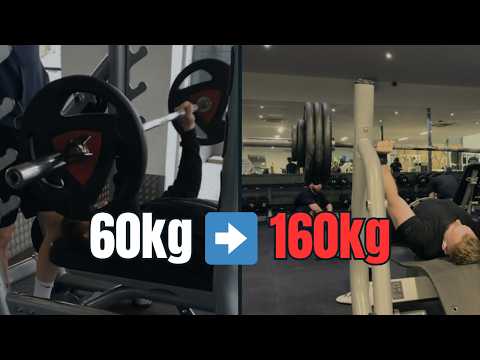
[0:00]In this video I'm going to tell you exactly how I was able to build a 160 kilo bench press, 352 pounds, completely natural, no steroids or anything like that, even though I started out really, really skinny. So, let me not waste any of your time and I'm going to get straight into the video. So, my starting point was not very good and I would argue that my starting point was much worse than probably you watching this video, even though you'll claim you've got like bad genetics and that's why you can't get a strong bench press. My starting point was terrible. So, look, this was me when I started out lifting. This picture here is actually like more than a year after I'd already started lifting, so you can imagine how skinny I was. Just look at my chest. Look how like sunken in my chest is. There is literally no pec muscle there at all. You can see my collar bone. So I was 132 pounds at 6 feet tall, which is like 60 kilos. And I'm not exaggerating, I'm not just saying this like other influencers will say, but when I went to the gym for the first time with my friends, I could not bench the empty bar. I remember they took out the rack, they did some reps. I took it out of the rack, dropped it to my chest, and I could not press that bar and it was so embarrassing. Um, probably you can relate to that experience. Very, very embarrassing because my friends were all stronger than me. At the time, I was extremely shy, awkward, every piece of clothing I wore was hanging off the sleeves, was really loose. I had that kind of skinny fat appearance just before here, like kind of here in this picture, you can see there's a little bit of fat down here at the bottom, but before that, I just had like the the like tire around my stomach. I had no veins, no definition, nothing like that, and just absolutely no muscle at all. And you can see like I've got very, very skinny joints, especially my wrists and stuff like that, and my even my neck now is still pretty skinny. Um with the narrow shoulders, so I was not built well to bench press at all, and still I've been able to get to this point. So now, I typically always sit at at least 200 pounds. When I cut down, I might get to like 190 or something like that. This is me just in a pretty like normal state, this is how I sit for most of the year, so I'd say I'm relatively lean. I've I've built a lot of muscle mass since my starting point. I'm obviously still not huge, but this should show you that you don't need to be like really freakishly big to to actually get strong. So yeah, I'm relatively lean most of the year, I keep I like to keep abs for most of the year, and I've got myself to 160 kilo bench press in competition here, so this was was judged in the IPF. They have very strict standards, you have to pause fully on your chest and stuff like that. And this is the most important part, that now I am just extremely confident in my training and my approach. So back here I was probably feeling how you do now that the strength training was just it honestly was just guess work. It was like I didn't really know how to get stronger. I didn't know what produced strength. Sometimes I'd hit this really big peak where I'd be able to bench like 275 or something, and then I'd fall off for like two or three months at a time and never really be able to recapture that strength because I didn't know what was causing it. I was doing a lot of training near failure, like 5x5s and stuff like that, just really hard training, like really just burning myself out all the time, really slow grindy reps. I'd bench a couple times a week, and I just had no confidence. Now I literally know, I have a training block that I've written for myself, that I design with my coach, and I know for a fact, if I do this block, I am going to get stronger. If I don't get stronger, I know which variables to change, and it's very kind of freeing and it's very relaxing because now I I just know how to train, I know how to get stronger, and I'm very confident this approach is going to get me to to 405 and maybe I'll even get past that eventually. So, let's get straight into what I did then to get to 160 kilos. I'm going to share literally everything I did, so that you can just copy it and hopefully this gets you to 160 kilos in half the time it took me and you don't make all the mistakes that I did. So, the first one is the actual bench press programming. So, most importantly is bench press responds extremely well to high frequency. I bench pressed four times a week, yes, that high. All of my guys who are really, really strong, bench four times a week. I've coached a guy to like 195 kilo bench, I've coached multiple four plate benchers. All of them did it benching high frequency. Always at least three times a week, but typically four times a week is the way to go. Now you might be thinking, that's way too much, I can't recover from that. Try and divorce this idea of hardness and frequency in your head. They are not the same thing. If you went in the gym and bench press the empty bar four times a week, do you think you could do that? Yes, so it's not the frequency is it, it's the intensity you're lifting at and we need to adjust that accordingly. I did lots of top set, back off, which basically means I would go in, I would do a heavy top set, which usually would be a single or a double at like an RP six, seven, eight, 80% and above, typically go a bit higher intensity for the bench press. Then I would drop the weight down and I would do my back off volume in typically the 65 to 75% range, okay, for sets of three to six reps. That would make up the bulk of my volume. The idea is those heavy top sets are for skill practice, they are low velocity skill production, they are lifting weights heavy to one rep max, so we build confidence, we build skill. And then we do the volume work at lower percentages so that we can accumulate that stimulus required to drive the adaptations, okay? Then I would use bench press variations to address my weak point. So I wouldn't just do the regular bench press four times a week. I would use variations that I know target a specific weak point for me. And too many intermediate guys do not do this. They just do the regular bench, or maybe some dumbbell press and stuff like that. Some key variations for myself, I would do a lot of three count pulls benching because it really improved my positioning at the bottom, improved my confidence, gave me some time to slow down and think about how I'm going to press the bar path, stuff like that. And I also loved to use tempo bench press. This was one that my coach had it into my program. I'll be honest, I fucking hated doing tempo bench, but the results were just undeniable. Like I could really focus on my arm path, keeping my joints stacked. I could think about my touch point on my body. They had really, really good results for my bench press and I kept those in as a staple and now I often use them with clients. So yeah, the programming was four times a week. I did lots of top singles, lots of top sets, and then I used variations to address weak points, okay? So like a typical setup for one bench day, maybe my primary bench press day would be a single on RP seven and then four sets of five with about 70% of my one rep max on the bar, okay? Now, the next one, and this is where a lot of guys will mess up, is on accessories, because you probably don't know how many accessories to be doing, where they should be arranged in the program, how hard should they be pushed and stuff like that. So when it comes to the bench programming, right, on the previous slide, here, we want things to be a bit more sub maximal. So we want to leave some reps in the tank, we don't want to be training to failure because the degree of fatigue that we get from failure training is significant. Failure training also causes more muscle damage, it impairs motor learning and technique expression, so we don't want to train to failure too much on the bench press, okay? And I would recommend never training to failure, unless you're going for one rep max or competition. When it comes to the accessories, we want to take the opposite approach. So these accessories should be done for lower volumes and they should be very close to failure if not too failure, okay? Because strength and hypertrophy are very different adaptations, we train for them differently, and hypertrophy requires um mechanical tension. So a stretching pulling force on the muscle, which needs to increase in magnitude over time and proximity to failure, meaning that you need to be within a couple reps of failure to maximize the muscle growth stimulus, okay? Now, this is the kind of checklist of what I would do on a weekly basis. So, I would do one chest or shoulder press, don't go overkill with this. Determine which one is your weak point. Do you have smaller, weaker pecs, or do you have smaller, weaker shoulders? For me personally, I'm actually quite a strong shoulder presser. I can overhead press my body weight without really training the overhead press very much, whereas my pecs are not quite as strong. So I would personally do a chest press like this chest press machine, that would be my supplemental press of choice. So I bench press four times a week, and then I do a chest press on one of those days, okay? Then we do one to two tricep isolations. If I'm in a period where I'm really trying to grow my triceps, I will personally do a single arm tricep push down, and then I'll do something like an overhead extension, or I really like doing Smith machine JM presses, okay? Then I'll do or I did at my strongest, one isolation for each head of the doubts. So I did a dumbbell lateral raise, I did a rear out fly on a machine, and I also did a dumbbell front raise. And some guys comment sometimes saying, oh, why are you doing a front raise, you're already benching four times a week. I promise you your front doubts are never going to get too big and too strong. Don't believe the bullshit out there that you shouldn't isolate the front delts because they get worked from benching or whatever. Okay, if your shoulders are huge and you bench press four plates, yeah, maybe you don't have to do front raises. If not, just isolate them like it takes like five minutes per week and you'll probably going to get some extra gains there from doing these front raises and taking them closer to failure. I promise you your shoulders are never going to be too big, so don't worry about it. Then to kind of summarize my accessory recommendations here, I would recommend that you do two to three sets of four to 10 reps at RPE9 to 10, okay? So movements like this, literally just two or three sets is more than sufficient, four to 10 reps, and make sure they are very close to failure. Now, when I say RPE 9 to 10, I do not mean 9 to 10 difficulty. I mean reps in reserve. So an RPE 10 would be zero reps in reserve, an RPE 9 would be one rep in reserve, okay? So that's really, really important that you train close enough to failure. And yeah, this allowed me to put on a fair amount of muscle mass, as you can see here, from my starting point, quite significant difference. The next one is bench press technique. Again, a big mistake that a lot of intermediate guys will make, and I'm willing to bet that your technique probably is not as good as it could be. The main thing that we want to consider with our technique is that we want to develop some kind of repeatable setup that you do every single time. So you should know off by heart your bench press technique. You should do it every single set, every single rep from the empty bar up to your one rep max, okay? Because we want things to be predictable, to be repeatable. Things need to look the same week to week. This is the most essential component of your technique. So a few of the kind of main considerations of technique, the first one is grip width. So basically we want to choose a grip width that produces a vertical forearm at the bottom of the lift. You can see here, my elbow is stacked over my wrist, same here as well. That's basically what we're looking for, this position when you bench press, okay? We don't want it to look like this and we don't want it to look like this. This would be a close grip, this would be a wide grip, this would be the ideal grip width for you, okay? For most of you, that is going to position your pinky finger on the power ring of the bar, or somewhere around there, okay? So start there and then assess. For the foot position, I recommend that guys go with their feet as wide and as far back under them as possible. It's just a nice default for most guys because it gets the it gives you a nice wide base of support to press from, it keeps you nice and balanced and powerful on the bench. But it also gets the hips into some extension so that we can create a little bit of an arch, reduce the range of motion and effectively use leg drive. So that's kind of my default and that's what worked for me. Something else might work for you. I know some guys like to have their feet quite close and in front of the bench. Personally, I never got on with that, so I like the feet wide and far back. For the grip, I teach guys to use the bulldog grip because a lot of guys will make the mistake, you probably do this as well, where you grab the bar like this with like a full fist. How you like same as how you would do like a pull up or a deadlift or something. Now, the problem is, when you grab the bar like this, it sits the bar really high in the hand up here near the calluses. Because of that, you introduce a moment arm between your wrist and the bar, which leaks some force transfer. It also means that the wrist probably has a little bit of slack and moves around a little bit when the bar is on the chest. So instead, I recommend that guys position the bar low in the hand, down here, towards this meaty part of the palm. When it is there in position, you internally rotate the hand slightly, pinch the bar, and this is called a bulldog grip. So you can go and search that up on YouTube. That's going to be the most efficient grip for you when it comes to the bench press, okay? The final one is the bar path. So a lot of guys will bench press with an inefficient bar path. So if you look like at your own bar path, for example, you probably press up and down in a very straight vertical line. Now, the problem with this is it means the doubts have to produce a lot more force to complete the lift than they otherwise would, because think about it. When you lower the bar on the bench press, it starts directly over the shoulder, but you lower it a few inches forward of your shoulder, like usually you'll touch around here, like on your sternum or upper abs. Because of that, we want to get the bar back quickly over the shoulders, okay? Otherwise, your shoulders are kind of having to do like a front raise and a press all in one. So the correct bar path on the bench press, on the way down, it should go like this in a diagonal, on the way back up, it should go slightly back and then up, okay? And you can search that up on YouTube in more depth. I have videos on that as well, but that is going to be the most efficient bar path, this reverse J curve. Now, when it comes to nutrition, so basically my simple rule, and I use this for my clients as well, that I will do cut and bulk cycles. I cut to as lean as I can without sacrificing strength, which typically is around 10 to 12% for myself. Then I will bulk to around 16 to 18%. Basically as high as I want to get, like without my abs disappearing, or without getting too fat. And then I rinse and repeat. I try and get bigger at the end of each cycle. So I consume one gram protein per pound of body weight. I know the research says you can get away with less now, but to be honest, I don't see any reason to do so because protein is quite satiating, it's filling. I find it quite easy to eat, I like to eat meat and stuff like that, it's it's very easy. Um, and I think it's just a good insurance policy, like and it's so simple, the math is so simple, just take body weight in pounds and just eat that much protein. For me, it's less thinking than having to do like an exact protein target and just I don't care enough to do it. Um, another point that I've put here, and by the way, this is like a staple meal that I'll eat when I'm training at my best, like uh, this was on a cut, so I've got some melon, there is uh whole eggs, some ground beef, some rice, some salad. Obviously, if you were bulking, just add some more carbohydrates to this meal. And this is a point that I made here that your pre and intra workout nutrition is very important if you want to maximize strength on the bench press. So pre-workout, I would highly recommend that you consume um about 30 to 50 grams of protein in your pre-workout meal. And the pre-workout meal I'd have this like an hour or two before training. So we get 30 to 50 grams of protein. I would recommend that you consume at least one gram of carbohydrates per uh kilo of body weight. So if you weigh 90 kilos, you would eat at least 90 grams of carbohydrates, okay? Then keep the fat and the fiber low so that we don't slow digestion prior to the gym, okay? This is really, really important. For intra workout, I have personally found it beneficial for myself on clients to make a drink containing electrolytes and carbohydrates during the workout. Now, there might not be like significant effects here if you look at the research, but just anecdotally, I tend to feel better, I feel fuller, I don't cramp, I don't feel so tired. So this has been really, really helpful for me when I want to perform at my best. The final one is caffeine. A lot of you guys who watch my videos know, like it's what, 9:00 a.m. right now and I've already had a can of monster and a large coffee. You know how I am with with caffeine. But caffeine has actual positive effects on performance, as well, strength performance. So I would recommend that you consume about 3 to 6 milligrams of caffeine per kilo body weight, around 30 to 60 minutes before the gym, okay? This is what the research would suggest actually improves one rep max strength. So give that a try as well. Now, this is an often overlooked factor of getting really, really strong on any lift, but in particular the bench press, and this is mindset and external. So basically, all the things outside of the gym. Now, I'm going to start with this point here, which is allostatic load. And a lot of guys maybe aren't familiar with this concept, so I'll give it you in really simple terms. Allostatic load is basically a sum of all of the stressors that are being applied to you, okay?
[16:41]So for a guy like yourself, maybe you've got work stress, stress from your boss, stress from your wife, from your kids, from poor sleep, all these different things, and yes, the gym is also a stressor as well. Now your body cannot really differentiate between all these forms of stress, it just views them as stress. They all kind of fill the same cup. So if life stress is really, really high, you cannot have really, really high training stress, because imagine that cup is going to overflow, you won't be able to recover. So basically, you just need a way to kind of regulate this. The way that I do it is with auto regulation, with the RPE scale, because that allows you to adjust the adjust, sorry, the intensity of each training session, based on stress outside of the gym and based on your daily preparedness. So that is really, really important, okay, that you use some form of auto regulation. Now, a big part of these externals is sleep. I will admit my sleep is not good, but when I was at my strongest, sleep is something that I really put a lot of attention on. Basically, just the most important thing is that you sleep enough, ideally 7 plus hours, and you have some kind of fixed sleep schedule where you sleep at the same time each day. It seems that consistency for sleep is really, really important. The next one is I had a rule that I never missed a training session. And when I got to my strongest, you can ask my friends, literally, I went years and years, probably five plus years without missing one single training session. It didn't matter if I had to go to the gym at 2:00 a.m., 3:00 a.m. on no sleep, sometimes I did all nighters and then went to the gym. The session just had to get ticked off. And you need that level of dedication if you really do want to get as strong as possible. The next one, this is a bit generic advice, but have your shit together outside of the gym. Like you you wouldn't believe how much of an impact it makes. Like even just imagine two scenarios, like scenario one, you you go into the gym for your bench press day, and this is like the day you're going to PR and you've slept like shit. You've argued with your wife, you haven't got your work done, your boss complained to you, you feel depressed because of all this. How do you think you're going to perform? Versus if you slept well, you got all your work done because you managed your time well. You avoided an argument with your partner, maybe because you've you've done some self-improvement stuff and you've worked on managing your emotions better and things like that. I mean, we're all, we all obviously need to work on these things, but just compare those two scenarios. So having your shit together outside of the gym, having some goals, having some structure, having a schedule, all these things have a massive impact on performance in the gym. Now this bottom one here, you might think what is this one? Everyone is on steroids. And if you take one thing from this video, I really want it to be this. Not everyone is on steroids. When I started training, I used to think guys who were rapping two plates on the bench press with these were just on drugs. But when you get there, you'll realize, shit, this isn't even very strong. Then you'll get to the point where you're rapping three plates on the bench, and still you're think, shit, this still isn't strong. Because you have way more potential than you have been led to believe. A lot of influencers will tell you that if you want to get really, really strong, you need to have amazing genetics, or you need to be on loads of drugs and stuff like this, and it's just not the case. The reason why right now you are not very strong is because the approach you follow is just shit for you. These intermediate approaches out there like 531, Texas method, stuff like that. They are just objectively not good programs, and that's why you're not getting as strong as you could be. So I promise if you change a lot of these things, you will get far stronger than you ever thought was possible. So, what I wish I did differently. Now, the first one, and you're probably going to say like, oh, you're a coach, of course you're going to say this, but I really do wish that I got a coach sooner. Because he knew things that I just did not know. He'd worked with guys way stronger than me. He knew what to try. When progress stopped, he'd already seen these problems like a hundred times before, so he knew what to change. It would be the same as like, imagine you want to you want to solve a a puzzle, like one of those jigsaw puzzles, and you go to a guy who's already put this puzzle together like 500 times. When you get stuck and you don't know which piece goes where, you just ask this guy and he's like, oh yeah, I did that so many times before. That one goes there, we change that, we put that there. It speeds the process up so much more rather than you just like trying to fumble your way through it in the dark and figure it out on your own. Sure, you can go and spend the next 10 years to try and figure it out, and then you'll get to 40 or 50 years of age, and you've never even bench press 275 or 315, or just get someone who's already done it, who knows more than you. There's no shame in getting help, okay? The next one is high frequency bench. I really wish I would have stopped benching once or twice a week, and I would have just went to three or four times a week like straight away. Because I always had this belief, probably like you do right now, where I was like, three or four times a week's too much, you can't recover from that, my shoulders are going to get beat up and injured. And if I would have just like pushed those stupid beliefs to the side because they're just self-limiting beliefs, you've never tried it, and went to high frequency, I would have got strong way, way sooner. Because seriously, once you get on high frequency, like if you go from benching once or twice a week straight up to three or four times a week, you'll be like, holy shit, I'm getting bigger again all over again if you program it properly. Now, a big part of programming it properly, and I've put that here, is stop training to failure. Your approach now is probably every week, you just try and max out, you just try and add five pounds to the bar. It's an idiotic approach to getting stronger, honestly. You might feel insulted by that and think, oh, like my approach isn't bad or whatever, but trust me, training to failure all the time is stupid. It comes with more muscle damage, more soreness, it impairs motor learning and your expression of technique. It doesn't allow you to bench press often enough because probably the reason you can't bench three or four times a week right now, is because the benching you do is way too hard and you can't recover. So just stop training to failure. The last one, and this sounds a bit backwards based on what I just said, but it's to push your accessories really, really hard. So the strength stuff, do that sub maximal. Your accessories, take those all the way to failure because they're low volume, those movements are inherently less stressful. Like just compare a lateral raise with dumbbells versus a bench press, the stress is not comparable, okay? So accessories, two or three sets, four to 10 reps, RPE 9 to 10. Thanks so much for watching this video. If you still need help, there are two links in the description. Link number one is a coaching application form, so you can literally book a call with me personally. Me and you will jump on the phone, and what usually happens is we'll go through your current approach, and we'll identify what is holding you back. I'll tell you which areas need work. Then we will put a plan in place to make sure your goals happen. I will tell you what I recommend that you do. I'll then explain for you how the coaching works, everything that's included. And if we're a good fit and you feel confident in my approach, you can sign up for my coaching, I'll take you on as a client, I write your programming every week, I do your nutrition for you, I help you with technique. I have an assistant coach who will work with you on rehab based stuff and get you as strong as possible, and I will literally give you everything you need to get strong. And then if you tap that second link, if you want something a bit more affordable, that will basically give you access to my entire strength training system. And what you're going to get there is an entire educational course. There's a bunch of videos that really go in depth on programming, nutrition, the mindset stuff, all these different facets of your performance to get you as strong as you can. In that course, there is also some meal plans, some nutrition stuff, various training programs, like three, four, and five day versions. So I've basically put everything in one place, and you can just take that, run it, and that's going to get you as strong as possible, okay? So, thanks so much for watching and until next time, I'll catch you in the next video.