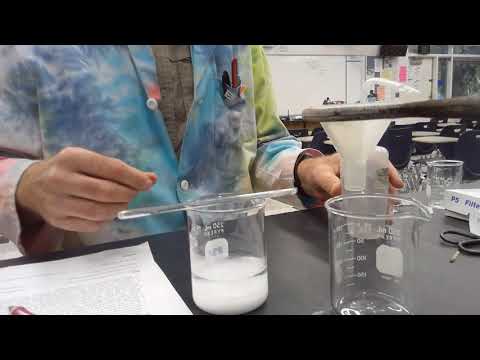
[0:00]Okay, today we're going to perform experiment 4A, the stoichiometry of a precipitation reaction. The reaction is between .6 molar sodium carbonate if you can see that and .45 molar calcium chloride. We'll mix the reactants together, we'll observe the precipitation process. We'll then collect the precipitate, dry it and mass it and determine the percent yield of our reaction. We'll also determine limiting reactant, reactant in excess. Okay, step one, we're going to measure out approximately 50 milliliters of my sodium carbonate solution. Sodium carbonate, so I've my already made the solutions, I've got my graduated cylinder, 50 milliliters.
[1:24]And there we have 50 milliliters. We'll pour that into our our beaker. Step two is to measure out approximately 40 milliliters of my calcium chloride solution.
[2:00]40 milliliters.
[2:07]Remember you read the bottom of the meniscus. Okay, now we're going to pour the sodium carbonate solution into the calcium chloride solution or vice versa I think in this case and we'll observe the precipitation. Okay, the instructions now are our job is to collect the solid precipitate. What I'll do is stir it for a while to make sure that it all reacts and we'll let it settle for about 5 minutes. While I'm doing that, you can predict the identity of the product. It's a double replacement reaction, one that we've been working with. We'll be back in 5 minutes. Okay, while we're waiting, we're going to measure the mass of a piece of filter paper that we'll use to collect our product in. Remember to when we use a balance, we push zero, we wait till it zeros out. This one's now calibrating. And we place our piece of filter paper on the balance, and we get a mass of 0.711 grams. Remember the significant digits. We're still settling.
[3:43]Okay, you can see that the precipitate settled to the bottom. We now have a layer of clear liquid on the top, and our solid precipitate is at the bottom. Our goal now is to collect that precipitate, dry it, and measure the mass of the precipitate. Our process that we'll use to do that is filtration. The way we make a filter we fold the filter paper is, we fold the filter paper in half, we've already measured the mass of it, so we'll collect our product in here. We fold it in half, then we fold it in half again, and we've got our cone-shaped filter paper that'll separate the solid from the liquid or the aqueous ions as well. So we'll talk about that as the process goes on. Open up the filter paper, you fold open up one side, put it in your funnel. Our funnel is what we'll use to support the filter paper and we can wet the filter paper with distilled water. You'll see distilled water is going to evaporate away in the oven, and so we can have as much as we want in there. Okay, my goal now is to pour off the liquid part with that has the dissolved ions in it. First, through the filter paper and at the very end pour the solid through. And here we go, we'll start to filter that out. I'll pour the liquid down the rod, so it doesn't fall fall down the side of the beaker. You can see the the liquid passing through the filter paper, that liquid that's being caught in the beaker below is called the filtrate. I'm trying to pour off the top layer into the filter paper first. So that we don't plug up the holes of the filter paper with the solid, or make sure that the liquid does not go over the edge of the filter paper. Otherwise it won't be doing its separation process. While we're doing this, we can think about what's in the filtrate, what what substances are in there, so what can we do with that when we're done?
[6:17]Still keeping the solid in the beaker.
[7:14]Some of the solid is coming through now. Okay, I'm going to let that drip through. Give myself some more room in the filter paper. Okay, the filter paper, most of the liquid is passed through the filter paper. Gotten a little bit more settling here. I'll try to separate it out more, but eventually we're just going to pour all the solid into the filter paper and wash it through, wash whatever liquid through we can. Some of the solid is coming through now.
[9:44]Okay, I'm going to let that let that liquid pass through and we'll get back to you. Okay, things are slowing down. I've got more room in my filter paper, but you can see the prot the filtration process is working because the filtrate is clear. There's no solid in the filtrate. If we could look down the filter paper, which we will in a second, we could see that there's solid getting caught in there, but we can certainly see solid left in the beaker. So what I'm going to do is rinse that with some water. Again, distilled water is fine because we're going to evaporate all that away in the oven, and now I'm going to pour that into my filter paper, rinsing, to make sure that all of, as much we can't get it all, but as much of the precipitate as we can gets into the filter paper. Again, this is partly why we're calculating percent yield because this is not a perfect process. You can see there's some a fine layer whoops. You can see a fine layer of of calcium carbonate of our precipitate at the bottom of the beaker. We can't get that out with rinsing. So we're going to let that drip through. Our goal will, and once we get as much liquid through again, we're going to wash it with water so that all the ions pass through and we're left only with our precipitate. So I'll rinse it one more time.
[12:26]Okay, we've now rinsed it several times and we're I'm sure that most of the ions, if not all the ions have been passed through the filter paper. They're now in the filtrate.
[12:47]You can see the filtrate is clear. So it's worked, and my job now is simply to dry this up. That's why water could we could use excess water because we're going to just evaporate the water, so I'll remove the filter paper. Fold it so that we're sure that we won't lose any, and then there's our oven. We'll place it in the oven overnight and tomorrow we'll measure the mass of it, of our clean dry product with filter paper. All right, we'll be back tomorrow.
[13:51]Okay, it's the next day and we're ready to get our dried precipitate and measure the mass of it. Here's our hot oven.
[14:10]Here's our folded precipitate that we've had yesterday. It's nice and dry. Simply we'll put it on the balance, measure the mass, and we're done with our experiment.
[14:47]2.321. Sorry, excuse me.
[15:02]We look inside at at our product. There it is our dried product, which was once a precipitate but it's our salt insoluble product of our double replacement reaction. Hopefully you know what it is by now.
[15:57]Okay, now that we've recorded the mass of our product with the filter paper, you can then start in on the analysis. Number one on the analysis is going to be determined the actual mass of just the product, not including the filter paper. Then we'll write the balanced chemical equation for the reaction. We'll then identify the limiting reactant, reactant in excess, by calculating moles of sodium carbonate, moles of calcium chloride that react. We'll then determine what the product is and calculate the theoretical yield of our reaction. The step next step will be to calculate the percent yield, which is of course the actual yield divided by the the theoretical yield. And then number four is is straightforward, so good luck with the lab.