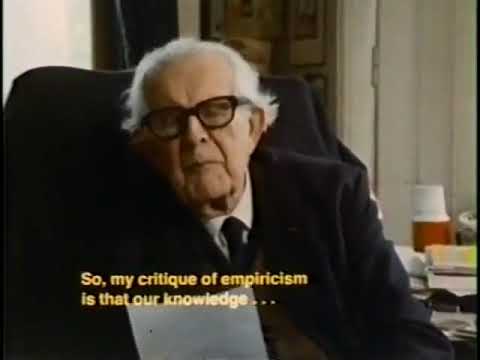
[0:00]Autant ma critique de l'empirisme, la connaissance n'est jamais uniquement moulée sur les observables. So, my critique of empiricism is that our knowledge is not molded directly by things we observe. Elle ne consiste pas en observable pur, mais toujours en interprétation par assimilation à des structures préalables. We always interpret according to our own structures.
[0:20]D'autre part, pourquoi ne suis-je pas innéiste ou à prioriste? On the other hand, why am I not an innatist or an apriorist? Et bien, prenez l'histoire des sciences. Toute l'histoire des mathématiques est une construction continuelle. Well, look at the history of mathematics. It is a continual construction. En partant des nombres naturels, 1, 2, 3, 4, il a fallu des siècles pour construire l'ensemble des nombres entiers avec les négatifs. It took centuries to construct negative numbers.
[0:41]En partant des rationnels, il a fallu attendre jusqu'à Pythagore pour découvrir les irrationnels. It wasn't until Pythagoras that irrational numbers arrived. Ça signifie que ces connaissances sont été construites, elles ne sont pas préformées. So mathematical knowledge is constructed, not pre-formed. Si on les croyait préformées comme le pense Chomsky avec sa grandeur biologique, et bien il faudrait penser que les mathématiques sont déjà là d'une manière implicite ou innée chez le bébé. If this knowledge was pre-formed, as Chomsky believes, it would have to exist implicitly in babies and even in animals.
[1:10]Mais pas seulement chez le bébé, chez l'animal, il faudrait remonter jusqu'aux invertébrés et aux protozoaires pour y voir la source des mathématiques. We would have to go back to invertebrates to find the source of mathematics. En réalité, les mathématiques, chez l'enfant, on assiste d'un jour à l'autre, sont sans cesse construites par les actions du sujet. Mathematics are continuously constructed by our actions.
[1:31]Elle procède à partir de la coordination des actions du sujet, de la logique de l'action du sujet. In the child, we can witness this from one day to the next. Et alors, de ce point de vue, il lui faut tout construire. The child must construct everything. Et même les choses qui nous paraissent les plus évidentes pour nous, il doit les construire. I will show you an experiment with a child. Je vous donnerai un petit exemple ou plutôt vous allez assister à l'expérience avec un enfant. We show a child a string with this configuration. On montre à un enfant une ficelle qui présente cette configuration. On lui demande ce qui se passe si on tire de ce côté-là. We ask him what happens if we pull this end.
[2:10]il comprend très bien que si on allonge de ce côté, on va raccourcir de ce côté. He understands that if you lengthen this part, then you shorten the other. Apparemment, il a tout compris. You might think that he has understood all about it. Mais si vous lui demandez est-ce que la longueur totale est la même dans les deux figures ou bien la même que dans l'objet témoin que vous allez voir dans l'expérience qu'on va faire à l'instant, et bien il nie la conservation. But, as you'll see, if you ask him whether the total length of the string is the same after you have pulled the end down, he'll say, "No." Ce n'est pas la même longueur totale quand même, il a compris une partie de la transformation. He doesn't subscribe to this conservation.
[2:38]Et bien que même une conservation aussi élémentaire ne soit construite que vers 7 ou 8 ans, vous montre combien il y a d'écart entre l'inné d'un côté et puis ce qui est peu à peu élaboré, construit, organisé par le sujet. This conservation is not achieved or constructed until 7 or 8 years. This example shows what a distance there is between what is innate and what is elaborated, constructed and organized little by little by each individual. There. So cut it. So we cut it. If we cut it there, will it be just as long? Yes. Is that okay? There. Now listen to me. Now the two strings are just as long? Okay. Now this one we'll leave here. Now then, listen to this. If I pull this string like this, what's going to happen? Uh, this one will be big, and that one will be little. Where will it be little? There. And where will it be big? There. Okay. There it will be big and here it will be little. Okay. So shall we do it? Yes.
[3:40]There. Is it, is that right? Good. Now tell me this. This string from this end to this end. Is it still just as long as that one, or is it not just as long as that one? Not just as long as that one. It is not just as long as that one. Okay. And what if we put this one back as it was before? How will it be if we pull here again? This one will be like this one. This one will be like this one. And where will the big part be? There. Yes, and where will the little part be? There. Okay. So we pull like that. And now this string from this end to that end. Is it just as long as that one? Yeah. Yes. Okay. And if we pull again, there like that, are they just as long, both of them? No.


